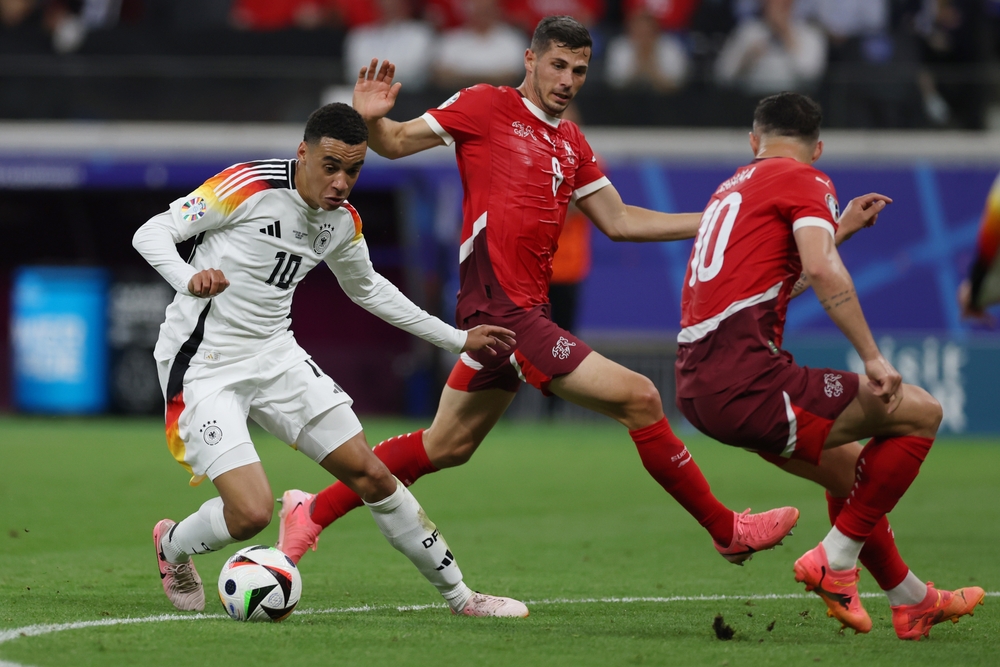
The specialist who put a name to what happened to Jamal Musiala did not do it in a Bayern statement. He did it in the pages of Bild.
Professor Christoph Kleinschnitz, head of neurology at University Hospital Essen, told the German tabloid that the back-to-back episodes are consistent with a form of absence epilepsy. His verdict on Musiala’s career was direct.
“It is highly treatable, but would require long-term therapy. Musiala can continue playing football,” he said.
Musiala fell to the pitch during Saturday’s 3-1 friendly win over RB Leipzig, then went down again three days later, four minutes after coming on as a substitute in Bayern’s 4-2 victory at Heidenheim. He was treated on the pitch before leaving the field.
Read also: Kimi Antonelli issues warning to George Russell with Mercedes vow
What the diagnosis actually means
Kleinschnitz has not examined Musiala and described the pattern from a distance.
“From a neurological perspective, this could potentially be an epileptic seizure. It could be a form of absence epilepsy, as symptoms such as brief periods of unresponsiveness are consistent with it,” he said.
Neurologist Doctor Regina Becker of the Munich Schwabing Neuro Centre went further on the mechanism in remarks carried by Goal. Absence epilepsy, she said, “originates in the so-called thalamus, the diencephalon, which controls consciousness”, and normally first appears in children aged four to 10, which makes a diagnosis at 23 unusual.
The medication is settled.
Read also: John Stones has been convicted: “Nothing to say”
“The treatment of choice is ethosuximide. In principle, it is a very well-tolerated medication,” Becker said, adding that most patients “become completely seizure-free” on it. Where the condition first appears in adulthood, however, “lifelong therapy may be necessary”.
Musiala and Bayern speak
Musiala himself has been open about what doctors have told him, posting a statement on Instagram describing the seizures as “brief, temporary” and “treatable”, and caused by a neurological dysfunction.
“I am receiving excellent medical care and remain very optimistic,” he wrote.
Bayern have moved to reinforce that his appearances in both friendlies were cleared by doctors. Club sources told German news agency dpa that “there is no evidence that the playmaker cannot continue his career at the highest level”, and sporting director Max Eberl confirmed afterwards that the coaching staff had known about the condition when he was sent on at Heidenheim.
Read also: Botev Plovdiv president shot in the head after Bulgaria’s Nations League tie
When he could return
Bayern’s Bundesliga season opens against VfB Stuttgart at the Allianz Arena on Friday 28 August. Musiala has not been ruled out.