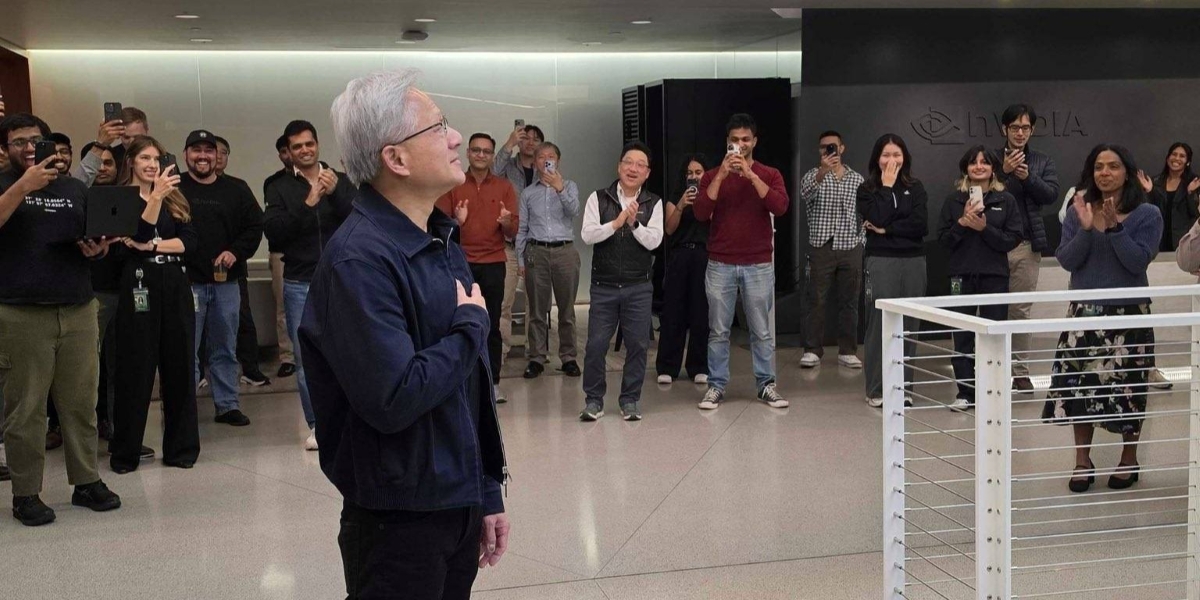
Huang walked back into the top job on Monday 23 November, eleven days after resigning over his affair with a woman now linked by the FBI to China’s intelligence services. Chief financial officer Colette Kress ran the company as interim CEO in the gap. Nvidia’s stock closed up around 31% on the day of his return, its best session since 2003, adding roughly $950 billion in market value after a slide that had wiped close to a trillion from the company at its trough.
For sports, the two weeks were not an abstract corporate drama. Most of the AI that clubs, leagues and broadcasters have been buying over the last year runs, somewhere in its pipeline, on Nvidia hardware.
A pipeline built on one supplier
Nvidia used the IBC broadcast conference in Amsterdam on 6 October to unveil a suite of sports products built around single-camera body pose tracking, AI-driven slow-motion replay and automated HDR video upscaling. The rollout partners are the names already inside every big broadcast truck: Hawk-Eye, Stats Perform, Peripheral Labs and Skyrim.ai, all of them building their newer tools on Nvidia infrastructure.
The dependency runs through the enterprise layer even where Nvidia is not the named partner. Microsoft is the Premier League’s cloud and AI partner, and Microsoft is one of Nvidia’s largest customers. The same pattern repeats through broadcast-AI deals announced across the NBA and the NFL this year.
Read also: WWE star Eugene placed on ventilator as family flies to London
“More deliberate about where they invest”
The upheaval has not scared sports organizations away from AI. It has forced them to ask sharper questions about who they are tied to.
“The upheaval should make sports organizations more deliberate about where they invest and who they rely on,” Shripal Shah, chief AI and innovation officer at sports consultancy Next League, told Sportico.
Shah frames the pause less as a reason to slow down than as a forced moment of discipline. For most clubs, that matches reality. The teams that have hired dedicated AI leadership in 2026, from NASCAR’s Richard Bowman to a new chief AI officer role at the Tampa Bay Buccaneers, are still working through proof-of-concept projects rather than running Nvidia-dependent AI at the heart of match-day operations.
NASCAR is not slowing down
NASCAR named Bowman its first director of artificial intelligence in April, with a remit to coordinate AI across the stock-car series after he joined in January as an operations specialist. Since the appointment the organization has replaced tens of thousands of dollars of outside software with in-house tools built on OpenAI’s Codex, running on infrastructure that, further down the stack, depends on Nvidia silicon.
Read also: Sidney Crosby’s agent speaks on the legend’s future
Bowman’s public message has been about discipline, not pace. “Technology creates value only when people can actually use it well, trust it, and see how it helps them in the flow of real work,” he told Motorsport.com when his role was announced.
That logic is what is giving the rest of the sports industry a small window of permission to breathe. A club still choosing what tools to pilot does not face the same risk as a hyperscaler whose quarterly earnings move on Nvidia’s chip delivery schedule.
Nvidia reports its quarterly results on 19 February 2027, the first set of numbers that will show whether customers, including the enterprise vendors that sell to sports, held their orders steady during the eleven days Huang was gone.
Read also: Roger Goodell’s Commanders blunder sparks immediate calls from NFL fans