Crowds, broadcasters and football fans, along with many who normally pay little attention to the sport, will turn their focus to Washington on Friday as FIFA conducts the official draw for the upcoming World Cup. The ceremony will determine how national teams are grouped in the opening stage, a pivotal moment that often shapes the competitive landscape months before a ball is kicked.
The draw takes place at the John F. Kennedy Center, a venue better known for performing arts than sporting bureaucracy. Yet the setting reflects how FIFA increasingly stages these events as global entertainment pieces, complete with celebrity guests, political figures and major broadcast partnerships.
Opening expectations
FIFA has outlined a revised procedure that accounts for an expanded 48 team format and the unusual scenario of three co hosting nations, according to the Daily Mail. The United States, Canada and Mexico, who qualify automatically, are placed in pot 1 alongside several top ranked teams. A redesigned seeding system ensures that major football powers, including Spain, Argentina, France and England, cannot meet each other until the later stages provided they win their groups.
To help preserve geographic diversity, FIFA continues its rule that teams from the same continental confederation cannot be drawn together in the early rounds except in the case of UEFA. Europe sends more teams than any other region which makes some overlap unavoidable.
Read also: Kylian Mbappe had just hit top form – now Real Madrid have a problem
For audiences less familiar with the mechanics, the draw functions as both an organisational requirement and a storytelling device. Once groups are set, analysts begin projecting possible knockout paths, broadcasters design promotional campaigns and national associations assess travel logistics and competitive expectations.
A showpiece event
Former England defender Rio Ferdinand will oversee the ceremony. He will be joined onstage by a roster of high profile American sporting figures including Tom Brady, Wayne Gretzky, Aaron Judge and Shaquille O’Neal.
FIFA has framed the event as a major media moment with US President Donald Trump expected to attend, according to the Daily Mail, and performances scheduled from the Village People and singer Robbie Williams.
The governing body is especially mindful of maintaining a smooth broadcast. Past draws, some unfolding before global audiences of tens of millions, have at times veered off script in ways that embarrassed officials and dominated news coverage long after the groups themselves were decided.
Read also: Premier League boss breaks silence with damning Manchester City statement
A history of chaos and confusion
1982 draw confusion
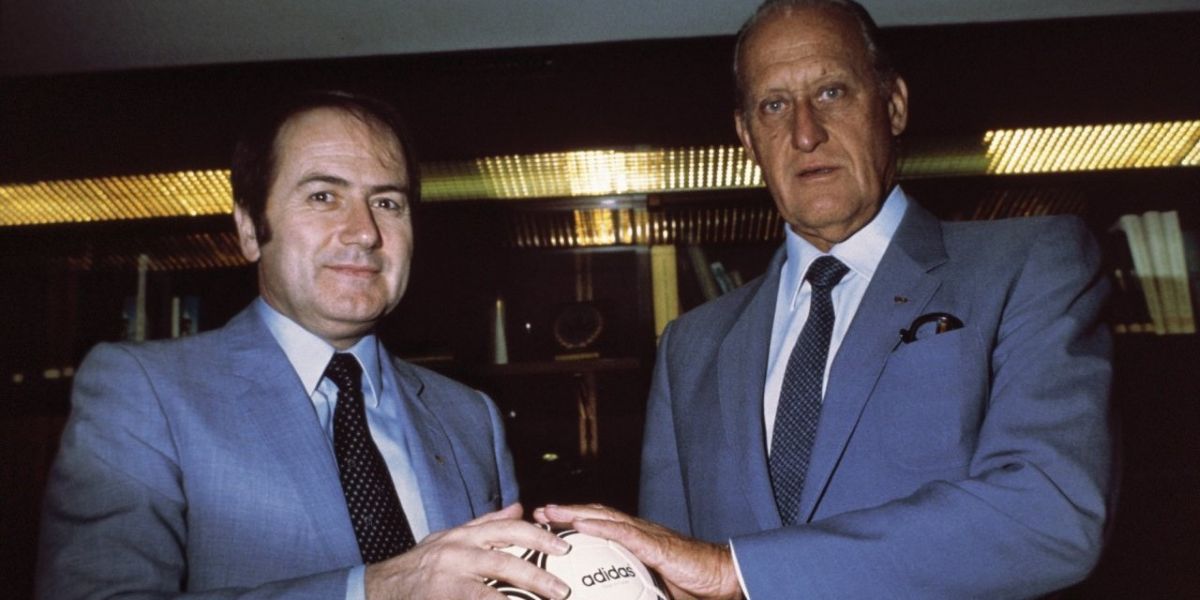
One of the most cited examples occurred during the 1982 World Cup draw in Spain. The tournament had recently expanded which introduced new seeding and allocation rules. According to coverage referenced by the Daily Mail, FIFA officials had repeatedly rehearsed the procedures including the requirement that only one South American team could appear in each group.
Despite those preparations, key officials, including then secretary general Sepp Blatter, appeared to forget the rule once the live broadcast began. Belgium were mistakenly paired with Italy and Scotland were placed in a group alongside Argentina. The error became clear only after an intervention from a delegate, stopping the ceremony midstream and forcing officials to reconsider the assignments on live television.
BBC commentator Brian Moore told viewers that the situation had become muddled and cameras even captured well known players such as Kevin Keegan and Graeme Souness exchanging puzzled looks in the audience.
Machines malfunction
Once the human error was corrected, technical issues created further delay. Spain’s lottery style machines, chosen to dispense the draw balls, jammed and in one case appeared to open a ball internally, according to the Daily Mail account. Officials had to reset equipment and intervene manually while young stage assistants tried and mostly failed to maintain composure as the event slipped into farce.
Read also: Kasper Schmeichel finds completely new path after football retirement
Comic disorder in 1994
Blatter meets Robin Williams
When the United States hosted the draw for the 1994 World Cup, organisers opted for a lighter tone by inviting comedian Robin Williams as one of the assistants. Archived footage often referenced in retrospective reporting shows that Williams embraced the moment with unrestrained theatricality. He wandered toward the pots prematurely, prompting Blatter to interrupt repeatedly with pleas for patience.
The exchange grew increasingly playful as Williams donned a white glove, bowed dramatically and joked with Blatter about meeting moments earlier in a restroom. His ad libbed humour delighted the audience but made it difficult for officials to maintain the formality of the process.
Unscripted energy
During the actual ball selection, Williams riffed constantly, joking about prizes or pretending to struggle with the final envelope. Blatter stepped in to clarify that the final team would be Switzerland, home to FIFA’s headquarters. Although the episode became a fondly remembered television moment, it again demonstrated how unpredictable the ceremony could become when live broadcast, comedy and complex procedures collided.
Temperature controversies resurface
The hot and cold balls debate
In 2016, long after leaving the presidency, Blatter stated in a media interview that some European competitions had historically used temperature manipulation to distinguish balls during draws. He claimed he had witnessed cooled or warmed balls being used to influence outcomes though he insisted such practices had never occurred within FIFA. UEFA denied the allegation immediately.
Read also: Andy Murray reveals one major regret about Nadal and Djokovic
The remarks resurfaced as the 2018 World Cup draw approached. Concerns mounted over whether the public could trust the randomness of the ceremony, according to reporting cited by the Daily Mail.
FIFA responds
In response, Chris Unger, then FIFA’s director of competitions, reassured reporters that no such techniques were used. He noted that all balls were made identical in feel and colour except for certain designated red ones which served a procedural purpose. Unger emphasized that the formation of groups was entirely random.
Why this year feels different
The Washington draw comes at a moment when the World Cup is expanding, geopolitical tensions are high and global audiences expect both transparency and spectacle from major sporting bodies. For many viewers who are not regular football followers, the draw serves as a first point of engagement, offering an accessible entry into a tournament that spans continents and cultures.
Should any confusion arise, memories of earlier mishaps will resurface quickly. Yet if the ceremony proceeds smoothly, it will signal that FIFA has learned from its more chaotic chapters and can manage a modern, globally scrutinized event with clarity.
Read also: Manchester United told to ‘nick’ two Man City stars if relegation hits
For England, Scotland and dozens of other national teams, Friday’s ceremony marks the beginning of the narrative that will define their World Cup journey.
Source: Daily Mail