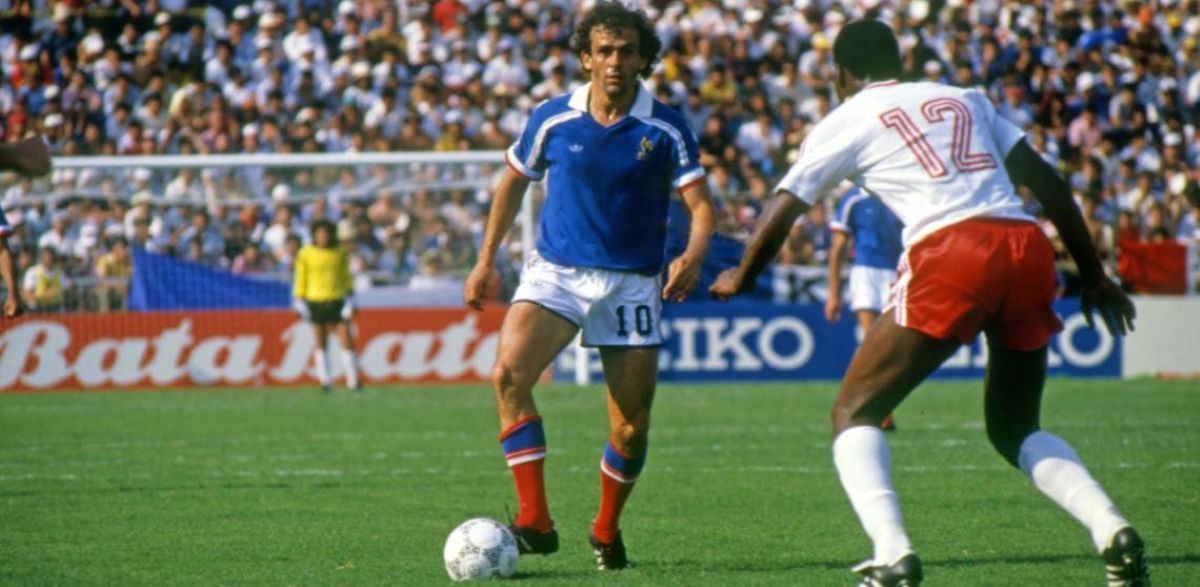
On summer nights in the early 1980s, matches slowed when Michel Platini touched the ball. Defenders hesitated, teammates adjusted their runs, and space seemed to open where none had existed. He did not overwhelm opponents physically. He disarmed them mentally.
For a short but decisive period, European football moved at his tempo. According to GOAL.com, that era ended with three consecutive Ballon d’Or awards between 1983 and 1985 a sequence that captured not just individual brilliance, but control over the game itself.
A scorer who played from the middle
Platini was born in Joeuf, in France’s Lorraine region, to a family with Italian roots. His upbringing was modest, his football education local. What stood out early was not flair, but clarity: he saw solutions before others recognised problems.
At Nancy, where he emerged in the 1970s, Platini played nominally in midfield yet scored with striker-like regularity. Between 1972 and 1979, he helped the club win promotion and the Coupe de France, performances that, as GOAL.com documents, quickly elevated him into the national conversation.
Read also: Rival teams pressure FIA over Mercedes advantage
A move to Saint-Etienne followed. The club were France’s dominant force, and Platini fitted naturally. Over three seasons, he helped secure the 1981 league title, confirming that his influence translated beyond a smaller stage.
Turin, tactics and control
Serie A was a different examination altogether. When Juventus signed Platini in 1982, Italian football was unforgiving, shaped by defensive structure and tactical detail. Creativity was welcomed only if it served the system.
Juventus owner Gianni Agnelli believed Platini could do more than serve it he could redefine it. After an early period of adjustment, that belief was rewarded. GOAL.com reports that Platini scored 104 goals in 224 appearances for the club, contributing to domestic titles and major European trophies, including the European Cup.
Under Giovanni Trapattoni, Platini became the axis. He pressed little, ran selectively, but dictated everything. His success challenged the prevailing assumption that control and imagination were opposing forces.
Read also: Leicester penalty sharpens focus on Manchester City’s 115 charges
The year everything aligned
Platini’s authority reached its height in 1984. By then, he had already established himself as Serie A’s most decisive midfielder, finishing as the league’s top scorer multiple times ahead of players such as Diego Maradona and Karl-Heinz Rummenigge, according to GOAL.com.
That summer, France hosted the European Championship. Platini captained the side and scored nine goals still a tournament record. Some came from free-kicks, others from late runs into the box, several from moments when the game seemed stuck until he intervened.
France won the final in Paris. The celebrations mattered, but so did the symbolism. French football was no longer a supporting act. Platini had pulled it to the centre of the stage.
A public figure, not just a player
Platini never cultivated mystique. He preferred wit. Looking back on his career path, he once said:
Read also: Barcelona ready to trigger Rashford buy option
“I started playing for the strongest team in Lorraine, continued with the strongest team in France, and ended up with the strongest team in the world.”
Agnelli, reflecting on Platini’s impact in Turin, offered a line that endured far longer than most match reports:
“We bought Platini for a pittance, then he topped it off with foie gras.”
The humour masked seriousness. Platini was acutely aware of football’s weight, a feeling that deepened after the 1985 Heysel disaster. Two seasons later, he walked away at 32.
Read also: Trump-linked song plays at US Olympic hockey opener
Explaining the decision, he said:
“The important thing is to always be true to yourself. I couldn’t do it anymore on the pitch. So I left.”
How he should be remembered
Platini does not dominate debates about football’s single greatest player. Others had longer peaks, broader global reach. But few have ever exercised such complete authority over European football in a defined window.
For three seasons, the game bent to his understanding. That is why his legacy endures not as nostalgia, but as a benchmark.
Read also: FIFA contract clause could block ICE at World Cup matches
Sources: GOAL.com