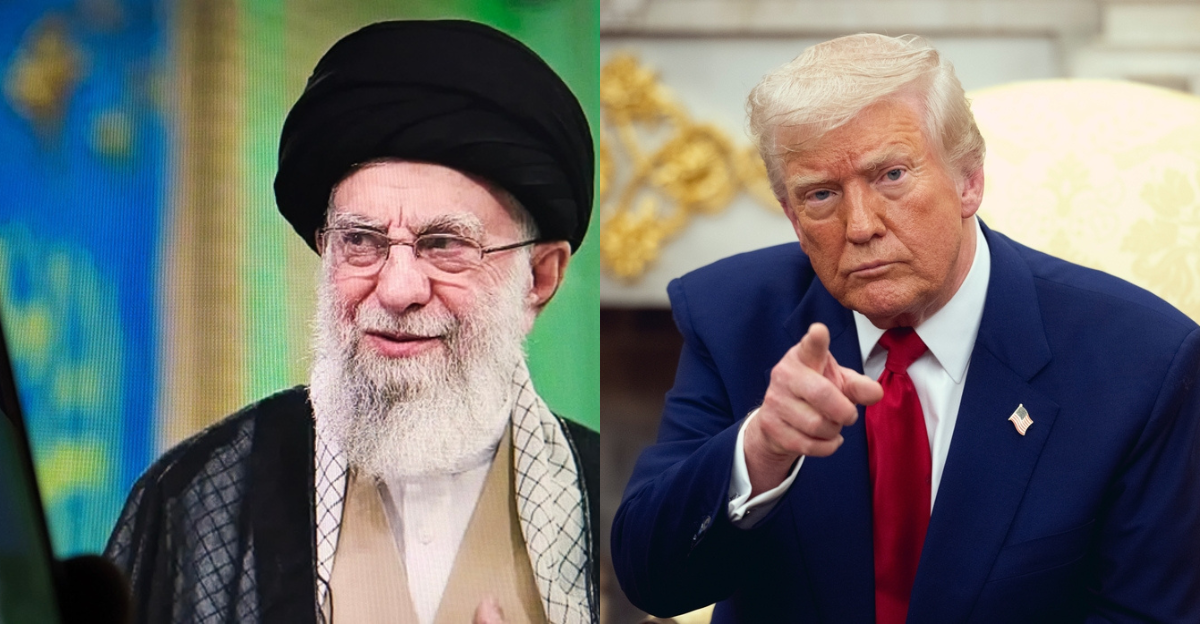
President Donald Trump said Friday that a change in Iran’s leadership “would be the best thing that could happen,” escalating rhetoric at a moment when the United States is preparing to host the largest World Cup in history.
His comments came after the Pentagon confirmed the deployment of a second US aircraft carrier to the Middle East, a move widely seen as a signal to Tehran amid renewed friction over Iran’s nuclear program.
“It seems like that would be the best thing that could happen,” Trump said.
“For 47 years, they’ve been talking and talking and talking.
Read also: Roy Keane gives Manchester City stars brutal message over medals after guilty verdict
“In the meantime, we’ve lost a lot of lives while they talk. Legs blown off, arms blown off, faces blown off. We’ve been going on for a long time.”
The remarks inject sharper political overtones into the run-up to the 2026 FIFA World Cup, which the US will co-host with Canada and Mexico.
Tensions abroad, scrutiny at home
Relations between Washington and Tehran have deteriorated in recent months. The Associated Press has reported on deadly unrest inside Iran tied to economic grievances, while noting that casualty figures are difficult to verify independently.
Trump has pressed Iranian officials to negotiate a new nuclear agreement and has warned that military options remain on the table. Tehran, for its part, insists its nuclear program is peaceful, according to BBC News.
Read also: Where Erling Haaland could end up if he leaves Man City
Iran’s Supreme Leader Ayatollah Ali Khamenei, in power since 1989, has cautioned that US military intervention could trigger wider conflict in the region.
None of that is directly connected to the World Cup but the political backdrop is hard to ignore.
A tournament spread across three countries
The 2026 edition will be the first to feature 48 teams and 104 matches. Of those, 78 games are scheduled to take place in the United States, including fixtures in cities such as New York, Los Angeles and Dallas, with Canada and Mexico staging the remainder.
Because the US will host the majority of matches, its domestic policies are drawing closer attention. In January, the Trump administration released an updated list of countries affected by visa processing suspensions.
Read also: Javier Tebas breaks silence on what should happen to Man City next
A State Department official told the Mirror last month that the “ban applies to the issuance of immigrant visas only, and does not apply to non-immigrant visas, such as those for tourists, athletes and their families, and media professionals intending to travel for the World Cup”.
Several countries subject to travel limitations including Ivory Coast, Haiti, Senegal and Iran have qualified for the tournament. While athletes and accredited staff would be eligible for non-immigrant visas, some supporters have questioned whether travel rules could complicate attendance.
Large international sporting events have previously required host governments to make temporary administrative adjustments. Whether similar flexibility is applied in 2026 remains to be seen.
Who decides participation?
Speculation has surfaced online about whether geopolitical tensions could lead to Iran being excluded from the tournament. FIFA has given no indication that such a step is being considered.
Read also: Messi admitted he targeted one World Cup rival on purpose
Under FIFA regulations, the governing body assumes operational control of the competition once a host nation is appointed. Participation decisions fall under its statutes, not those of individual governments.
Professor Simon Chadwick told SPORTbible in January that any exclusion would be a matter for FIFA alone.
“They’ll [FIFA] be on the ground working on security issues,” Chadwick said.
“They’ll be on the ground working on sponsorships and partnerships. They’ll be on the ground dealing with broadcasting and media content.
Read also: Cristiano Ronaldo crisis forces Portugal chief into emergency action
“So it is part of FIFA’s rules that if you become an event host, at some point the host nation steps aside and FIFA comes in and runs the event. So this is a FIFA decision, ultimately.
“It’s not a United States decision. It’s not a British government decision. It’s not a football fan decision. This is a FIFA decision.”
SPORTbible reported that it had contacted FIFA for comment.
With more than two years before kickoff, planning for the tournament continues across North America. Whether diplomatic tensions remain contained or spill further into international sport will shape the atmosphere surrounding one of the most commercially significant World Cups ever staged.
Sources: Associated Press, BBC News, Mirror, SPORTbible