The countdown has begun to what FIFA says will be the biggest World Cup ever staged. But as anticipation builds across North America, the 2026 tournament is unfolding against a backdrop of intensifying political tension and global instability.
According to Oliver Kay in The Athletic, what was once promoted as a unifying festival of sport is now increasingly shaped by immigration disputes, diplomatic friction and military escalation. The expanded competition will feature 48 teams, 104 matches and 16 host cities across the United States, Canada and Mexico over 39 days.
FIFA President Gianni Infantino has described the tournament as “the greatest event that humanity, mankind, has ever seen and will ever see”. He has said up to six billion people could engage with the event and that ticket requests surpassed 50 million within the first month of sales. “The world,” he said via FIFA media channels, “will stand still.”
On the field, the narratives are powerful. Lionel Messi and Cristiano Ronaldo may be preparing for their final World Cup appearances. Stars such as Kylian Mbappe and Erling Haaland are expected to headline the tournament, while emerging talents including Lamine Yamal will take center stage. Nations such as Curacao, Cape Verde, Jordan and Uzbekistan are set for historic first appearances.
Read also: Is Kim Kardashian and Lewis Hamilton engaged?
Yet the spectacle is colliding with mounting uncertainty, as Wars and tensions across the globe with US in the center of it all, fills the headlines.
Growing tensions
According to The Athletic, relations between the United States and co hosts Canada and Mexico have faced strain in recent months. A United States immigration crackdown has prompted concerns that supporters from certain qualifying nations could encounter visa difficulties.
International tensions have escalated further following a joint military operation by the United States and Israel targeting Iran. Iran responded with strikes on United States military bases across parts of the Middle East. As reported by Oliver Kay, the deteriorating situation has raised uncertainty about whether Iran’s national team will ultimately participate in the tournament.
The Athletic also reported that earlier this year some European football associations discussed hypothetical boycott scenarios amid broader geopolitical friction. The German Football Federation stated that a boycott was “currently not under consideration”, citing the “unifying power of sport and the global impact that a football World Cup can have”.
Read also: Ocon breaks silence on F1 Haas exit: ‘I don’t deserve this’
Security and political pressure
Major tournaments frequently attract dire predictions, but the scale of current turbulence is striking. Previous World Cups faced different controversies. South Africa in 2010 and Brazil in 2014 saw concerns about crime. Russia in 2018 was overshadowed by political tension and allegations of racism. Qatar in 2022 drew global scrutiny over migrant worker welfare and LGBTQ rights.
In 2018, Infantino said of Russia, “this is a new image of Russia”. FIFA later suspended Russia from international competition following its invasion of Ukraine. Infantino has since argued that the ban “created more frustration and hatred”.
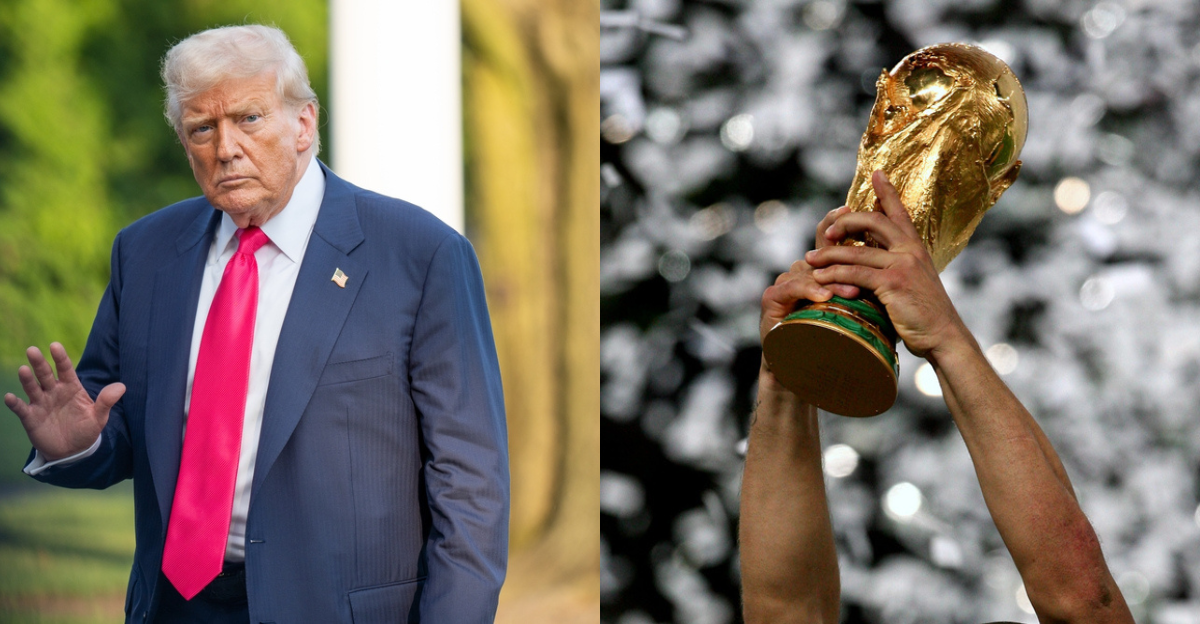
Last year, under the banner “Football Unites the World”, FIFA launched a “Peace Prize” to “reward individuals who have taken exceptional and extraordinary actions for peace”. Its first recipient was current United States President Donald Trump, whom Infantino has described as a “great friend”, a striking choice that blurred the line between sport’s message of unity and overt political symbolism.
Security funding has also become a domestic issue within the United States. According to reporting cited by The Athletic, officials warned of potentially catastrophic consequences if host cities do not receive federal support during a partial government shutdown. Combined with rising accommodation prices and logistical strain, the concerns extend beyond geopolitics to practical readiness.
Read also: Neville on Manchester City: Removing the owners is the only punishment that fits
Between spectacle and instability
The tournament is scheduled to open on June 11 at Azteca Stadium in Mexico City, with the final set for July 19 at MetLife Stadium in New Jersey. Record attendances, global viewing figures and commercial revenues are widely expected.
Infantino said in 2022, “Football is and unites in hope. It unites in joy. It unites in passion. It unites in love, as well as in diversity.”
That ideal remains central to FIFA’s messaging. Yet as Oliver Kay observed in The Athletic, the political climate today is markedly different from when the United States, Canada and Mexico first launched their joint bid, built on themes of unity, certainty and opportunity.
Regardless of the geopolitical issues, the wars, the problems in the world, the television numbers will almost certainly break records. And by mid July, a new world champion will be crowned in New Jersey.
Read also: Michael Schumacher accident mystery finally explained 13 years later
But I do still believe it’s fair to ask the question: Does World Cup 2026 even make sense?
Sources: The Athletic
Read also: Jurgen Klopp speaks out on Man City verdict