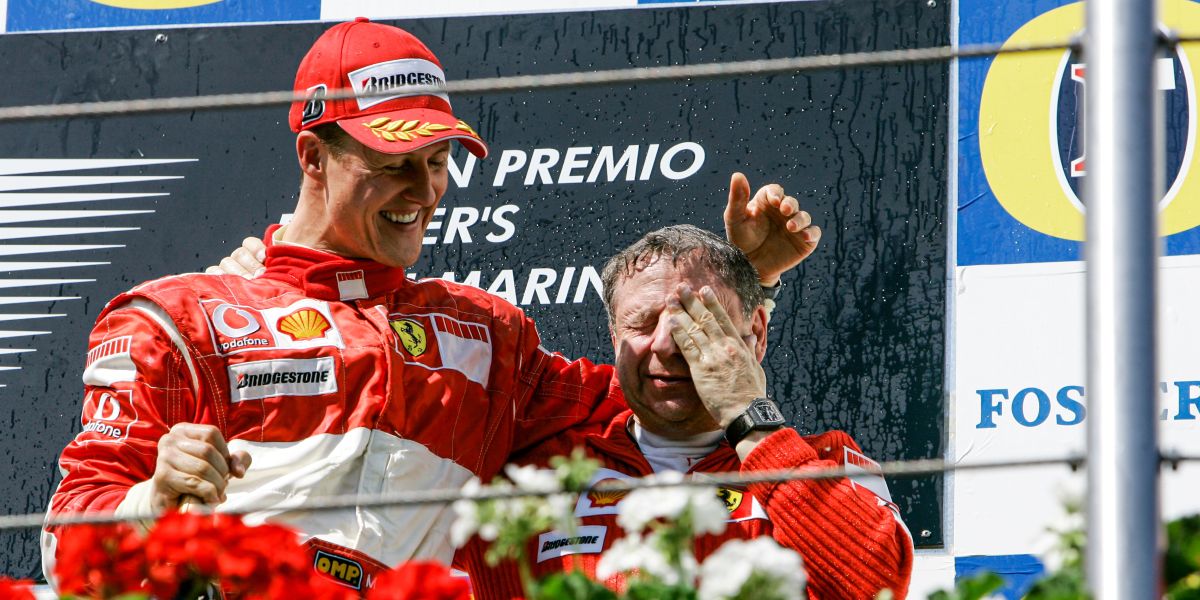
Michael Schumacher’s reputation as one of Formula 1’s greatest drivers is firmly established, but his career was not without controversy and not everyone admired him at the time.
One of those critics was Jock Clear, now a senior Ferrari engineer, who once held serious doubts about Schumacher’s sportsmanship following one of the sport’s most infamous incidents.
From rivalry to resentment
Speaking in an interview with Peter Windsor, Clear reflected on his time working with Jacques Villeneuve during the 1997 season, when tensions with Schumacher were at their peak.
The flashpoint came at the European Grand Prix in Jerez, where Schumacher collided with Villeneuve in a title-deciding moment. The move ultimately backfired, costing Schumacher the championship and leading to his disqualification from that year’s standings.
Read also: Liverpool turn back to Kostas Tsimikas as Andy Robertson’s exit reshapes the left back plan
“I knew Michael reasonably well because of our battles in 1997,” Clear said. “We spoke to each other, but we were enemies. Honestly, I had a pretty poor opinion of him for a few years after that…”
That incident left a lasting impression. Clear even suggested that modern drivers operate differently, adding: “Lewis wouldn’t have done it for sure. I had a pretty poor view of his sportsmanship.”
A stance that followed him to Mercedes
Those feelings didn’t fade quickly. Years later, when Schumacher returned to Formula 1 with Mercedes in 2010, Clear was reluctant to work with him.
Recalling a team meeting led by Ross Brawn, Clear said: “I guess we need to sort out who is going to be race engineer for whom. I said, ‘I’m not going to race engineer Michael, that’s for sure.’”
Read also: Ranked by Jamie Carragher: Top 10 Premier League midfielders
At the time, Clear was working with Nico Rosberg, while Schumacher was beginning his comeback after a three-year absence from the sport.
A surprising turning point
However, circumstances inside the team soon changed. After his working relationship with Rosberg came to an end, Clear found himself moving across the garage at Schumacher’s own request.
“I finished working with Nico at the end of 2010. We just didn’t click,” he explained. “Michael immediately said, ‘Well, if Nico doesn’t want him, I’ll have him.’ I crossed the table and went to the other side.”
What followed challenged his long-held assumptions.
Read also: Did Kai Trump break Masters rules fans weigh in
Working alongside Schumacher and race engineer Peter Bonnington, Clear began to see a very different side to the seven-time world champion.
“It was a real eye-opener to see how a seven-time world champion goes about business,” he said. “He just knew how to deal with people…”
Respect beyond the track
Over time, Clear’s earlier criticism of Schumacher’s on-track behavior became far less important compared to his experience working with him personally.
“Going from not having a great deal of respect for him as a sporting player, that became completely irrelevant,” he said. “Because I had a huge amount of respect for him as a man. He is a lovely human being…”
Read also: NFL Star dies at the age of 30 after Florida crash
Although Schumacher’s return with Mercedes did not produce championship success, it offered those around him a closer look at his character away from the intensity of title fights.
He secured his final Formula 1 podium at the 2012 European Grand Prix a closing highlight in a career that continues to influence how drivers are judged today.
Sources: F1 Oversteer, Peter Windsor interview
Read also: International Judo Federation welcomes back Russian athletes