Analysis: Trump, Putin and the World Cup, why Iran changes everything
Why Trump matters so much to FIFA
The 2026 World Cup will be the biggest tournament in the competition’s history, with 48 teams and 104 matches across the United States, Canada and Mexico, including 78 matches in the United States, according to FIFA’s official tournament information.
Trump has already created a White House task force for the tournament and placed himself at the top of it. According to the official government record of the signing ceremony, the State Department, Homeland Security and other federal agencies are expected to coordinate entry, security and travel planning. That means Trump does not decide who wins matches, but he can shape the conditions under which teams, officials, journalists and fans are even able to enter the country.
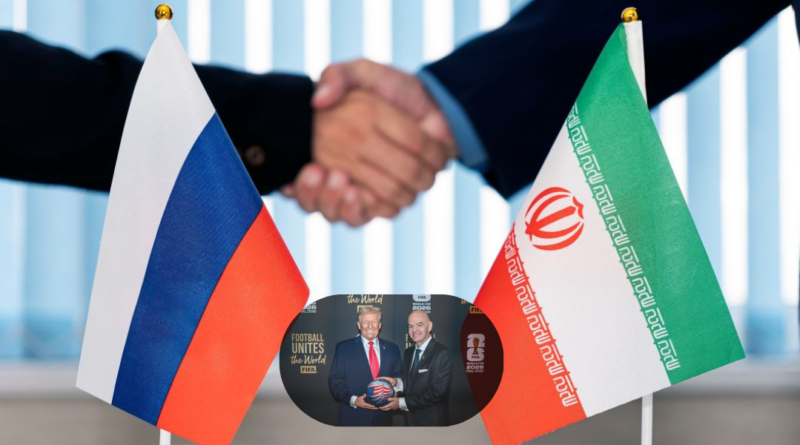
According to that same official record, Trump also told FIFA president Gianni Infantino that they had been friends for a long time. That matters because it shows how closely the host government and FIFA leadership now have to work together on visas, security, infrastructure and political messaging. For FIFA, Washington is not a side stage, it is one of the tournament’s main power centers. It's dangerous, as FIFA should be this huge organisation that excludes politics and solely focuses on the football as a sport.
How Putin could still shape the tournament indirectly
Russia has been suspended from FIFA and UEFA competitions since 2022, and the Court of Arbitration for Sport upheld those measures, according to FIFA’s official statement on the suspension.
Read also: Arsenal turns quadruple ambition into genuine contention
At a White House task force meeting in November 2025, Infantino said Russia remained excluded for now, but added that a return could become possible if peace were achieved. Trump immediately picked up that idea and framed a possible World Cup return as an incentive to end the war, according to the official government transcript of that meeting. That is the point where a sporting question starts to look like a political signal.
Calling Trump and Putin close personal friends would go too far. But there is clear evidence of an unusually direct line between them. According to the official readout of their March 18, 2025 call, the two leaders discussed better bilateral relations, the Middle East and shared the view that Iran must never be allowed to destroy Israel. They spoke again in March 2026 about the war involving Iran. That does not prove any secret joint control over FIFA, but it does show that Putin is not treated by Trump as a distant adversary. He remains a leader Trump talks to directly about overlapping global crises.
Why Iran makes this story more explosive
This is where Iran becomes central. Iran has already qualified for the 2026 World Cup and is listed by FIFA’s official team page as part of the tournament field.
Tehran would prefer its matches to be moved from the United States to Mexico because of security and visa concerns, but FIFA has so far kept the existing structure in place. Trump, meanwhile, publicly suggested that it might not be appropriate for Iran’s team to come to the United States because of security concerns, even though he had earlier signaled to FIFA leadership that Iran would be welcome. It suggests that the host country is sending mixed signals at exactly the moment when clarity matters most.
Read also: WADA delays decision on potential Trump ban from major sporting events until after World Cup
Iran also matters because it is where Russia’s regional role becomes visible. Russia and Iran signed a broad strategic partnership agreement in January 2025, according to the official Iranian presidency announcement. In an Associated Press analysis by Vladimir Isachenkov, AP reported that Moscow is not openly defending Iran as a military ally, but is still expected to benefit politically and economically from the conflict, including through higher energy prices and reduced Western focus on Ukraine. The same analysis, citing two officials familiar with U.S. intelligence, said Russia had shared information that could help Iran target U.S. assets in the region, while the Kremlin stopped short of taking on any direct military obligation under the partnership.
So when people ask whether Russia has anything to do with what is happening there, the most credible answer is yes, but mainly in an indirect, opportunistic and strategic way, not as an openly fighting protector of Iran.
What the travel ban could mean for fans from Muslim countries
One important correction is necessary here. Among the currently qualified teams from Muslim majority countries are Morocco, Qatar, Tunisia, Saudi Arabia, Iran, Egypt, Algeria, Jordan and Uzbekistan, according to FIFA’s official list of qualified teams. Turkey and Iraq are not currently qualified. Turkey is still in the UEFA playoff path, while Iraq remains in the FIFA playoff stage. That means the debate about Muslim fans and entry rules cannot be discussed as one single bloc. It has to be judged country by country.
For fans, Trump’s travel ban does not affect everyone equally. According to the June 4, 2025 presidential proclamation, the United States imposed a full entry ban on nationals of 12 countries, including Iran. The order includes a sports related exemption, but that exemption applies to athletes, coaches, necessary support staff and immediate relatives attending events such as the World Cup or the Olympics. Fans are not explicitly covered by that blanket sports exemption.
Read also: Ballon d’Or 2026: Power Rankings Revealed
The same proclamation also says the ban applies to affected nationals who were outside the United States on the effective date and who did not already hold a valid visa. Existing visas were not automatically revoked. In practical terms, that could mean many Iranian fans may not be able to travel at all, while supporters from Morocco, Qatar, Tunisia, Saudi Arabia, Egypt, Algeria, Jordan or Uzbekistan would generally remain subject to standard visa screening rather than the same full country level restriction.
There is also a broader safety question, that needs to be answered. On one level, officials insist the tournament will be secure. U.S. Customs and Border Protection says it is preparing both safe and efficient entry procedures. Also FIFA still consider the overall risk level for the U.S. led tournament as low. On another level, critics such as Congresswoman Nellie Pou argue that aggressive immigration enforcement could create fear and uncertainty for legal visitors, including fans, journalists and even players. For many travelers from Muslim countries, the issue is therefore not just stadium safety, it is whether they will feel protected during border checks, travel between host cities and public fan events.
What role ICE could play during the games
ICE is not expected to stay entirely in the background. During a congressional hearing, ICE director Todd Lyons said Homeland Security Investigations would be a central part of the wider World Cup security effort and that the agency had a responsibility to protect all participants and visitors, according to Sports Illustrated’s reporting on the hearing.
That sounds routine at first, meaning intelligence sharing, investigations and event coordination. But the political tension appears in the next step. According to Congresswoman Nellie Pou’s official statement after the same hearing, Lyons did not rule out the possibility of enforcement activity taking place around World Cup events. As long as the administration does not clearly separate public safety work from immigration enforcement, many fans may view ICE’s presence not as reassurance, but as a deterrent. That perception could matter especially for Muslim communities and migrant communities, even in cases where the travelers themselves are entering legally.
Read also: Is Liverpool losing their edge under Slot?
FIFA is under pressure
For FIFA, this is an extremely delicate balancing act. Officially, the organization is meant to remain politically neutral. In reality, it has to rely on Trump as the leader of the main host country, defend Russia’s exclusion, manage Iran’s participation and respond to mounting concerns about visas, border checks and ICE.
According to the official White House meeting transcript from November 2025, Infantino has already suggested that Russia could return if peace is achieved, while Trump framed that possibility as a diplomatic incentive. At the same time, FIFA’s official team and tournament structures still keep Iran tied to a competition heavily centered on the United States, despite Iran’s concerns about security and access.
The core of the story, then, is not that Trump and Putin have been proven to jointly dictate FIFA’s decisions. There is no public evidence for that. The real issue is that Trump has direct influence over the state machinery surrounding the tournament, while Putin can still shape the context indirectly through war, Iran, energy markets and geopolitical distraction. Iran is the point where those two lines of power become visible at the same time. That is why the 2026 World Cup is already becoming much more than a football tournament.
Read also: Iran players split as asylum drama ends with return home