Ticket prices raise concern
The 2026 World Cup has yet to begin, but concerns are already mounting over the cost and scale of the tournament.
A ticket for Brazil’s group-stage match against Morocco in New York is currently listed at around 11,000 Danish kroner. While that is among the more expensive examples, even the cheapest tickets for many early group-stage matches are reportedly priced between 2,500 and 5,000 kroner.
The prices stand in sharp contrast to FIFA’s repeated message that the World Cup should be accessible to supporters across the world, according to a TV 2 Sport article by Christopher Roth.
Stanis Elsborg, head of the organisation Play the Game, said the current pricing does not match FIFA’s public narrative.
Read also: Cristiano Ronaldo crisis forces Portugal chief into emergency action
“It does not fit in any way with the story that football should be for everyone and for the whole world, and that it should be accessible to most people. That is simply not the case here,” he said.
A World Cup driven by distance
The tournament will be played across the United States, Canada and Mexico, making it the largest World Cup in history. But the format also means long travel distances for teams and fans.
According to the New Weather Institute, the 2026 World Cup is expected to be the most climate-damaging tournament ever, despite the fact that no new stadiums have been built. In a report published in May, the think tank said the tournament would produce twice as much CO₂ as the average of the previous four World Cups.
Former Ekstra Bladet journalist Jan Jensen, who has followed the politics of international football for more than 15 years, said the structure appears to benefit business interests more than players or supporters.
Read also: Harry Kane breaks silence on Man City verdict
“They do not defend it. They do not care,” Jensen said. “You also have to remember that the fans have to make those journeys. Huge groups will have to travel back and forth across the United States. Who benefits from that? It is not the players or the fans. There is only one perspective left, and that is money.”
Teams face long journeys
Bosnia-Herzegovina will face the longest travel schedule during the opening group stage. The team will be based in St Louis, but must fly around 5,000 kilometres to play matches in Toronto, Seattle and Los Angeles.
Elsborg said the planning showed too little regard for teams and supporters.
“It is completely insane that a country has to play in three cities in its first three matches and then continue from there across long distances,” he said. “It benefits FIFA, the United States and the airlines. Not many others.”
Read also: Phil Taylor comes out of retirement for stunning darts return
The tournament will be staged in 16 stadiums: 11 in the United States, three in Mexico and two in Canada.
Experts question the legacy
Although the tournament will eventually produce a world champion, both Elsborg and Jensen are already sceptical about whether it can be remembered as a success.
Elsborg said it was impossible to separate the sporting event from the political and commercial decisions around it.
“You can only subscribe to the success story if you separate sport and politics, and you cannot do that in connection with this,” he said.
Read also: ‘If you lie to me, I will leave’: Guardiola’s City warning takes on new weight
Jensen was even more direct.
“This cannot become a success. It is an insane World Cup before it has even started,” he said. “And it will become even more insane in four years.”
Concerns already turning to 2030
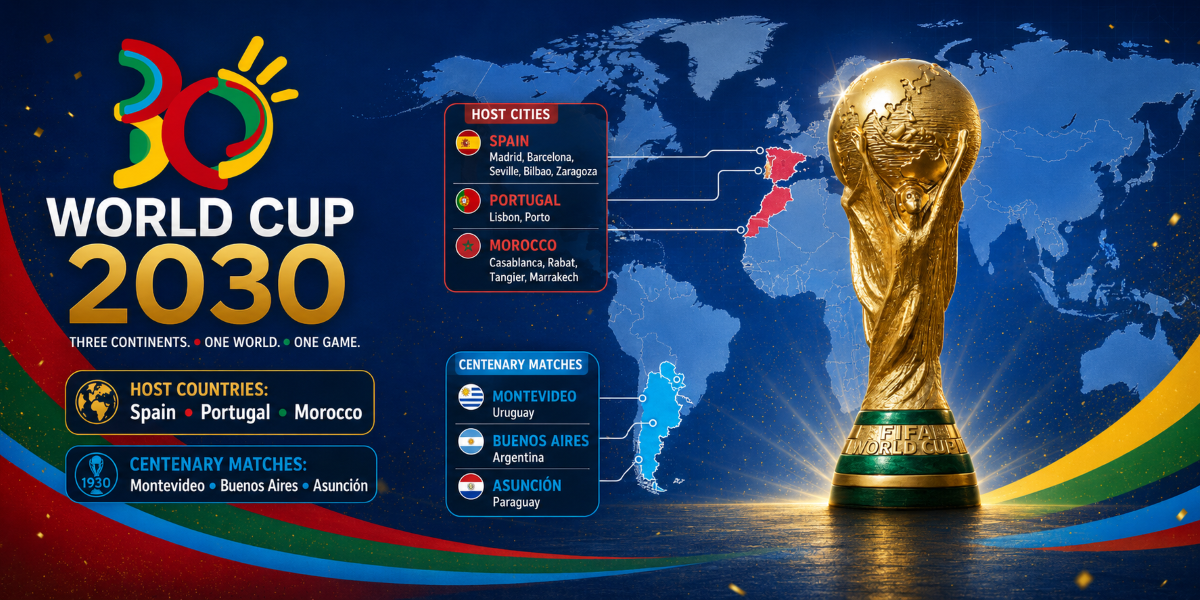
The criticism comes as attention is already shifting towards the 2030 World Cup, which will be hosted by Spain, Portugal and Morocco, with three matches also due to be played in Argentina, Paraguay and Uruguay.
There have been discussions about expanding that tournament to 64 teams, a prospect that has raised further concerns among critics of FIFA’s direction.
Read also: Harry Kane’s Bayern future suddenly comes with a Tottenham escape route
“Not everyone should be at a World Cup,” Elsborg said. “It is a championship for the best teams.”
The 2026 World Cup begins on Thursday at 21:00 Danish time, when Mexico face South Africa in the opening match.
Sources: sport.tv2.dk