Donald J. Trump and the weaponization of modern sport
The intersection of athletics, finance, and ideology
The trajectory of Donald J. Trump’s public life is inextricably bound to the world of professional sports. It is a relationship defined not merely by the passive enthusiasm of a fan, but by a half-century of aggressive participation as an owner, promoter, litigant, and cultural antagonist.
To understand Trump’s business psychology and his eventual political ascension, one must first navigate the chaotic history of his sporting endeavors. From the courtrooms of the USFL antitrust battle to the boardrooms of the NFL, and from the ringside seats of Atlantic City boxing to the fairways of controversial golf summits, sport has served as the primary laboratory for Trump’s brand of populism, negotiation, and conflict.
This report offers an exhaustive analysis of this multi-decade saga. It posits that Trump’s interactions with the sporting world were not diversions, but rather the essential proving grounds for the tactics he would later deploy on the national political stage.
It examines the "David vs. Goliath" narrative construction of the USFL lawsuit, the "counter-puncher" mentality honed in the fight game, the "us vs. them" polarization weaponized during the NFL kneeling protests, aswell as a sight on the World Cup 2026.
Read also: El Clásico: Reliving the Most Dominant Wins in Football's Greatest Rivalry
Through a forensic review of financial disclosures, legal transcripts, and historical accounts, this article tries to reconstructs the sporting life of the 45th President of the United States, revealing a pattern of seeking validation from established institutions, and, when rejected, attempting to dismantle them through insurgency and spectacle.
The USFL and the architecture of insurgency
The genesis of a challenger league
In the early 1980s, the American sports landscape was dominated by a singular monolith, the National Football League (NFL). The United States Football League (USFL) was conceived as a modest alternative, a spring league designed to satisfy the nation’s insatiable appetite for football during the NFL’s off-season. The league’s initial business plan was predicated on fiscal restraint and a respectful coexistence with the established order. This equilibrium was shattered in 1983 when Donald Trump, a brash real estate developer from Queens, purchased the New Jersey Generals franchise.
Trump’s entry into the USFL marked a radical shift in the league’s philosophy. He viewed the spring schedule not as a viable niche, but as a "testing ground" for a much grander ambition, forcing a merger with the NFL.
His strategy was one of rapid, reckless expansion and exorbitant spending, designed to create a product so undeniable that the NFL would be compelled to absorb it. "Trump was the big, crazy-spending owner, and the NFL guys were scared to death of him," recalled Bill Tatham Jr., owner of the Arizona Outlaws.
Read also: The 20 greatest darts players of all time, ranked from legends to rising stars
The financial bleeding was immediate and severe. By Trump’s own admission, he lost $3 million after taxes on the New Jersey Generals, a significant sum in 1980s currency. However, his calculus was not based on operating profit but on brand equity. "I got a billion dollars of free publicity," he later boasted, noting that in his first six months of ownership, his name appeared in newspapers 161 times, more than in the previous four years combined.
This commodification of attention, regardless of the underlying financial health of the asset, would become a hallmark of the Trump business model.

The Move to Fall: A suicidal Strategy?
The defining conflict of the USFL’s short life was the decision to abandon the spring season and compete directly with the NFL in the fall. This pivot was championed relentlessly by Trump, who argued that direct competition was the only path to a merger.
He persuaded a majority of the owners to support this move, effectively burning the league’s ships. The logic was basicly high-stakes poker. If the USFL could win an antitrust lawsuit against the NFL, the resulting damages or forced merger would make them all billionaires. If they lost, the league would die.
Read also: The 10 Biggest Sponsors in Formula 1 - Ranked
The lawsuit, filed in 1986, sought $1.32 billion in damages. It alleged that the NFL maintained an illegal monopoly over television broadcasting rights and player contracts, conspiring to strangle the infant league in its crib.
The case was led by Trump and his longtime attorney and mentor, Roy Cohn, a figure notorious for his aggressive, take-no-prisoners legal tactics. The suit accused the NFL of pressuring the major TV networks to shun the USFL, thereby cutting off its financial oxygen.
However, the legal strategy backfired spectacularly in the courtroom. The NFL’s lead counsel, Frank Rothman, adopted a strategy of judo-like deflection. Rather than denying the NFL’s dominance, Rothman painted Trump as the villain, a wealthy, impatient dilettante who had hijacked a promising spring league and steered it into a suicidal confrontation with the NFL simply to gratify his own ego.
Rothman meticulously dismantled the USFL’s narrative of victimhood, arguing that the league’s financial woes were self-inflicted wounds caused by overspending and the ill-advised move to the fall schedule.
Read also: Trump and Obama clash over Team USA comments
The $3 verdict
The trial, held over 42 days in Manhattan federal court, captivated the sports world. It featured testimony from NFL Commissioner Pete Rozelle, Howard Cosell, and Trump himself. The jury’s verdict remains one of the most bizarre outcomes in legal history.
They found the NFL guilty of maintaining a monopoly, technically validating the USFL’s central claim. However, they also concluded that the NFL’s monopolistic behavior was not the primary reason for the USFL’s failure. The jury attributed the league’s demise to its own mismanagement—specifically, the strategies driven by Trump.
The damages awarded were symbolic: one dollar. Under antitrust law, damages are trebled, bringing the total award to three dollars. The NFL was also ordered to pay approximately $6 million in attorney fees, but the $1.32 billion windfall that Trump had promised his fellow owners evaporated.
The economics of the USFL lawsuit
Read also: Diego Maradona’s old Trump criticism resurfaces after Messi moment
| Component | Strategic Intent | Actual Outcome |
| Schedule Shift | Move to Fall to force NFL merger | Alienated fans; destroyed spring niche |
| Legal Claim | $1.32 Billion Antitrust Damages | $3.00 (Trebled from $1.00) |
| Merger Goal | Force NFL to absorb USFL teams | No merger; USFL dissolved |
| Trump's Narrative | "We fought the monopoly and won" | "A desperate attempt to extort money" (Critics) |
| Financial Impact | Expected windfall for owners | Total loss of franchise investment |
The psychological impact of this verdict cannot be overstated.
Trump had bet the entire league on a legal long shot and lost. Yet, in the aftermath, he spun the verdict as a moral victory, focusing on the "guilty" finding while ignoring the negligible damages. This ability to reframe objective failure as subjective success would serve him well in future political campaigns.
The USFL ceased operations shortly after the trial, leaving Trump with a defunct team but a nationally recognized name. He had successfully used the league as a ladder for his own celebrity, even as he kicked the ladder away for everyone else.
The Buffalo Bills and the origin of grievance
The 2014 Ownership Bid
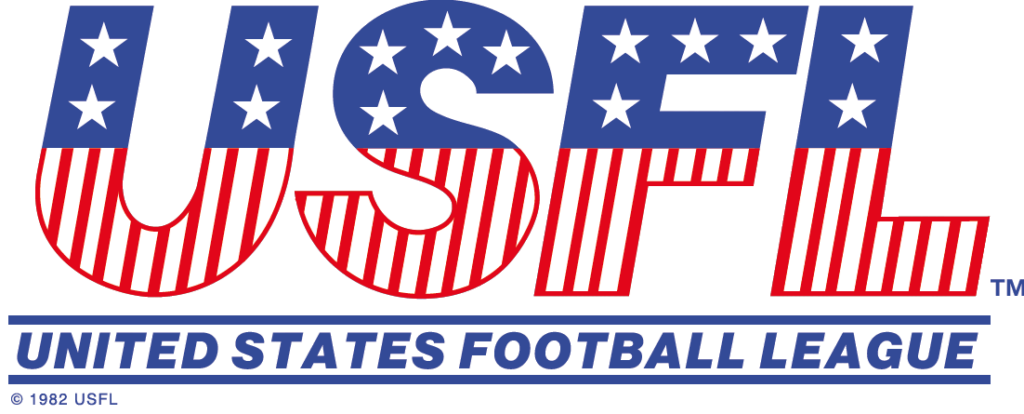
Three decades after the USFL collapsed, Trump attempted to return to professional football, this time seeking entry into the establishment he had once sued. In 2014, following the death of Ralph Wilson, the Buffalo Bills franchise was put up for sale. Trump, now a reality television star and global brand, saw ownership of an NFL team as the ultimate status symbol, a validation of his wealth and power that had eluded him in the 80s.
His bid for the Bills was characterized by the same aggressive tactics he used in real estate. He faced stiff competition from a group led by rock legend Jon Bon Jovi and another by billionaire Terry Pegula.
Trump’s team engaged in a "black ops" campaign to undermine the Bon Jovi bid, employing political emissaries to spread rumors that the singer intended to move the beloved franchise to Toronto. This "Ban Bon Jovi" movement successfully mobilized Buffalo fans against the rock star, poisoning his bid.
Despite these maneuvers, Trump’s bid ultimately failed due to financial realities. Reports indicate that Trump’s liquid assets were approximately $1.1 billion, insufficient to match Terry Pegula’s all-cash offer of $1.4 billion.
The NFL finance committee, which vets all potential owners, reportedly scrutinized Trump’s net worth and found it wanting relative to the league’s stringent liquidity requirements. Furthermore, the memory of the USFL antitrust lawsuit lingered as many older owners and league officials viewed Trump as a litigious loose cannon who could not be trusted.
The Michael Cohen testimony and fraud allegations
The specifics of Trump’s financial maneuvering during the Bills bid resurfaced years later in a criminal context. In 2019, Trump’s former personal attorney, Michael Cohen, testified before Congress that Trump had inflated his net worth on financial statements provided to Deutsche Bank in an attempt to secure a loan for the Bills purchase.
Cohen alleged that Trump provided false financial records to project the liquidity necessary to buy the team, a claim that became central to the New York Attorney General’s civil fraud case against the Trump Organization. This suggests that the Bills bid was not merely a vanity project but a high-risk financial gambit that exposed Trump to significant legal jeopardy.
From owner to president
A compelling theory championed by sports media figures like Stephen A. Smith posits that Trump’s rejection by the NFL was the catalyst for his 2016 presidential run. Smith recounted a conversation with Trump in 2014, shortly after the Pegula purchase was finalized, in which Trump allegedly said, "If them MFs get in my way, I'm going to get them all back. I'm going to run for president".
While this may be anecdotal, the timeline is suggestive. The Bills sale concluded in late 2014; Trump descended the golden escalator to announce his candidacy in June 2015. The humiliation of being deemed "not rich enough" by the billionaire boys' club of the NFL may have fueled a desire to achieve a position of power that superseded their authority. As President, Trump would relentlessly attack the NFL, engaging in a feud that felt deeply personal, a retribution for the club that refused to let him in.
Boxing, MMA, and the strongman archetype
Managing Mike Tyson
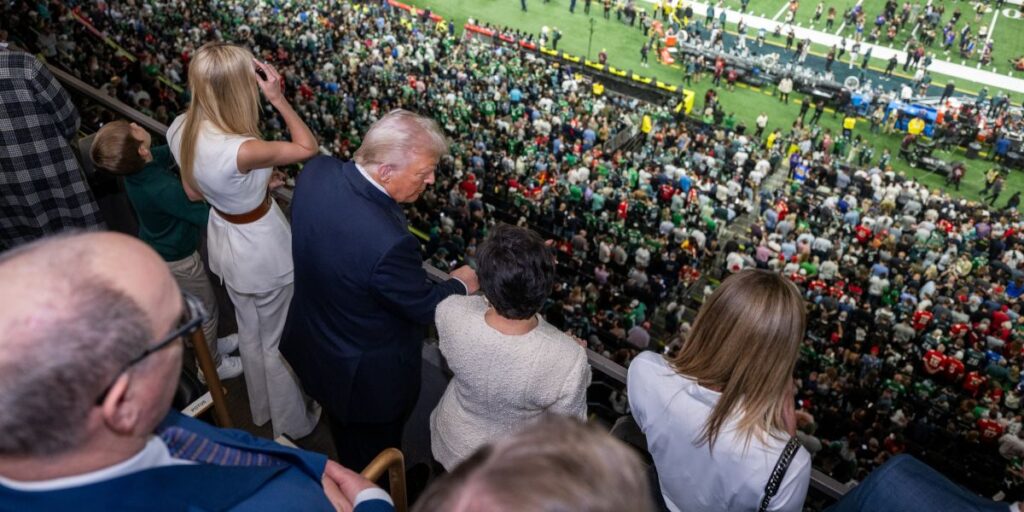
Before he was a politician, Trump was a fight promoter in all but name. In the late 1980s, he identified heavyweight boxing as a vehicle to bring high rollers to his Atlantic City casinos. He partnered with Don King to bring Mike Tyson’s biggest fights to the Trump Plaza and Trump Taj Mahal, effectively turning Atlantic City into the boxing capital of the world for a brief period.
Trump’s involvement went deeper than hosting. In 1988, following the death of Tyson’s manager Jim Jacobs, Trump stepped into the vacuum. He briefly served as Tyson’s advisor and manager, orchestrating a massive payday for the fighter’s bout against Michael Spinks.
This relationship was symbiotic, as Tyson provided the raw power and spectacle, while Trump provided the venue and the veneer of business acumen.
Trump’s defense of Tyson following the boxer’s 1992 rape conviction offers a window into his moral flexibility regarding sports stars. Trump publicly argued that Tyson should not serve jail time but instead be allowed to fight, with the proceeds going to victims of rape.
"He can do more for the people that he hurt by fighting than by sitting in a jail cell," Trump argued, a utilitarian view that prioritized commerce over criminal justice. This willingness to excuse the transgressions of "winners" and "stars" would reappear in his defenses of various political and cultural allies.
The Savior of the UFC
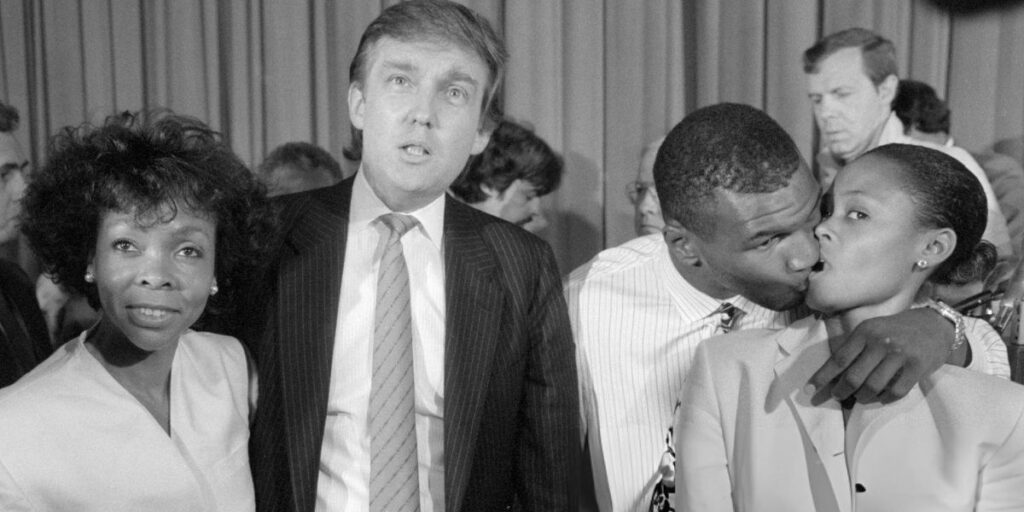
If boxing was Trump’s past, Mixed Martial Arts (MMA) became his future. In 2001, the Ultimate Fighting Championship (UFC) was a pariah sport. Labeled "human cockfighting" by Senator John McCain, it was banned from cable pay-per-view and exiled from major arenas. The new owners, Zuffa (led by the Fertitta brothers and Dana White), were struggling to find a venue that would host their events.
Trump saw an opportunity where others saw a liability. He opened the doors of the Trump Taj Mahal to the UFC, hosting UFC 30 and UFC 31. These events were critical lifelines. UFC 31, featuring the first fight of B.J. Penn and a heavyweight title bout with Randy Couture, is now legendary, but at the time, it was a desperate attempt to keep the company afloat.
Dana White has never forgotten this gesture. "Trump gave us our first shot... he was one of the first guys there in his seat," White recalled. "He saw it when no one else did".
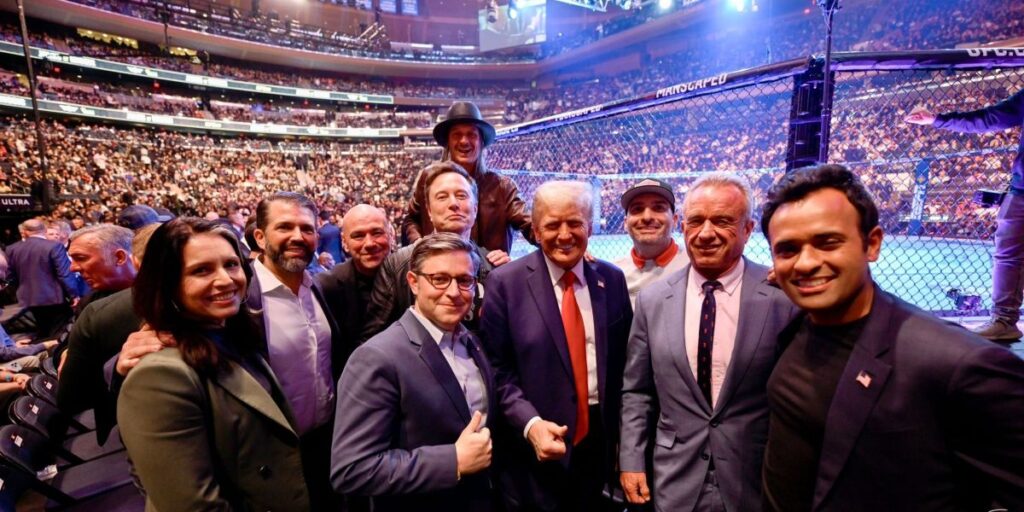
This early investment paid massive political dividends. As the UFC grew into a $15 billion global juggernaut, it became a cultural stronghold for the MAGA movement. Dana White spoke at the Republican National Convention in 2016 and 2020, mobilizing the UFC’s young, male, anti-PC demographic for Trump.
Fighters like Colby Covington and Jorge Masvidal became energetic surrogates. Covington famously wore a MAGA hat to weigh-ins and visited the Trump White House, calling Trump a "dragon energy" figure. Masvidal joined Donald Trump Jr. on a "Fighters Against Socialism" bus tour through Florida, explicitly linking the fighter’s immigrant narrative to Trump’s anti-socialist rhetoric.
The symbiosis of Trump and combat sports
| Era | Sport | Key Figure | Trump's Role | Political Payoff |
| 1980s | Boxing | Mike Tyson | Host/Advisor | Global media exposure; "Strongman" association |
| 2000s | MMA | Dana White | Venue Provider | Unwavering loyalty from UFC leadership |
| 2016-24 | MMA | Covington/Masvidal | Icon/Mascot | mobilization of young male demographic |
The "Battle of the Billionaires"
Trump’s relationship with Vince McMahon and World Wrestling Entertainment (WWE) provides the Rosetta Stone for his political style. In 2007, Trump participated in the "Battle of the Billionaires" at WrestleMania 23.
The storyline involved Trump and McMahon each choosing a champion to fight for them, with the stipulation that the losing billionaire would have his head shaved live in the ring.
The event shattered pay-per-view records. Trump’s champion, Bobby Lashley, defeated McMahon’s champion, Umaga. The climax saw Trump, glee on his face, shaving the head of a bound and screaming McMahon. This was "kayfabe", the wrestling art of presenting staged conflict as reality.
Trump’s mastery of this form, generating heat, humiliating rivals, and playing to the cheap seats, was a direct rehearsal for the 2016 Republican debates. He learned that the American public craves conflict and dominance, and that the line between entertainment and governance is permeable.
The green empire
The Portfolio
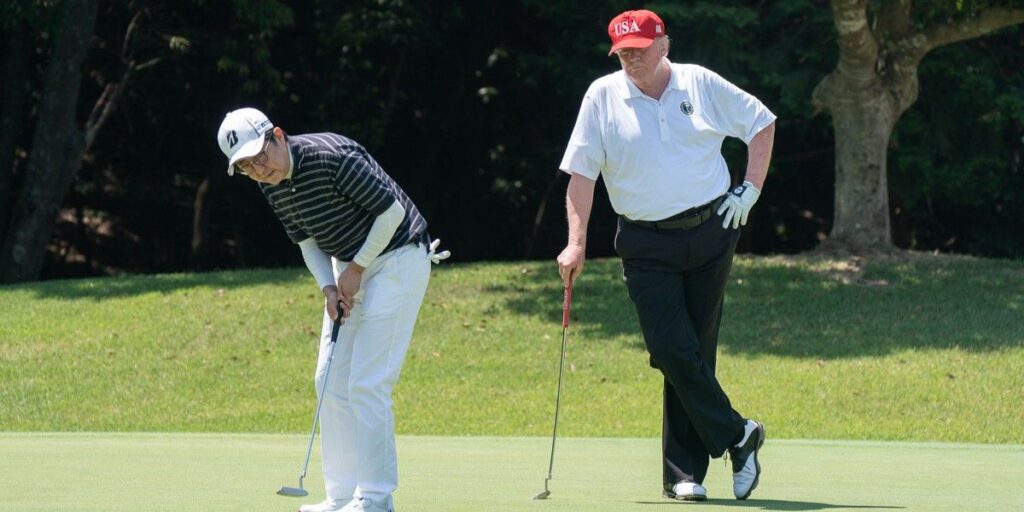
Golf is the sport that Trump actually plays, and his ownership of golf courses is central to his identity as a billionaire mogul. His portfolio includes some of the world’s most historic venues, most notably Turnberry in Scotland and Doral in Miami. However, the financial performance of these assets often contradicts their gilded image.
Trump Turnberry, acquired in 2014, has been a financial sinkhole. Financial filings from the UK reveal that the resort has posted millions in losses year after year, losing £2.3 million in 2019 alone.
The property is sustained by massive loans from Trump’s own trust. Despite investing heavily in renovations to make the Ailsa course arguably the best in the world, the governing body of British golf, the R&A, has quietly blacklisted Turnberry from hosting the Open Championship. The R&A views the security risks and the potential for protests associated with the Trump brand as insurmountable obstacles, denying Trump the global validation he craves.
Similarly, Trump National Doral was the longtime host of the prestigious WGC-Cadillac Championship. In 2016, the PGA Tour abruptly moved the tournament to Mexico City. While the Tour cited sponsorship issues, Trump correctly interpreted it as a political dissociation from his polarizing campaign rhetoric. The loss of this tournament was a significant blow to the prestige of his golf empire.
The LIV golf alliance
Spurned by the golf establishment, Trump found a powerful new ally in LIV Golf. The Saudi-backed breakaway league, seeking venues willing to defy the PGA Tour, found open arms at Trump Bedminster and Doral. Hosting these tournaments was a lucrative pivot; while exact figures are guarded, the hosting fees and associated revenue from these events are estimated to be in the millions, providing a vital revenue stream for courses that had lost their mainstream tour affiliations.
This alliance was also geopolitical. By partnering with the Saudi Public Investment Fund (PIF), Trump aligned himself with a disruptor challenging an American monopoly (the PGA Tour). He aggressively defended the league against "sportswashing" accusations, citing his long business history with Saudi Arabia. "They buy apartments from me.
They spend $40 million, $50 million," he once noted. Trump predicted that the PGA Tour would eventually be forced to merge with LIV, a prediction that proved prescient when the framework agreement between the entities was announced in 2023.
The "Commander in cheat"
Trump’s personal conduct on the golf course has been the subject of extensive reporting, most notably by sportswriter Rick Reilly in his book Commander in Cheat. Reilly details a litany of offenses: Trump allegedly kicks balls out of the rough (the "foot wedge"), throws opponent’s balls into bunkers, and claims championships at his own clubs that he never actually played in.
Reilly recounts a story where Trump claimed to have won the club championship at his Bedminster course during a weekend he was actually in Philadelphia. "He plays the first round at any new course he buys and calls that the club championship," Reilly noted.
These anecdotes are not merely sports trivia; they are character studies. They reveal a psychological need to win so acute that reality is bent to accommodate it. However, it is also true that Trump is a better golfer than most men his age.
Tiger Woods, who has played with him, noted, "For a person who's 70 years old, he hits it hard... he has an inordinate amount of energy". Swing analysis by professionals confirms that while his style is unorthodox, a flat, baseball-style backswing, he generates legitimate power through hip rotation. The dichotomy of Trump the Golfer, legitimately skilled yet compulsively dishonest about his score, is a microcosm of his broader public life.
Culture wars: NFL and Nike
The kneeling controversy
During his presidency, Trump identified the NFL player protests, led by Colin Kaepernick, as a potent wedge issue. At a rally in Alabama in September 2017, he unleashed a tirade that would define the era: "Wouldn't you love to see one of these NFL owners, when somebody disrespects our flag, to say, 'Get that son of a bitch off the field right now. Out! He's fired. He's fired!'".
This statement transformed a protest about police brutality into a referendum on patriotism. It forced NFL owners, many of whom were Trump donors, into an impossible corner. Trump relentlessly attacked the league, tweeting that ratings were "WAY DOWN" because of the protests.
While NFL ratings did dip by approximately 8% in 2016-2017, analysts attributed this to a confluence of factors including the distracting presidential election, cord-cutting, and oversaturation of primetime games, rather than a mass boycott by conservatives. Nevertheless, Trump successfully branded the NFL as "unpatriotic" to his base, damaging the league’s standing in red states.
The Nike boycott analysis
When Nike made Colin Kaepernick the face of its 30th Anniversary "Just Do It" campaign in 2018, Trump predicted disaster. "Nike is getting absolutely killed with anger and boycotts," he tweeted. Videos of people burning Nike shoes went viral, seeming to confirm his prediction.
However, the market data told a different story. While Nike’s stock initially dipped, it quickly rebounded and surged to all-time highs. Social media analysis showed that mentions of the brand increased by 1,400%, and the campaign resonated deeply with Nike’s core demographic: young, urban, and diverse consumers.
Trump’s attack on Nike highlighted the limits of his economic power; while he could damage a domestic league like the NFL, he could not derail a global lifestyle brand aligned with youth culture.
The White House visit: A broken tradition
Trump’s presidency effectively ended the bipartisan tradition of championship teams visiting the White House. High-profile athletes, particularly from the NBA and NFL, refused to attend. When Golden State Warriors star Stephen Curry expressed hesitation about visiting, Trump preemptively "disinvited" him via Twitter.
This led LeBron James to famously tweet, "U bum @StephenCurry30 already said he ain't going! So therefore ain't no invite. Going to White House was a great honor until you showed up!"
This exchange solidified the NBA as the center of anti-Trump sentiment in sports. Entire teams, including the 2018 Philadelphia Eagles and the US Women’s National Soccer Team (led by vocal Trump critic Megan Rapinoe), skipped the visit.
Conversely, teams from more conservative-leaning sports, such as the Houston Astros (MLB) and the Baylor Lady Bears (NCAA), continued to attend. The White House visit, once a unifying ceremonial lap, became a political litmus test, further sorting American sports fans into ideological camps.
Championship team visits during the Trump presidency
| Year | Team (Sport) | Outcome | Key Conflict/Quote |
| 2017 | Golden State Warriors (NBA) | Invitation Rescinded | "U bum... going to White House was a great honor until you showed up" (LeBron James) |
| 2017 | New England Patriots (NFL) | Attended (Partial) | Many players skipped; Tom Brady absent citing "family matters" |
| 2018 | Philadelphia Eagles (NFL) | Invitation Rescinded | Trump canceled ceremony due to low player participation |
| 2019 | US Women's National Team (Soccer) | Did Not Attend | "I'm not going to the f***ing White House" (Megan Rapinoe) |
| 2019 | Washington Nationals (MLB) | Attended | Kurt Suzuki wore MAGA hat; Sean Doolittle boycotted |
| 2019 | LSU Tigers (NCAA Football) | Attended | Joe Burrow and team visited; generally positive reception |
The myth of the natural athlete
Deconstructing the baseball legend
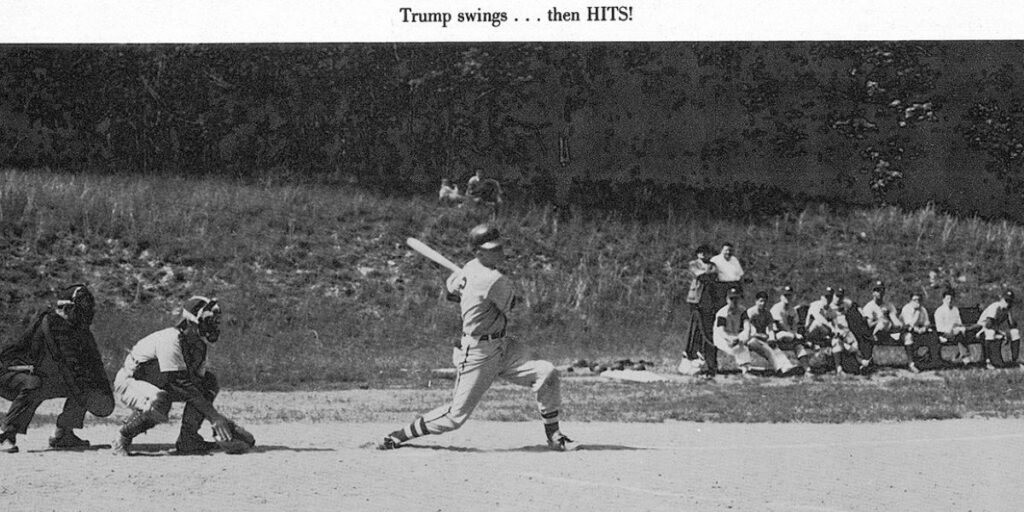
A cornerstone of Trump’s self-mythology is his claim to have been a baseball prodigy. He has repeatedly stated that he was the "best player in New York State" during his time at the New York Military Academy (NYMA) and that he was scouted by the Philadelphia Phillies and Boston Red Sox.
He often recounts a specific "game-winning home run" against Cornwall High School that was featured in a local newspaper.
Investigative research into these claims reveals a tapestry of exaggeration. While former classmates and coaches confirm he was a "good" first baseman with a strong arm, there is no evidence in professional scouting databases to support the idea that he was a pro prospect.
Crucially, records show that NYMA did not even play Cornwall High School in the year Trump claims the home run occurred. The "little local paper" headline he cites has never been located by archivists.
This fabrication serves a specific psychological purpose. It constructs a history of physical dominance and "what could have been." By claiming he could have been a pro athlete but chose real estate, Trump frames his business career as a deliberate conquest rather than a default path.
It reinforces the "strongman" image that is essential to his political appeal, the idea that he possesses an innate, superior genetic quality that translates across all domains, from the diamond to the boardroom.
The World Cup 2026
The 2026 task force and the 250th anniversary
In his second term, Trump has seized upon the 2026 FIFA World Cup, co-hosted by the United States, Mexico, and Canada, as a vehicle for American exceptionalism. Explicitly linking the tournament to the nation's 250th anniversary celebrations, Trump established a "White House Task Force on the FIFA World Cup 2026" via executive order.
He views the event not merely as a sporting tournament, but as a validation of his "America First" resurgence, aiming to maximize the projected $480 million economic impact and massive tourism influx.
The task force, composed of key cabinet members, is designed to ensure the event showcases "American greatness," turning the logistics of the tournament into a direct extension of executive power.
The Infantino alliance and the "Peace Prize"
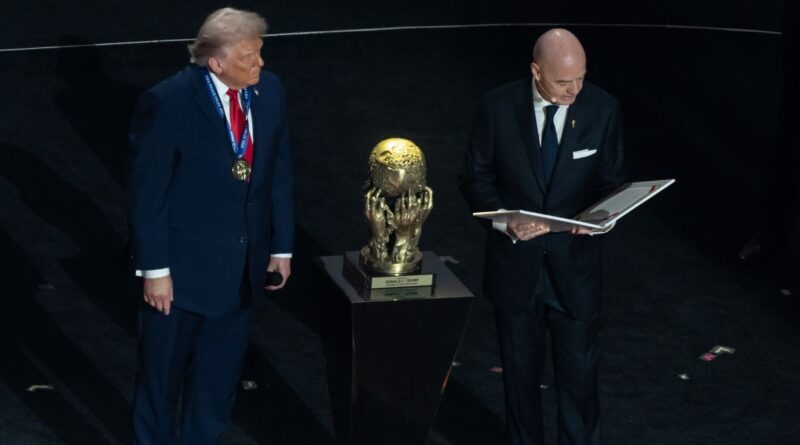
The alignment between Trump and FIFA President Gianni Infantino has drawn intense scrutiny, mirroring Trump's symbiotic relationship with Dana White in the UFC. In December 2025, during the World Cup draw in Washington D.C., Infantino awarded Trump the inaugural "FIFA Peace Prize," a move critics slammed as a sycophantic violation of FIFA's political neutrality statutes.
Infantino praised Trump for his "action for peace," while opponents viewed the award as a transactional gesture to secure Trump's favor for the tournament. This alliance grants FIFA security and logistical support from the U.S. government, while providing Trump with a global stage and a literal gold trophy to validate his statesmanship.
Immigration tensions and relocation threats
Despite the "peace" rhetoric, significant friction remains between Trump's domestic policies and FIFA's international requirements. Trump has threatened to withhold support or relocate matches from Democratic-run cities he deems "unsafe," specifically targeting venues in Seattle and California, introducing a partisan dimension to host city logistics.
Furthermore, his administration's strict immigration policies and travel bans have clashed with FIFA's mandate for open borders for fans and teams. Human rights organizations and legal experts have raised alarms that fans from banned nations may be unable to attend, creating a tense standoff over visa guarantees that threatens to undermine the "unity" theme of the tournament.

Financial deep dive
Loss leaders and brand equity
Historically, Trump’s sports investments have been loss leaders designed to generate fame.
- The USFL Generals: Trump lost ~$3 million on operations but gained immense media exposure. He effectively bought national fame for the price of a failed football team.
- Turnberry: The resort has accumulated over £40 million in losses since he bought it, yet it remains the jewel of his portfolio, a vanity asset that signals "aristocratic" status.
- The Bills Bid: Losing the Bills to the Pegulas likely saved Trump from financial ruin. Had he won with a $1.4 billion bid against his $1.1 billion liquidity, he would have been dangerously over-leveraged.
Post-Presidency revenue streams
In the post-presidency era, sports have transitioned from a vanity play to a vital revenue engine.
- LIV Golf: The partnership with the Saudis has injected millions into his golf courses at a time when the PGA Tour has boycotted them.
- Merchandising: The monetization of the MAGA brand through sports, selling "Trump 45" golf gear and capitalizing on his association with the UFC, has created a direct-to-consumer revenue line.
- Crypto and Licensing: Trump’s recent financial disclosures show millions in revenue from licensing deals, some of which leverage his "winner" image honed in the sports arena.
The arena as ideology
Donald Trump’s journey through the sporting world is a fifty-year campaign of disruption. It is a story of a man who desperately sought acceptance from the gatekeepers of American leisure, the NFL owners, the Augusta National members, the baseball scouts, and, upon being rejected, dedicated his life to building his own arenas where he could set the rules.
In the USFL, he tried to bully the NFL and failed, but learned the power of the lawsuit as a weapon. In boxing and the WWE, he learned that the American public loves a heel and that "kayfabe", the blurring of truth and fiction, is a potent political tool. In the UFC, he found a loyal tribe of disaffected young men who would become the foot soldiers of his political movement. And in his war with the NFL and the NBA, he learned that dividing the fans is just as profitable as uniting them.
To view Trump’s sports history as a collection of hobbies is to miss the point entirely. The stadium was his classroom. The athletes were his first subjects. And the game was never about the score, it was always about the crowd.
Appendices
Appendix A: Timeline of key sporting conflicts
- 1983: Trump purchases NJ Generals (USFL).
- 1986: USFL v. NFL verdict; $3 damages awarded. League folds.
- 1988: Trump advises Mike Tyson; hosts Spinks fight in Atlantic City.
- 2001: Trump Taj Mahal hosts UFC 30, saving the promotion.
- 2007: "Battle of the Billionaires" at WrestleMania 23.
- 2014: Trump bids for Buffalo Bills; loses to Terry Pegula.
- 2016: PGA Tour moves WGC Championship from Trump Doral to Mexico.
- 2017: "Sons of Bitches" speech in Alabama regarding kneeling players.
- 2021: PGA Championship canceled at Trump Bedminster after Jan 6.
- 2022: LIV Golf (Saudi) holds first event at Trump Bedminster.
- 2026: World Cup 2026, To be continued..
Appendix B: Financial impact data
- Nike Stock (2018): Initial drop of ~3%, followed by rally to all-time highs.
- NFL Ratings (2016-17): Declined ~8% year-over-year during protests (multi-factor causality).
- Trump Turnberry: Reported £2.3m loss in 2019; total debt to Trump Trust ~$150m.