Fifa rulings push European clubs toward risky payments despite sanctions
Background to the conflict between sport and sanctions
As Russia’s full scale invasion of Ukraine reshaped global politics, governments across Europe imposed sweeping financial sanctions that restrict transactions with Russian entities. These measures apply not only to banks and corporations but also to sports organisations involved in international transfers. When a club owes money for a player transfer, that payment typically travels through several banking intermediaries, and sanctions can block or freeze such transactions.
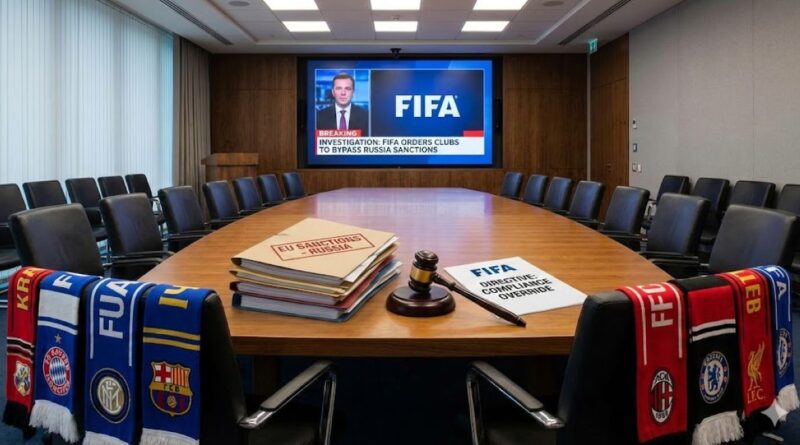
However, FIFA’s legal body, the FIFA Football Tribunal, has continued to treat transfer agreements as binding regardless of these restrictions. According to Follow the Money, a Dutch investigative outlet, the organisation has repeatedly ordered clubs to honour their contracts even when doing so may violate national or EU law.
How Fifa handled disputed payments
According to Follow the Money, the tribunal has ruled on 13 cases since 2022 involving clubs unable to pay or receive fees linked to Russian teams. In each case, FIFA instructed the clubs to pay within 45 days or face a ban on registering new players for three transfer windows, a penalty severe enough to shape a club’s competitive future.
One of the most notable examples involved West Ham United, which still owed part of a 26 million euro fee for Croatian midfielder Nikola Vlasic to CSKA Moscow. West Ham argued that CSKA, its leadership, and its banking partners appeared on the United Kingdom’s sanctions list, meaning that completing the payment could expose the English club to legal consequences.
Read also: England handed major advantage by new 2026 World Cup seeding format
Despite this, FIFA concluded that the obligation remained intact. In its rulings, the organisation stated that “the existence of sanctions has no effect on the existence and expiry date of a debt.”
Legal challenges and rare exceptions
West Ham appealed the ruling in May 2025 and prevailed. The Court of Arbitration for Sport found it was “objectively impossible to make payment of the second instalment,” overturning FIFA’s order. This decision underscored the growing conflict between international sports regulation and national laws governing sanctions compliance.
Only one other club, Sweden’s Djurgardens, succeeded in convincing FIFA that national and EU rules made payments to Zenit St Petersburg unlawful, according to Follow the Money. Most other teams found alternative routes for payment, often through licensed financial channels or intermediaries, to avoid the risk of FIFA penalties.
Wider implications for global sports governance
Public documents reviewed by Follow the Money suggest that FIFA’s approach has placed clubs in an unprecedented position, forcing them to weigh the risk of violating national legislation against the consequences of breaching FIFA rules. This tension illustrates how global sports organisations sometimes operate on principles that do not fully align with geopolitical realities or international legal frameworks.
Read also: Barcelona president urges patience after Araujo’s time away
The controversy adds to other criticisms directed at FIFA in recent years. In 2022, the organisation suspended Russia from international competitions, yet subsequent decisions have drawn public backlash. According to Follow the Money, FIFA displayed a map during the 2026 World Cup draw that omitted Crimea from Ukraine and later lifted a ban on participation by under 17 Russian players.
Why this matters beyond football
The dispute highlights a broader issue that reaches far beyond sports. International governing bodies, whether in finance, culture, or athletics, often claim neutrality. Yet they must navigate a world where sanctions, political conflict, and legal restrictions increasingly shape cross border activity. How FIFA interprets debts and obligations in a sanctioned environment may influence how other global organisations handle similar dilemmas in the future.
Sources, according to Follow the Money, Reuters, AP, BBC
Read also: Alexander-Arnold sidelined again as Madrid weigh the costs
Read also: Real Madrid dominates Athletic, yet dressing-room split deepens around Xabi Alonso