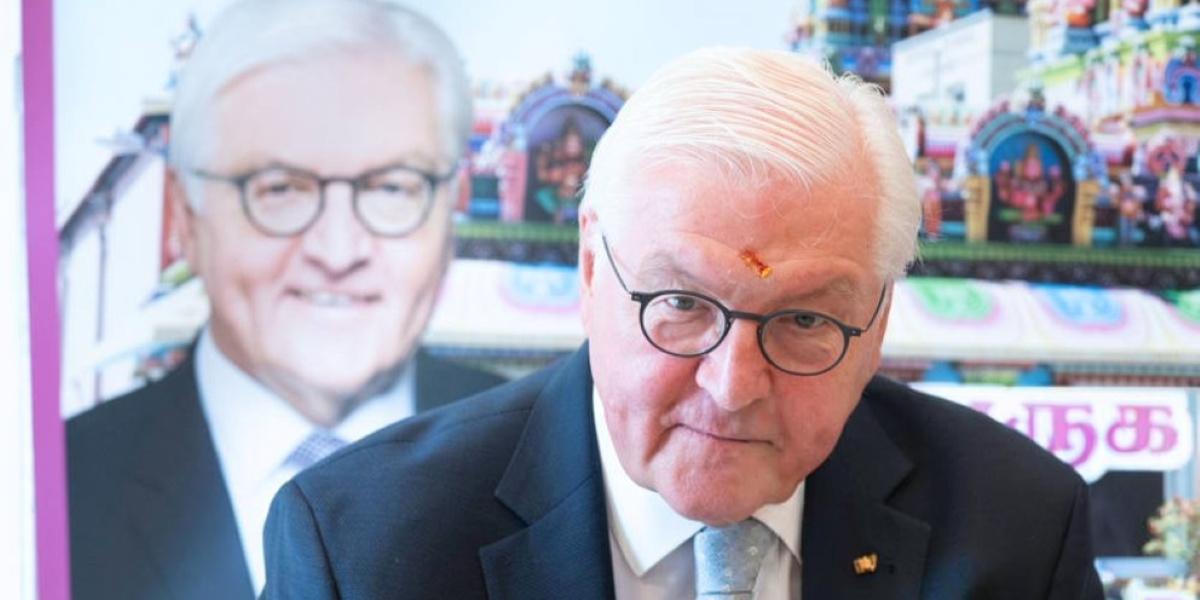
Germany’s president has dramatically changed his position on one of the country’s most sensitive sporting questions.
Frank-Walter Steinmeier now supports a German bid for the 2036 Olympic and Paralympic Games, despite previously expressing serious concern about staging the event exactly a century after the Nazi-controlled Berlin Olympics.
His reversal provides important political backing for Germany’s campaign as Berlin, Munich and the KölnRheinRuhr region compete to become the country’s official candidate.
According to Tagesschau’s report on Steinmeier’s change of position, his historical concerns have not disappeared. However, the president now believes Germany’s sporting and political institutions can deal responsibly with the symbolism of the year 2036.
Read also: Aymeric Laporte exposes ugly side of Pep Guardiola relationship
Steinmeier drops his opposition
Steinmeier had previously indicated that Germany should target the 2040 or 2044 Games instead.
The year 2036 carries an unavoidable historical burden. The 1936 Berlin Olympics were used extensively by Adolf Hitler’s government to present an image of German strength, order and international respectability while concealing the persecution taking place under the Nazi regime.
A German-hosted Olympics exactly 100 years later would therefore attract enormous international attention and force organisers to confront that history throughout the bidding process and the Games themselves.
Steinmeier has now concluded that the date should not automatically prevent Germany from competing for the event.
Read also: Manchester City face new panel that could reopen the 115-charge verdict
“I very much hope that, after Munich 1972, Olympic Games will finally take place in Germany again,” he said.
The president also pointed to Germany’s stadiums, sporting culture and experience of hosting major international competitions.
A controversial centenary
The 1936 Olympics remain among the most politically charged events in sporting history.
Hitler’s regime used the Games as an enormous propaganda operation, temporarily removing some visible signs of antisemitic persecution and presenting Germany as a peaceful and modern nation to foreign visitors.
Read also: UK Tax-service (HMRC) is coming after Manchester City now
German authorities would therefore face difficult questions about symbolism, remembrance and the risk of turning the centenary into a national celebration detached from its historical context.
Steinmeier’s office told ARD that the president’s original concerns had not vanished, but that he was convinced the relevant organisations would handle the anniversary responsibly.
The German Olympic Sports Confederation welcomed the intervention, arguing that support from the head of state would strengthen the country’s position internationally.
Three German bids remain
Germany has not yet selected the city or region that would lead a future Olympic campaign.
Read also: The huge job Jose Mourinho rejected for Real Madrid – and why it could already haunt him
Berlin, Munich and KölnRheinRuhr remain in contention after Hamburg’s population rejected its proposed bid in a referendum.
According to the German Olympic Sports Confederation’s official statement following the Hamburg vote, 54.9 per cent voted against continuing the city’s application. The DOSB will choose between the three remaining candidates at an extraordinary assembly on September 26.
The German candidate could ultimately pursue the Games in 2036, 2040 or 2044, depending on the international bidding process and the strategy adopted by the DOSB.
Steinmeier’s decision is particularly important because it removes one of the most prominent political objections to targeting the earliest edition.
Read also: 10 things the commission found Manchester City guilty of
Berlin’s bid carries the heaviest symbolism
A successful Berlin campaign would create the most direct connection with the 1936 Games.
The German capital plans to reuse many existing venues, including the Olympiastadion, which was constructed for the Nazi-era event and later extensively modernised.
According to the Berlin government’s latest update on the BERLIN+ project, the city says more than 90 per cent of the required sports and event venues already exist.
Berlin’s organisers argue that the city could transform the anniversary into a demonstration of modern democratic Germany.
Critics may question whether it is possible to separate the sporting celebration from the venue’s origins and the historical meaning of the centenary.
Unlike Munich and the KölnRheinRuhr region, Berlin has not held a binding public referendum on its Olympic plans.
Munich relies on public support
Munich’s campaign is built around the legacy of the 1972 Olympics and the promise of reusing existing infrastructure.
The city’s residents approved the proposed application with 66.4 per cent of the vote in a referendum held in October 2025.
As explained on the Bavarian government’s official Olympic bid page, the plan includes established venues in the Olympic Park, Augsburg, Garching and Oberschleißheim.
Supporters say Munich offers a more sustainable and less historically controversial option than Berlin.
However, the city also carries its own Olympic trauma. Eleven members of the Israeli team and a German police officer were killed during the terrorist attack at the 1972 Games.
Any future Munich Olympics would therefore also involve substantial security and remembrance responsibilities.
KölnRheinRuhr claims the strongest mandate
The KölnRheinRuhr bid stretches across several cities in North Rhine-Westphalia, with Cologne expected to serve as the central location.
Its organisers argue that the project has the strongest democratic mandate of the three remaining bids.
More than 1.4 million votes were cast across participating municipalities, with approximately 66 per cent supporting the proposal.
According to the North Rhine-Westphalia government’s presentation of the final bid, the concept places particular emphasis on existing venues, a central athletes’ village and reduced construction.
The region says its widespread public backing could prove decisive when the DOSB makes its choice.
Its weakness may be the lack of a single globally recognised host city comparable with Berlin or Munich.
Germany has repeatedly fallen short
Germany has not hosted the Summer Olympics since Munich in 1972.
Several later attempts failed before reaching the final international selection stage, often because of public opposition or political division.
Munich withdrew from the race for the 2022 Winter Olympics after voters rejected the plan. Hamburg’s proposed campaign for the 2024 Summer Games was also abandoned following a negative referendum.
Steinmeier’s support therefore provides something German bids have often lacked: a clear signal of national political unity.
The president has also used recent appearances with German athletes to argue that hosting the Olympics could encourage greater participation in sport and create new role models for young people.
In his speech honouring Germany’s 2026 Olympic and Paralympic medallists, Steinmeier described a future German Games as an enormous opportunity for elite and grassroots sport.
A sporting dream with a political shadow
Supporters will present a 2036 Olympics as an opportunity for democratic Germany to reclaim a date once exploited by a dictatorship.
Opponents will argue that the symbolism is unnecessary and that the country could avoid the controversy simply by targeting 2040 or 2044.
The debate will also extend beyond history. Olympic projects are regularly criticised for rising costs, security spending and promises of economic benefits that can be difficult to verify.
Steinmeier’s reversal does not guarantee that Germany will bid for 2036, nor does it decide which city will represent the country.
It does, however, remove a significant political obstacle.
Germany’s president once considered the date too uncomfortable. He now believes the country is ready to face it.