‘I’m proud to defend my country’: Greenland’s Olympian responds as Trump eyes the Arctic
Greenland has governed itself in most domestic matters since gaining expanded self-rule from Denmark in 2009. But on the Olympic stage, the Arctic territory still competes under the Danish flag.
International Olympic Committee rules recognize sovereign states, not autonomous territories. For Greenland, which fields its own teams at events such as the Island Games and Arctic Winter Games, that distinction has long fueled quiet debate about sporting independence.
This year, that discussion is unfolding against a sharper geopolitical backdrop.
Recent comments by U.S. President Donald Trump about Greenland’s strategic importance have stirred anxiety on the island, where questions of autonomy and future statehood are deeply rooted. At the Milano Cortina Winter Games, those tensions have formed a subtle backdrop to one athlete’s race.
Read also: Potential 2026 departure adds to questions surrounding Liverpool’s direction
More Than a Result
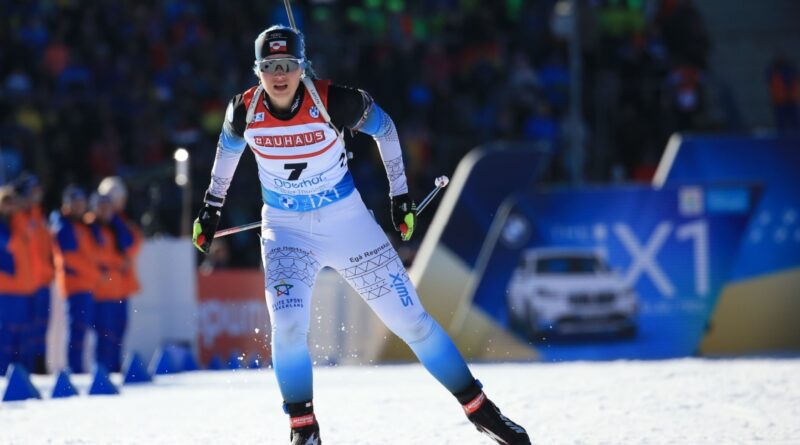
Ukaleq Slettemark, 24, finished 52nd in the women’s 15km biathlon. On paper, it was a mid-field result. In Greenland, it carried more weight.
“There aren’t many famous people from Greenland,” she said after crossing the line. “So of course, if there’s only one Greenlandic person everyone knows, I’m happy to defend my country and show people who we are and where we are on the map.”
She and her brother Sondre, both raised between Nuuk and Norway in a biathlon family, are the only Greenland-born athletes competing at these Games.
Although the red-and-white Erfalasorput is not flown officially at Olympic venues, its colors appeared in the stands in northern Italy, waved by supporters who see the siblings as representatives of both Greenlandic heritage and Danish citizenship.
Read also: Title race tightens after Arsenal stumble
For now, Slettemark says she is comfortable competing within Denmark’s delegation, even as independence remains a distant aspiration for many at home.
“You know, if we were going to compete for the Greenlandic flag here, we would have to become an independent nation and that’s such a big question. I think it’s every Greenlander’s dream to become independent far in the future. But right now, I’m very happy to be racing for Denmark.
“I mean, I feel like I still represent Greenland here. Everyone knows I’m from Greenland. We see the Greenlandic flags here, we race with the Greenlandic suit, I really feel like I’m representing both Denmark and Greenland.”
Politics at the Periphery
Among the small group of Greenlandic supporters in Italy was Nivi Olsen, the territory’s minister for sport, culture, education and church.
Read also: Trump immigration policies complicate security planning for 2026 World Cup
Speaking at the venue, Olsen connected the athletes’ participation to wider concerns following Trump’s remarks.
“Life is very difficult in Greenland,” Olsen said. “People are afraid. I think that Trump is crazy. I know it is a tough thing to say, but you can’t buy people, you can’t buy a country, there are people who live in Greenland, Greenland is our home, so we can’t understand Trump, we can’t understand how he can do what he does. But also we have hope. I can see the hope in people. And we stand together. And we fight together for our country.”
According to reporting from The Guardian, residents in Nuuk were closely following the race, viewing the siblings’ presence at the Olympics as a rare unifying moment.
Identity Woven Into Competition
Slettemark’s appearance in Italy was deliberately infused with references to home. She wore seal-skin accessories made in Greenland, and her race suit — created with her brother and supported by the Danish Olympic Committee — incorporated northern lights imagery and motifs inspired by traditional kakiorneq tattoos.
Read also: Verstappen tries new trick as F1 2026 testing begins
“It’s deeply inspired by Greenlandic culture, so it has the northern lights, it has these amulets that are inspired by the female tattoos called kakiorneq, and it has a pattern that’s a mix of the Greenlandic flag and the biathlon targets,” she said.
The symbolism was subtle but intentional: a reminder that Olympic affiliation and cultural identity are not always the same thing.
Greenland’s efforts to gain separate Olympic recognition have surfaced periodically in Danish political debate, though IOC membership remains tied to sovereignty. For now, athletes like Slettemark compete under Denmark’s banner while carrying their own national story alongside it.
At these Games, that story has traveled well beyond the finish line.
Read also: “A curious club”: Postecoglou reacts to Tottenham changes
Sources: The Guardian, International Olympic Committee statutes, Government of Greenland.