Inside the “Trump-Infantino Axis” reshaping the 2026 World Cup
Speed meets scrutiny
As of January 9, 2026, preparations for the 2026 FIFA World Cup are entering their final phase, marked by faster logistics and rising political controversy. According to AP News, planning for the tournament has advanced more quickly than many previous World Cups, helped by unusually deep involvement from the U.S. federal government.
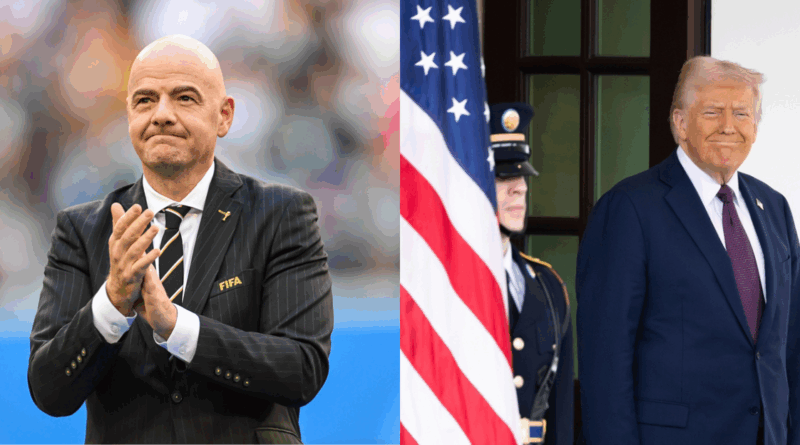
At the same time, critics argue that this efficiency has come with reputational risks for FIFA. According to The Guardian, the close working relationship between FIFA President Gianni Infantino and U.S. President Donald J. Trump has blurred traditional boundaries between sport and state power.
Venezuela and the neutrality question
The debate intensified after the U.S. military intervention in Venezuela on January 3, 2026, known as Operation Absolute Resolve. According to The Independent and OPB, the operation ended with the capture of Venezuelan President Nicolás Maduro and the installation of a U.S. backed transitional authority in Caracas.
Analysts cited by The Guardian say the timing of the intervention has placed FIFA in an uncomfortable position. The organization has long claimed political neutrality, but its flagship tournament is now being hosted by a country engaged in a major regional conflict.
Read also: Martinelli issues apology following late incident against Liverpool
Power and proximity
The relationship between Infantino and Trump has evolved beyond ceremonial appearances. According to AP News, early symbolic gestures gave way to direct coordination on World Cup related decisions.
One frequently cited moment occurred during an Oval Office visit when Infantino presented Trump with a referee’s red card, joking that it could be used against the press, according to The Guardian. Another came during the July 2025 Club World Cup final at MetLife Stadium in New Jersey, where senior level discussions reportedly took place outside FIFA’s usual committee structures.
Efficiency with limits
Operationally, U.S. involvement has delivered clear results. According to the White House and the U.S. State Department, a White House led task force helped accelerate visa processing and expand security coordination.
Central to that effort is the FIFA PASS visa priority system. According to Inside FIFA and the U.S. Travel Association, the program allows ticket holders to access faster consular appointments in countries facing long backlogs. However, KSAT and Al Jazeera report that the system excludes nationals from countries under U.S. travel bans and offers no additional safeguards for undocumented immigrants already in the United States.
Read also: Donald J. Trump and the weaponization of modern sport
Ethics and commercial ties
Questions about conflicts of interest have also surfaced. According to The Guardian and Front Office Sports, FIFA opened an office in Trump Tower in New York in 2025, making the organization a commercial tenant of a building owned by the president’s family business.
Watchdog groups cited by Play the Game argue that the arrangement creates the appearance of a financial link between FIFA and the U.S. president, even if no rules were formally broken.
A prize and its fallout
The sharpest criticism followed a December 5, 2025 ceremony in which Infantino awarded Trump the inaugural FIFA Peace Prize. According to Hindustan Times and Inside FIFA, the citation praised Trump for promoting peace and unity.
Weeks later, the Venezuela intervention reshaped how that award was viewed. According to The Independent, critics now point to the episode as evidence that FIFA applies different standards to different countries, particularly when major commercial interests are at stake.
Read also: Trump targets transgender athletes in speech to House Republicans
Fault lines in global football
Reaction across the football world has been uneven. According to World Soccer Talk, UEFA leadership has kept a visible distance from several FIFA events in the United States, reflecting broader unease in Europe.
In South America, IFCPF and El País report growing political pressure on federations to reconsider participation, especially after Venezuela’s withdrawal from regional competitions. While no major boycott has been confirmed, the debate highlights widening divisions within the sport.
When delivery collides with legitimacy
Taken together, the reporting suggests a mixed verdict. According to AP News, the U.S. government has delivered on logistics, security, and economic planning at a scale few hosts could match. Yet, as The Guardian and The Independent note, those gains have intensified concerns about FIFA’s independence and credibility.
As the opening match approaches, the World Cup appears on track to run smoothly on the field. Off the field, however, the tournament has become a case study in how global sport struggles to separate efficiency from power, and profit from principle.
Read also: Manchester City player wages in 2026 revealed
Sources: AP News, The Guardian, The Independent, Inside FIFA, The White House, U.S. State Department, FEMA, U.S. Travel Association, OPB, IFCPF
Read also: Man utd move quickly on interim solution