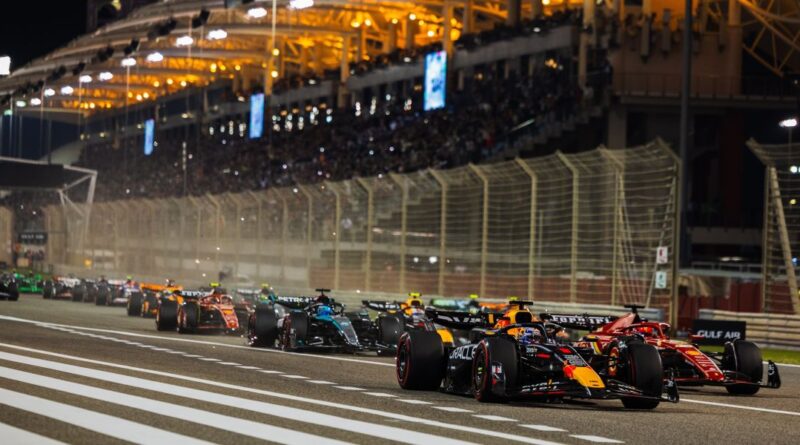
Missiles near the track: F1 catastrophe as Iran strikes Bahrain
Formula 1 says it is closely tracking developments in the Middle East after Iran launched a wave of missile and drone attacks on U.S. military installations across several Gulf states.
According to The Athletic, the strikes included locations in Bahrain, Saudi Arabia, Qatar and the United Arab Emirates, all of which host Formula 1 events. The developments come just weeks before the championship is scheduled to hold back to back races in Bahrain and Saudi Arabia, prompting fresh questions about security planning for teams and personnel.
Iran’s Islamic Revolutionary Guard Corps (IRGC) said the attacks were carried out in response to what Iranian officials described as a joint U.S., Israel offensive earlier that day. The IRGC declared the campaign would continue “relentlessly until the enemy is decisively defeated,” while an Iranian armed forces spokesperson warned that any base supporting the U.S., Israeli operation would be considered a legitimate target.
The Bahrain Grand Prix is set for April 10 to 12, followed by the Saudi Arabian Grand Prix from April 17 to 19.
Read also: McLaren confirm team orders stance for Norris and Piastri ahead of Australian GP
Security focus shifts to Gulf venues
One of the sites reportedly struck, U.S. Naval Forces Central Command, is situated roughly 15-20 miles from the Bahrain International Circuit and about seven miles from Bahrain International Airport, underscoring the proximity of military infrastructure to the race venue.
A spokesperson for Bahrain International Circuit said organizers are maintaining regular communication with Formula 1 as the situation develops. According to The Athletic, the championship has emphasized that its immediate schedule remains unchanged.
The 2026 season opens in Melbourne from March 6 to 8, before heading to China and Japan later in the month. In a statement, Formula 1 emphasized that its next three events are outside the Middle East, distancing the immediate calendar from the escalating tensions.
“Our next three races are in Australia, China and Japan, not in the Middle East, those races are not for a number of weeks,” the statement read. “As always, we closely monitor any situation like this and work closely with relevant authorities.”
Read also: Adama Traore banned in the gym
The response does not really address whether the Bahrain or Saudi Arabian Grands Prix are under active review, nor did it outline any contingency plans for the April rounds. Instead, the messaging focused on the short term schedule, signaling that no immediate changes have been announced.
Pirelli halts Bahrain running
Tyre supplier Pirelli has already adjusted its plans in response to the regional instability. The company cancelled a wet weather development test that had been scheduled for February 28 to March 1 at Bahrain International Circuit.
If Pirelli pulled personnel out, it suggests that, at minimum, their internal risk assessment determined the situation had moved beyond acceptable operational risk. That doesn’t automatically mean the Grand Prix is in danger. But it does mean a key F1 stakeholder judged the environment unstable enough to act.
“The two days of development testing for the wet compounds scheduled for today and tomorrow at the Bahrain circuit have been cancelled for safety reasons, following the evolving international situation,” Pirelli said last week.
Read also: Liverpool eye shock reunion with defender just one year after exit
“All Pirelli personnel currently in Manama are safe in their hotels. The company is working to ensure their continued safety and to arrange their return home as soon as possible.”
Has happend before in 2022
Geopolitical instability has disrupted Formula 1 weekends in the region before. In 2022, the Saudi Arabian Grand Prix was thrown into uncertainty after a Houthi missile struck an oil facility visible from the Jeddah Corniche Circuit. Drivers held emergency discussions with officials before the race ultimately proceeded.
With Bahrain and Saudi Arabia forming a key early segment of the calendar, the sport now faces renewed examinations over how it manages risk in sensitive regions.
Sources: The Athletic
Read also: Arsenal’s secret bonus: Coach cashes in for dead-balls
Read also: Zidane’s GOAT Choices: why he once said a rival was ‘miles better’ than himself