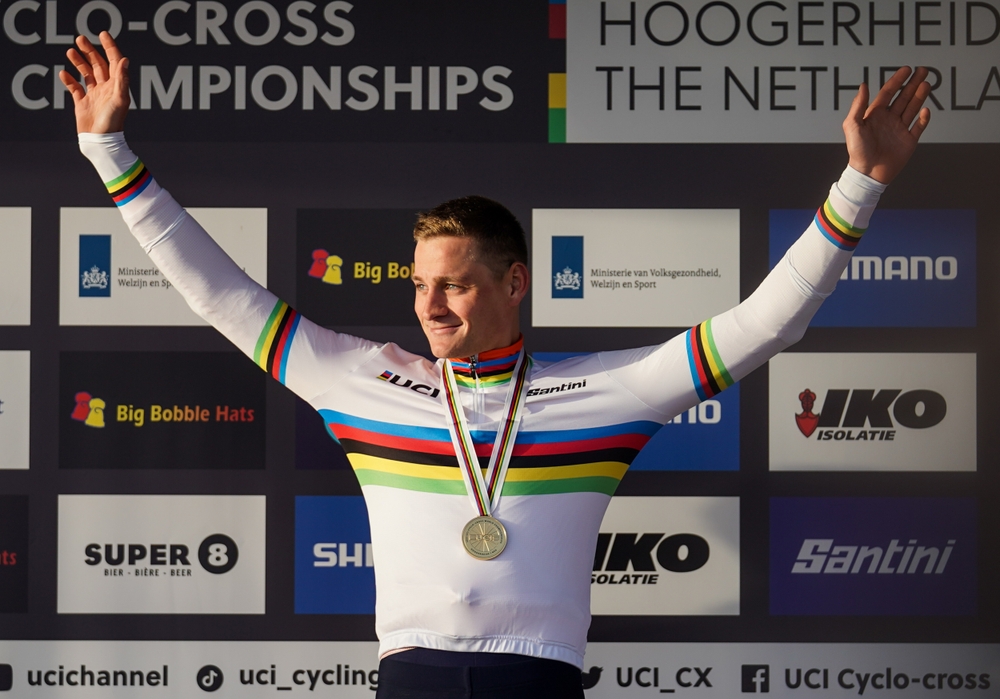
Mathieu van der Poel entered the Arenberg Forest in April as the three-time defending Paris-Roubaix champion and the favourite to make it four in a row. He left it with two flat tyres and a two-minute deficit. By the end of the day in the Roubaix velodrome, Wout van Aert had outsprinted Tadej Pogačar for the win, Jasper Stuyven had taken third, and Van der Poel had rolled over the line in fourth, 15 seconds behind.
That Arenberg sequence has become the hinge of the argument now dividing Belgian cycling media. Michel Wuyts, the veteran analyst and former commentator, wrote in Wieler Revue, rejecting what he sees as a lazy reading of Van der Poel’s year.
“Mathieu was simply the strongest at Paris-Roubaix, but bad luck and some unfortunate decisions in the Arenberg Forest cost him the race,” Wuyts told Wieler Revue.
A monument scoreline without a win
For the first time in several seasons, Van der Poel finished a year without a Monument victory. He was dropped on the Poggio at Milan-San Remo in March and finished in the chase group in eighth. Three weeks later at the Tour of Flanders, Pogačar shook him off on the final ascent of the Oude Kwaremont and rode to a record-equalling third De Ronde. Van der Poel finished second.
Read also: Ten things Xabi Alonso’s Chelsea have shown after 10 Premier League games
Then came Roubaix, and the punctures.
Wuyts’s point is that the result sheet distorts how the race unfolded: Van der Poel had been dropping rivals and closing gaps in the finale before the mechanicals arrived, and he still clawed back time on the lead group on broken rhythm.
Two cobbled wins the mockery ignores
The defence also rests on the one-day races before April. Van der Poel made his debut at Omloop Het Nieuwsblad in February and attacked on the Muur van Geraardsbergen to win the season-opening cobbled classic at the first attempt. Four weeks later, he launched a solo from the Taaienberg with nearly 70 kilometres to go to take a third consecutive E3 Saxo Classic, holding on as the chase closed to within touching distance inside the final kilometre.
Neither is a Monument, but neither is a footnote in a career year either. Wuyts argues the dismissal of 2026 as a failure ignores both the quality of those wins and the identity of the two riders who beat him at the Monuments.
Read also: Barcelona left stunned as Mauricio Pochettino changes Manchester United transfer plans
“You can’t expect Van der Poel to win Flanders or Roubaix every season. Some people have been a bit mocking about his season, especially young journalists. And that bothers me,” he told Wieler Revue.
The racing instinct that will not change
Wuyts framed the other recurring complaint, that Van der Poel attacks too early or refuses to wait on wheels, as a feature rather than a flaw of the rider. The Dutchman is not built to sit in and sprint. That style has delivered the previous three editions of Roubaix and three Tours of Flanders, and on the day the tyres held, it carried him clear of everyone.
The next test of that method is the Classics opener on 28 February 2027 at Omloop Het Nieuwsblad, where Van der Poel will defend the title he took on debut.
Read also: ‘I don’t quite belong’: Ash Barty’s Hall of Fame confession