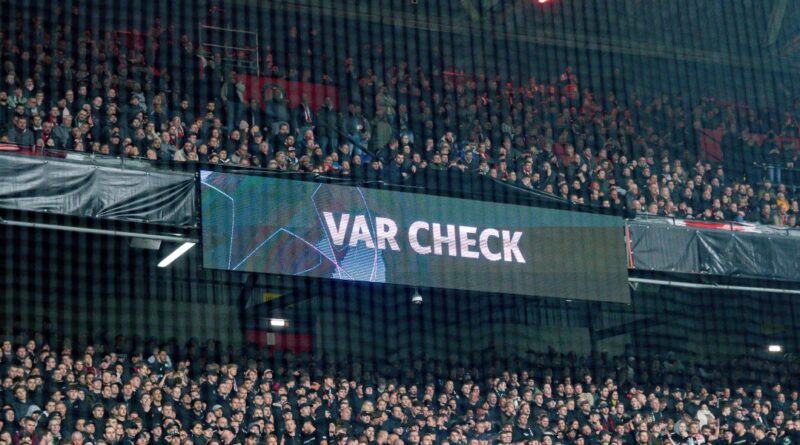
VAR crisis? football launches major rethink of controversial video system
Football’s use of video technology is once again under scrutiny as the sport’s governing bodies prepare to examine how VAR should function in the future.
According to Philip Buckingham’s reporting in The Athletic, the International Football Association Board, IFAB, has begun a formal reassessment of the video review system as debate intensifies across major leagues and competitions.
The move comes almost ten years after VAR was first approved, and officials now want to evaluate how the technology should develop over the next decade of the sport.
A decade of VAR
Speaking after IFAB’s annual general meeting in Cardiff, technical director David Elleray confirmed that football’s lawmakers intend to review the system in depth.
Read also: Appeals court confirms Harry Maguire guilty In Mykonos incident
“We have agreed today that we need to now look, after 10 years, at VAR, Video Assistant Referees,” Elleray said.
“What do we want from VAR in the future? How do we develop it for the benefit of the game?”
According to The Athletic, the review could take up to two years as IFAB examines possible adjustments before future international tournaments, including the FIFA World Cup.
Pierluigi Collina, chairman of the FIFA Referees Committee, acknowledged the frustration surrounding VAR but argued that the system has still brought improvements to refereeing.
Read also: Carrick’s run smashed by last minute Newcastle blow
“In Italy, we say that in every wonderful marriage, there is a crisis after seven years,” Collina said.
“So it might be possible that people fell in love with VAR, and then after some years, as with your wife, you have a small crisis.”
From innovation to controversy
VAR was officially approved by IFAB in 2016 and introduced widely after its use at the 2018 FIFA World Cup in Russia.
At the time, FIFA President Gianni Infantino described the decision as a historic moment for the sport.
Read also: Messi’s Inter Miami visit to White House raises questions
According to figures cited in The Athletic, refereeing accuracy during that tournament increased from roughly 95 percent to 99.2 percent.
Supporters of the system say it has helped correct obvious mistakes and deter dangerous challenges because players know their actions can be reviewed after the fact.
Former Premier League referee Graham Scott told The Athletic that VAR has quietly influenced player behaviour.
“It clears up clear, factual errors, which would ordinarily sit very uncomfortably with people,” Scott said.
Read also: Expert warns Gulf Grand Prix races may be cancelled
Fans losing patience
Despite those advantages, VAR continues to divide opinion throughout Europe’s major leagues.
Supporters regularly complain about long delays during reviews, extremely tight offside decisions and limited communication from referees during the process.
According to reporting by The Athletic, protests have appeared in Germany’s Bundesliga, where fans have displayed banners criticizing the technology during matches.
Managers have also expressed frustration. Burnley manager Scott Parker criticised VAR after two marginal offside decisions ruled out goals during his team’s 4,3 defeat to Brentford earlier this season.
Read also: Favourites to win the 2025/26 PFA Premier League Player of the Season
“I think football is better without VAR,” Parker said after the match.
New ideas being tested
Rather than scrapping the system entirely, football authorities are examining ways to improve how video reviews are used.
One proposal being tested is called Video Football Support, a system that would allow coaches to challenge certain decisions rather than relying on constant monitoring from off-field officials.
According to The Athletic, the model gives teams a limited number of challenges to trigger a video review, similar to systems used in sports such as Basketball and Rugby League.
However, IFAB officials remain cautious about introducing the concept more broadly.
They warn that too many challenges could slow matches and potentially leave serious errors uncorrected if teams have already used all of their appeals.
Football searches for the right balance
As the debate continues, football’s leaders appear focused on reforming VAR rather than removing it completely.
According to The Athletic, officials believe the technology still provides important safeguards against clear refereeing mistakes, even if its use remains controversial.
The upcoming review is expected to examine how the system can operate faster, communicate decisions more clearly and avoid the types of marginal calls that frustrate supporters.
Nearly a decade after its introduction, VAR remains one of the sport’s most divisive innovations, and the next round of discussions could shape how refereeing technology is used across Football for years to come.
Sources: The Athletic