A short pause with a high price
The World Cup has always been more than a football tournament. This year, across the United States, Canada and Mexico, even the pauses in play have become part of the commercial story.
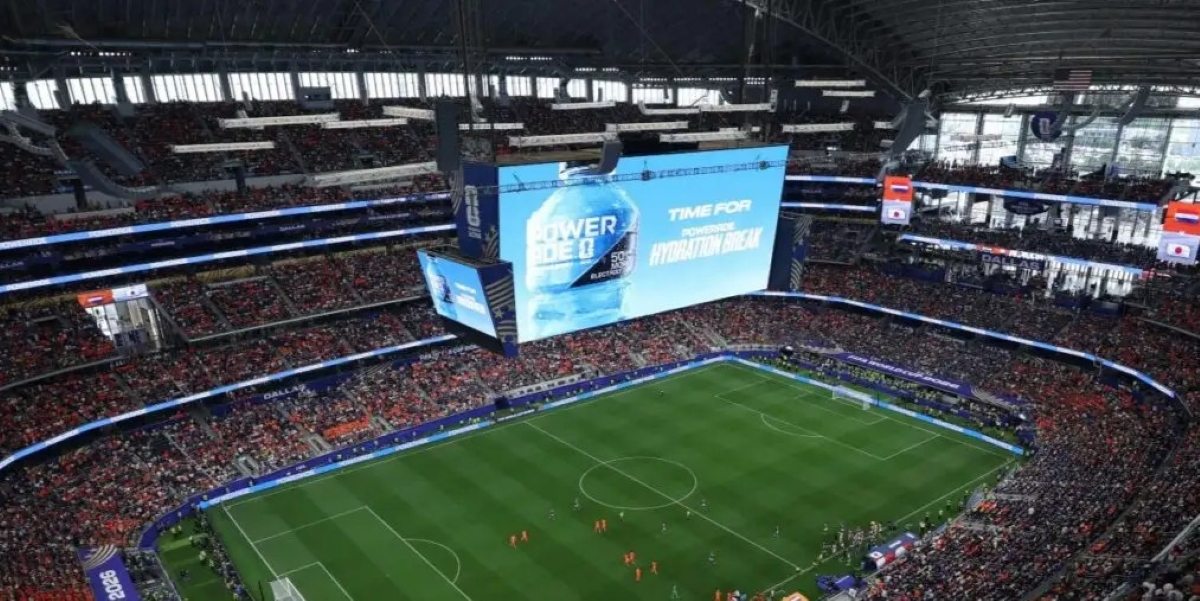
For the first time at a World Cup, FIFA has introduced three-minute hydration breaks in each half of all 104 matches. The stated purpose is player welfare, with the tournament being played in summer conditions across North America. But the stoppages have also opened a rare window for broadcasters: a chance to sell advertising during a sport that is normally built around uninterrupted play.
According to a Reuters report syndicated by WKZO, the breaks could become a valuable new source of revenue for television networks, particularly in markets where viewers are already used to commercial interruptions during live sport.
Player welfare meets broadcast business
Hydration breaks are not new to football. They were first used at a World Cup during the Netherlands’ match against Mexico in Brazil in 2014, when temperatures rose above 32 degrees Celsius. Until now, however, they were usually applied on a match-by-match basis.
Read also: "You could hear the bone snap": Jesse Marsch provides update on Ismael Kone's condition
This tournament is different. Every match has the same built-in stoppages, regardless of venue or temperature. That gives broadcasters a predictable slot in both halves, something football has traditionally avoided.
The issue was also highlighted by DR Sporten’s live World Cup coverage, where the commercial value of the breaks was treated as a notable subplot of the tournament.
For advertisers, the attraction is obvious. A World Cup audience is vast, emotionally invested and difficult to reach at this scale in any other setting. The 2022 final between Argentina and France reached a cumulative global audience of 1.42 billion viewers. Even a short mid-match break can therefore carry significant value.
The Super Bowl comparison
The most striking estimate comes from Michael Johnson, a research analyst covering the U.S. sports industry for S&P Global. He told Reuters that the new hydration breaks could be “extremely valuable” and could “potentially command those Super Bowl-level prices within that seven to probably nine-million-dollar range.”
Read also: World Cup standouts Jonathan David and Johan Manzambi ignite Premier League transfer speculation
That does not mean every short ad during every water break has been sold for that amount. It is an analyst’s estimate of the potential value of the inventory. Still, the comparison shows how much commercial weight these breaks may carry.
Johnson also pointed to the North American sports model as part of the explanation.
“U.S. viewers are used to the NFL-style model, NBA-style model, four quarters. They’re used to in-game breaks. This World Cup is essentially a mirror to those style models,” he said.
A harder sell in Europe
The same idea may be less welcome in traditional football markets. In much of Europe, fans are accustomed to advertising before the match, at half-time and after the final whistle, not during the game itself.
Read also: Gaza bodybuilder: "They took my leg, but they did not take my dream"
That difference could make the breaks controversial. Football’s appeal has long rested on its rhythm, with two halves of largely continuous play. More scheduled interruptions risk changing how the match feels, especially for viewers who already complain about delays caused by VAR.
Johnson warned that the model could irritate supporters.
“Football is known for continuous play. Purists are worried about how this Americanises the game. More ads could annoy fans, especially if they feel intrusive or excessive,” he said.
In the United Kingdom, ITV has said it will not show adverts during the hydration breaks because of advertising rules and viewer expectations.
Read also: Clark surges clear as Shinnecock bites back
A glimpse of football’s commercial future
The debate over World Cup water breaks is about more than a few minutes of television time. It shows how every part of the modern game is now viewed through a commercial lens.
FIFA’s expanded 48-team tournament already means more matches, more broadcast hours and more sponsor exposure. The hydration breaks add another layer: officially designed for player safety, but also highly attractive to broadcasters and advertisers.
That tension is unlikely to disappear. If the breaks prove commercially successful, future tournaments and domestic leagues may face pressure to find similar windows.
For now, the World Cup has given advertisers something football has rarely offered: a guaranteed pause in the middle of the action, with the whole world still watching.
Read also: AI predicts 2026 World Cup Golden Boot race