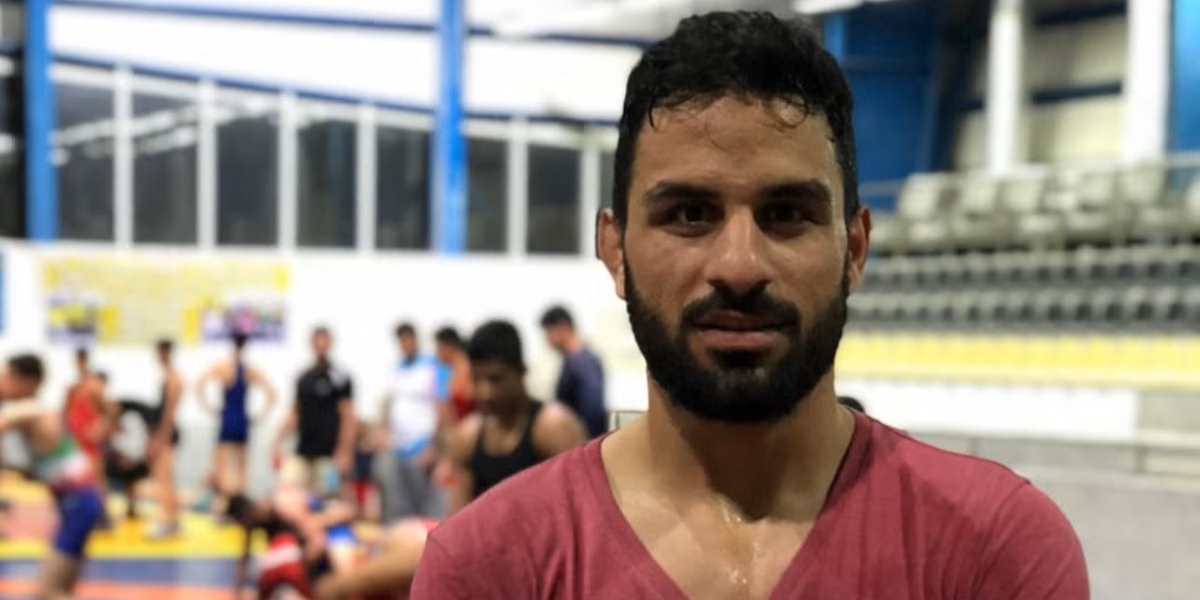
Navid Afkari was only 27 when he was executed in Iran.
To the Iranian authorities, he was a convicted murderer. To many human-rights groups, athletes and campaigners around the world, he became a symbol of something far larger: the fear that sport, protest and political repression had collided inside Iran’s justice system.
His case still carries weight years later, not only because of the execution itself, but because of the questions that surrounded it.
A wrestler caught in a political storm
Afkari was a Greco-Roman wrestler from Shiraz, in southern Iran. He had competed in national events and had been involved in the sport since childhood.
Read also: Zlatan Ibrahimovic names the best player in the world at 2026 World Cup
He was arrested in September 2018, after anti-government protests had taken place in Iran earlier that year. Iranian authorities accused him of killing Hasan Turkman, a security guard connected to a water and sewage company in Shiraz.
According to Human Rights Watch, Afkari and his brothers faced several charges, including participation in illegal demonstrations, insulting Iran’s supreme leader and murder.
Iranian state-linked sources denied that the case was connected to the protests. But outside Iran, Afkari’s prosecution was widely discussed in that political context.
Claims of torture and forced confession
Afkari initially confessed to the killing, but later withdrew the confession.
Read also: Kane passes Lineker to claim England World Cup record
He said it had been obtained under torture. His family also said he had been abused in custody, while his lawyer argued that there was no reliable evidence linking him to the killing.
The case drew particular concern because of the alleged use of confession evidence.
Amnesty International described Afkari’s execution as a “travesty of justice” and said he had been subjected to torture, enforced disappearance and denial of fair-trial guarantees.
Before his death, a recording from prison was released in which Afkari maintained his innocence.
Read also: Pele and Maradona's candid 2016 chat about Lionel Messi's leadership
“If I am executed, I want you to know that an innocent person, even though he tried and fought with all his strength to be heard, was executed,” he said.
Iran’s judiciary denied the torture allegations, and Iranian state media broadcast what it said was his confession.
Global appeals came too late
The case caused an international outcry before the execution was carried out.
Then-U.S. president Donald Trump publicly urged Iran not to execute Afkari. UFC president Dana White and several athletes also appealed for clemency.
Read also: Dallas police surprise Norway with fan tribute before World Cup clash
The International Olympic Committee said its president, Thomas Bach, had made direct personal appeals to Iran’s supreme leader and president, asking for mercy.
Those efforts failed.
Afkari was executed on September 12, 2020, at Adel-Abad prison in Shiraz.
The IOC said after his death that it was “shocked” by the announcement.
Read also: Rashford vs Anthony Gordan: Barcelona might be choosing the wrong guy
Brothers also sentenced
Afkari was not the only member of his family punished in the case.
His brothers Vahid and Habib Afkari were also sentenced to long prison terms in connection with the same proceedings. Reports from human-rights groups said Vahid received a 54-year sentence, while Habib received 27 years.
Their case added to the anger surrounding the execution, with campaigners arguing that the family had been subjected to pressure and punishment far beyond Navid himself.
The Iranian authorities maintained that the case was handled through the courts.
A case that never disappeared
Afkari’s execution did not end the debate.
Human-rights organisations continued to raise concerns about the use of forced confessions in Iran. His name also became a reference point in later campaigns involving Iranian athletes, protesters and political prisoners.
For many in world sport, his death exposed a difficult question: how should international federations respond when athletes are caught in political repression?
Afkari was not a global superstar in the way many famous athletes are. But his case reached far beyond wrestling.
He became a symbol of a young athlete whose final fight was not on the mat, but against a justice system that many outside Iran believed had failed him.