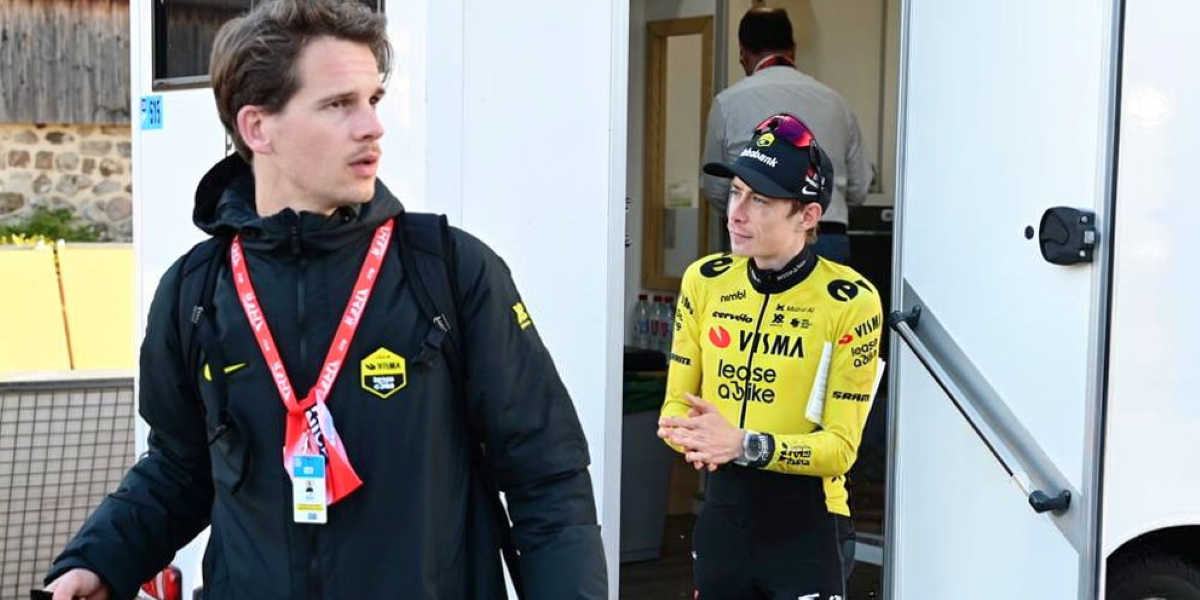
Anti-doping authorities are supposed to protect the credibility of the Tour de France. In the early hours of Sunday morning, however, their methods created a new concern over the welfare of the riders they are testing.
Jonas Vingegaard was woken at approximately 2am before Stage 15, while race leader Tadej Pogačar received a similar visit three hours later.
Both riders were required to complete unexpected anti-doping controls during the period normally reserved for their most important recovery.
Later that same day, Vingegaard crashed and suffered the broken collarbone that ended his Tour. There is no evidence that the disrupted night caused the accident, but the sequence of events has intensified the debate over whether night-time testing creates an unnecessary performance and safety risk.
Read also: Abu Dhabi United Group financed them for years
Forty minutes taken from the night
Vingegaard was asleep when officials knocked on his hotel-room door.
According to Cyclingnews’ account of the overnight controls, the Dane said:
“I think it took me about 40 minutes before I was back in my room.”
That distinction matters. It has not been confirmed that the collection procedure itself lasted exactly 40 minutes, nor that Vingegaard immediately returned to sleep afterwards. What is established is that almost three-quarters of an hour passed before he was back in his room.
Read also: Dana White on ownership of new Las Vegas NBA Team: “YES”
Pogačar said he slept for only around four hours and was unable to fall asleep again after his own test at 5am. Rather than returning to bed, he listened to music and made coffee before preparing for the stage.
For an ordinary person, one interrupted night may be an inconvenience. During the third week of a Grand Tour, it interferes with the narrow window in which the body must recover from repeated days of extreme physical stress.
Recovery is part of performance
Sleep does not merely make riders feel fresher. It supports physical repair while also helping to maintain concentration, reaction speed and decision-making.
Those cognitive functions matter in professional cycling, where riders move through crowded groups, descend at high speed and make rapid decisions about wheels, corners and road furniture.
Read also: Aymeric Laporte exposes ugly side of Pep Guardiola relationship
A disturbed night does not automatically produce a visible collapse in performance. Pogačar still finished among the strongest riders on the final climb, despite sleeping for only a few hours.
That does not prove the interruption was harmless. The effects of reduced sleep vary considerably between individuals, and elite athletes may be able to compensate for fatigue in one area while becoming marginally less precise in another.
At Tour level, those margins are significant. A slightly slower response or a momentary lapse in attention may matter more on a technical descent or at a roundabout than it does during a controlled climbing effort.
The crash cannot be blamed on the test
Vingegaard crashed as the peloton negotiated the exit from a roundabout later on Stage 15. He broke his collarbone and was forced to abandon the race.
Read also: Manchester City face new panel that could reopen the 115-charge verdict
Pogačar suggested afterwards that the disturbed sleep could have contributed by a small percentage. That remains speculation rather than evidence.
Vingegaard himself stopped short of drawing a connection between the two events. Crashes are common in cycling and can be caused by positioning, road design, speed, contact between riders or movements by race vehicles.
A responsible analysis must therefore separate two arguments.
It cannot be claimed that the 2am control caused Vingegaard’s crash. It is reasonable, however, to ask whether intentionally interrupting a rider’s sleep increases avoidable risk before a stage involving high speeds and technical roads.
Read also: UK Tax-service (HMRC) is coming after Manchester City now
The absence of proof in this particular accident does not remove the broader welfare question.
The tests required judicial approval
The controls were not routine hotel visits conducted at the discretion of individual testers.
As reported by The Guardian in its account of the legal authorisation, the International Testing Agency applied to a specialist Paris judge for permission to conduct the tests during the night of July 18 and 19. The request was approved.
Under the UCI’s rules, riders are not normally tested between 11pm and 6am unless they have selected a testing window during those hours, consented to the control or authorities possess a serious and specific suspicion of possible doping activity.
That legal threshold makes the controls more significant than ordinary random testing. It does not establish that either Vingegaard or Pogačar committed an offence, and neither rider has been publicly accused of an anti-doping violation.
The authorities have not disclosed the intelligence or circumstances behind the request. That secrecy may be necessary to protect an investigation, but it also makes it difficult to assess whether the disruption was proportionate.
ITA defends the timing
The International Testing Agency has acknowledged that night-time controls can interfere with rest and recovery.
According to Cycling Weekly’s report on the agency’s response, the ITA said:
“Effective testing must, in limited and justified circumstances, be capable to occur outside standard daytime hours.”
The agency said the controls were conducted in accordance with the World Anti-Doping Code, UCI regulations and French law, with consideration given to rider welfare and fundamental rights.
The sporting argument is clear. Some prohibited substances can be used in small doses and may only remain detectable for a limited period. Restricting every control to predictable daytime hours could create an exploitable window for cheating.
Former professional Jonathan Vaughters, who has admitted doping during his own career, argued that 2am testing is an effective weapon against the microdosing of substances including EPO, growth hormone and testosterone.
Cycling’s history makes that argument difficult to dismiss.
Clean sport still requires proportionality
The choice should not be reduced to unrestricted night testing or weak anti-doping enforcement.
Authorities can retain the power to conduct such controls while imposing a much higher operational threshold during Grand Tours. A night test before a mountain stage should be used only when the timing is essential to the effectiveness of the control, not simply because it is permitted.
The system also needs greater accountability. Once an investigation has concluded, authorities should explain as much as legally possible about why an overnight intervention was considered necessary.
Without that transparency, riders are asked to accept a considerable intrusion into their recovery while the public is given little basis on which to judge whether it was proportionate.
The Tour cannot protect its credibility without serious anti-doping work. It also cannot treat sleep as an expendable part of a rider’s schedule.
Vingegaard and Pogačar accept that they must be tested. The unresolved question is whether proving they are clean should require them to compete after authorities have deliberately taken away part of the night they depend on to recover.