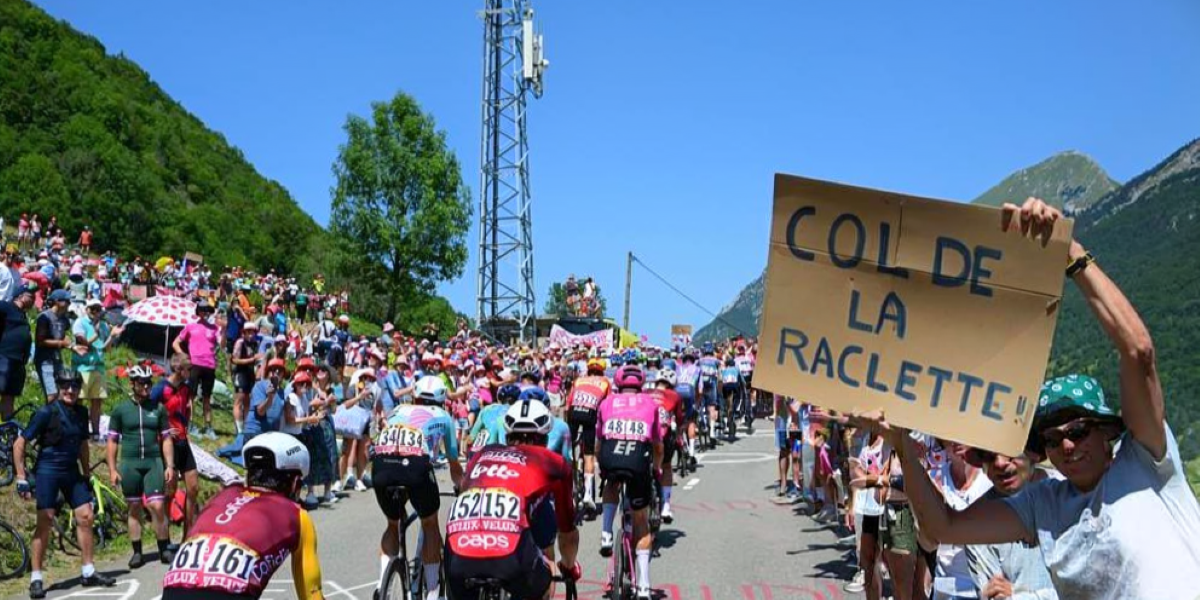
The road leading from Bourg d’Oisans to Alpe d’Huez has been closed to ascending traffic after the number of spectators arriving on the mountain exceeded expectations.
The Isère prefecture brought the closure of the RD211 into force at 14:00 on Thursday, July 23. The restriction is scheduled to remain in place until midnight at the beginning of Sunday, July 26.
“Because of the very heavy attendance, the ascent of Alpe d’Huez on the RD211 has been closed to all vehicles since 2 p.m. on Thursday,” the prefecture said, according to Le Parisien’s report on the emergency measure.
Authorities act as fans flood the mountain
Drivers had initially been permitted to reach the resort until later on Thursday, but the volume of traffic forced officials to close the ascent early.
Read also: Uruguayan football rocked as former Peñarol striker dies aged 22
The road remained open for vehicles travelling down from Alpe d’Huez until 22:00 on Thursday. A separate evacuation period was also planned between 20:00 on Friday and 01:00 on Saturday following stage 19.
The closure is not the only restriction facing spectators. Access on foot or by bicycle is also subject to specific security periods during the stages, meaning supporters cannot assume that the road will remain continuously open simply because they are not travelling by car.
Official traffic regulations give police the power to change the restrictions at short notice depending on crowd levels, safety concerns and the progress of the race.
Tour doubles down on its most famous mountain
The extraordinary number of supporters can largely be explained by the Tour’s decision to finish two consecutive stages at Alpe d’Huez.
Read also: Serena reveals the truth behind her weight loss
Friday’s stage 19 takes the riders 127.9 kilometres from Gap to the summit. The decisive finale uses the traditional road from Bourg d’Oisans, taking the peloton through the climb’s famous numbered bends before the finish at 1,850 metres.
According to the Tour de France’s official stage profile, the mountain stage includes approximately 3,500 metres of climbing and is expected to finish shortly after 17:20.
The riders return to Alpe d’Huez only 24 hours later. Saturday’s stage 20 begins in Bourg d’Oisans but takes a punishing 170.9-kilometre detour through the Alps.
The route includes the Col de la Croix de Fer, Col du Télégraphe, Col du Galibier and Col de Sarenne before reaching Alpe d’Huez from the opposite side. The official stage 20 route features around 5,450 metres of climbing, making it one of the hardest days of the race.
Read also: Tom Brady for president? NFL icon’s growing profile fuels unlikely theory
Spectators face a gruelling final journey
The restrictions have created a difficult logistical situation for supporters who had hoped to drive close to the course.
Many fans traditionally arrive several days before the Tour and sleep in camper vans or tents beside the mountain road. Those who had not reached the climb before the closure must now follow the alternative access instructions issued by local authorities.
Special arrangements have been introduced for residents, holidaymakers and people working at the resort. According to the Isère prefecture’s official access information, three cable-car services from Allemond are being used to transport eligible workers to Alpe d’Huez during the disruption.
The authorities have advised spectators to follow police instructions and check the latest restrictions before attempting to approach the mountain.
Read also: AGF warn supporters of five-year prison risk before Poland trip
The 21 bends prepare for another wall of noise
Alpe d’Huez remains one of the most recognisable climbs in professional cycling.
The traditional ascent covers approximately 13.8 kilometres at an average gradient of 7.9 per cent. Its 21 numbered hairpin bends have become synonymous with the Tour, with enormous crowds often leaving only a narrow passage for the riders.
According to Alpe d’Huez tourism’s guide to the legendary climb, the route rises by more than 1,100 metres between Bourg d’Oisans and the resort.
The decision to close the road underlines the scale of the crowds already in place. It also offers an early warning of the atmosphere awaiting the peloton when the race reaches the mountain.
Read also: Lidl-Trek’s double threat gathers momentum before Alpine showdown
Two finishes, thousands of spectators and one of cycling’s most confined roads have created a security challenge before the first rider has even reached the opening bend.