Rudi Völler has admitted that he came close to leaving his position as sporting director of the German Football Association following the national team’s disappointing 2026 World Cup campaign.
Germany travelled to North America hoping to repair the damage caused by their early exits at the previous two tournaments. Instead, the four-time world champions were eliminated by Paraguay on penalties in the round of 32.
The result prompted Julian Nagelsmann to resign as head coach and led to another period of intense reflection within German football.
Völler has now revealed that he also considered walking away.
Read also: Messi admitted he targeted one World Cup rival on purpose
Völler questioned whether he should continue
Speaking at the International Coaches Congress in Mainz, the 66-year-old acknowledged that Germany’s latest failure had left him unsure whether he remained the right person to oversee the national team’s sporting direction.
According to a report from German news agency DPA published by Welt, Völler said:
“I wondered whether it still made sense to continue after this World Cup, and I wavered. I was close.”
The defeat represented Germany’s third consecutive disappointing World Cup. They were eliminated in the group stage in both 2018 and 2022 before losing in the first knockout round in 2026.
Read also: Cristiano Ronaldo crisis forces Portugal chief into emergency action
Völler accepted that his own position had to be evaluated alongside those of Nagelsmann and the rest of the DFB’s sporting leadership.
Klopp’s intervention proved decisive
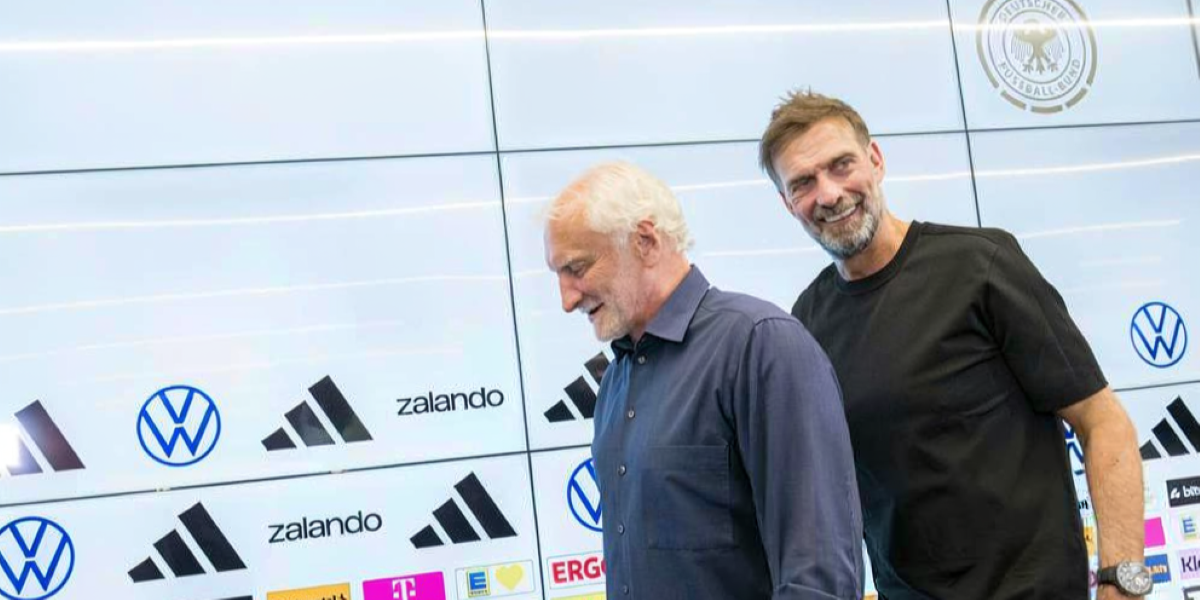
One of the most influential figures in Völler’s decision to remain was Jürgen Klopp.
The former Liverpool and Borussia Dortmund manager spoke directly with Völler during the DFB’s search for Nagelsmann’s successor and made it clear that he wanted the experienced sporting director to remain part of the organisation.
“Jürgen has an enormous résumé. When he says you have to stay, that naturally makes me happy,” Völler said. “I will support him in my own way.”
Read also: Harry Kane breaks silence on Man City verdict
Völler also received backing from DFB president Bernd Neuendorf, vice-president Hans-Joachim Watzke and several senior figures in German football.
He subsequently confirmed that he would fulfil his contract, which runs until the end of Euro 2028. He has made clear, however, that he intends to step down after that tournament.
Klopp begins major rebuilding project
Klopp was formally appointed as Germany’s new national coach on July 24 and will begin work on August 15.
As the DFB described in its official announcement, the 59-year-old signed a four-year contract covering Euro 2028 and the 2030 World Cup.
Read also: Phil Taylor comes out of retirement for stunning darts return
He will be assisted by long-time colleagues Peter Krawietz and Pepijn Lijnders, while former Germany international Sven Bender has also joined the coaching staff.
Klopp arrives with one of the strongest managerial records in European football. He won two Bundesliga titles with Borussia Dortmund before guiding Liverpool to the Champions League, Premier League, FA Cup and League Cup.
For the DFB, his appointment represents an attempt to restore both sporting credibility and public enthusiasm around the national team.
Völler believes Klopp can reconnect Germany
Völler said Klopp’s personality and ability to inspire supporters were central to the decision to appoint him.
Read also: ‘If you lie to me, I will leave’: Guardiola’s City warning takes on new weight
“We need to give people in Germany a certain confidence over the next two years,” Völler said. “He can do that with his personality. He has already set the country alight.”
The former Germany striker also praised Klopp’s ability to connect with players and supporters during difficult periods.
“Besides his football expertise, his great strength is his ability to inspire people,” he said.
Völler expects to take a less prominent role under Klopp, offering advice on the administrative and political demands that accompany the national-team position rather than becoming involved in tactical decisions.
Germany searching for a new identity
Germany have struggled to recover the authority that carried them to the World Cup title in 2014.
Their 2018 title defence ended in the group stage, while another early departure followed in Qatar four years later. The defeat to Paraguay in 2026 extended the country’s run without a World Cup knockout victory.
According to the DFB’s response to the elimination, Neuendorf acknowledged that the team had failed to meet both its own expectations and those of the German public.
Völler believes the rebuilding process must begin with greater resilience and stronger defensive performances.
“We have to inspire the masses again and do better at the next European Championship,” he said.
For Völler, that mission was almost left to somebody else. Klopp’s arrival, however, persuaded him that one final attempt to revive German football was worth making.