FIFA moves with extraordinary speed
The World Cup could expand from 48 to 64 teams as early as 2030, with FIFA accelerating its examination of the controversial proposal. Such a move would add another 16 countries only four years after the tournament completed its first edition under the expanded 48-team format.
Research companies have been invited to submit proposals by August 7, with FIFA planning to select an independent agency on August 14. The successful bidder will then have just four weeks to complete its assessment and deliver a final report by September 11.
According to The Guardian’s report, FIFA’s research brief states that the organisation is “considering the strategic implications of a possible expansion of the FIFA World Cup beyond the current format”. Member associations were reportedly not informed about the tender before it was issued.
September 11 is not a confirmed vote date
The accelerated timetable indicates that FIFA could make a decision before the end of 2026. However, the original claim that member associations are expected to decide the matter on September 11 is not supported by the available documents.
Read also: ‘They completely destroyed me’: Lolo Jones accuses Team USA of risking paralysis
September 11 is the deadline for the independent agency to submit its findings. FIFA has not publicly confirmed that a vote will take place that day, nor has it announced precisely which body would make the final decision or when formal approval would be sought.
The report is expected to inform later discussions within FIFA’s committees and governing bodies. Any claim that the 64-team format has already been approved, or that a final vote has been formally scheduled, would therefore be premature.
Another expansion after only one tournament
The men’s World Cup featured 32 countries from 1998 until 2022. That structure was replaced by a 48-team competition in 2026, producing a larger group stage, a new round of 32 and a total of 104 matches.
A move to 64 teams in 2030 would give the 48-team experiment a lifespan of just one tournament. FIFA has not yet revealed how the additional teams would be divided into groups, how many matches would be required or how long the competition would last.
Read also: The brutal A$6.9m twist behind the Matildas’ historic World Cup run
The lack of a published format makes it impossible to determine the full effect on stadium requirements, travel and recovery periods. It also leaves national associations without a clear picture of how qualification places would be distributed among the six continental confederations.
South America could receive a much bigger role
The 2030 World Cup is currently scheduled to be staged primarily in Morocco, Portugal and Spain. Uruguay, Argentina and Paraguay will each host one centenary celebration match to mark 100 years since the inaugural tournament was held in Uruguay.
As described in FIFA’s official hosting plan, the three South American fixtures will take place several days before the main opening matches in Europe and Africa. The teams involved will then travel across the Atlantic to continue their campaigns.
A 64-team competition could give the South American hosts a much larger part in the tournament. The Guardian reported that the expansion could allow Uruguay, Argentina and Paraguay to stage an entire group each rather than a single ceremonial fixture, although FIFA has not confirmed such an arrangement.
Read also: ‘Money has no smell’: Saudi Arabia’s $75m esports spectacle takes over Paris
UEFA and Concacaf push back
The proposal has been promoted by South American football body CONMEBOL, whose president, Alejandro Domínguez, renewed the campaign after the 2026 final. Supporters believe a one-off expansion would provide a fitting global celebration of the World Cup’s centenary.
UEFA and Concacaf have opposed another increase, arguing that the tournament has already become large enough. UEFA president Aleksander Čeferin previously called the 64-team proposal “a bad idea”, warning that it could weaken qualification and reduce the value of reaching the finals.
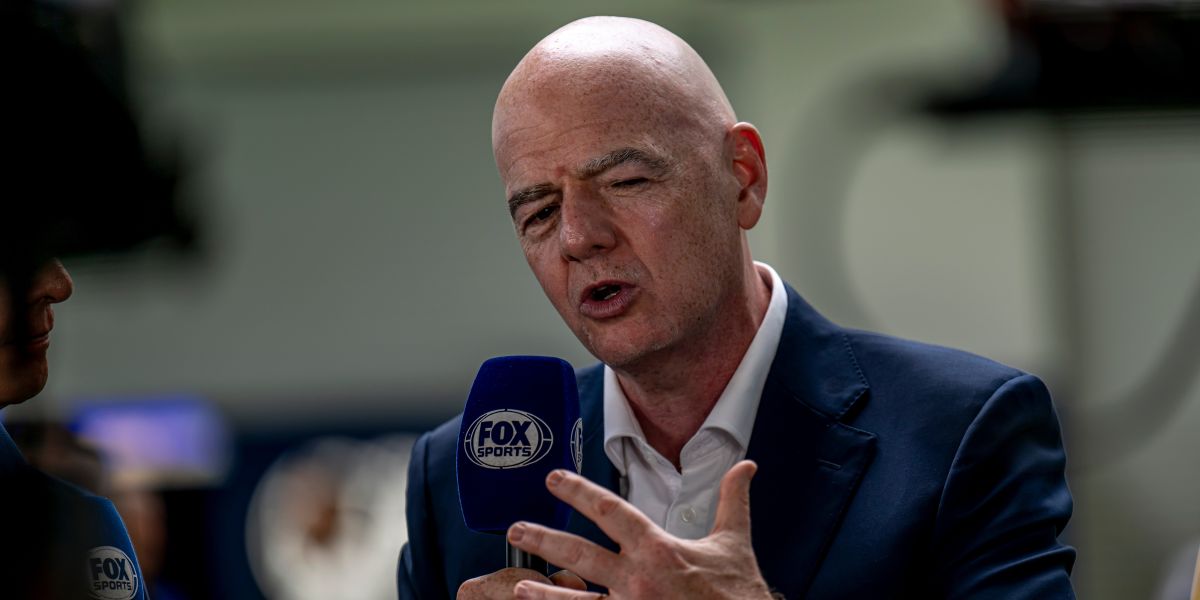
Gianni Infantino nevertheless confirmed that the matter would remain under consideration. The FIFA president said it was “an issue that will be looked at and discussed in the relevant committees after this World Cup”, as quoted by ESPN.
Money will be weighed against player welfare
FIFA has asked the selected agency to estimate the additional income a 64-team tournament could generate through ticket sales, sponsorship agreements and broadcasting rights. The research will also examine how the proposal could be received by national associations, confederations, players, clubs and commercial partners.
Read also: “Why are they using it?”: Chelsea fans fear injury nightmare on battered Sydney pitch
Financial growth is only one part of the assignment. The study must also consider player welfare, the international calendar, tournament quality and the overall integrity of the competition.
Those questions are especially significant because leading players already face demanding domestic and international schedules. Adding more teams could create new commercial opportunities, but it could also require more matches, additional venues and an increasingly complicated qualification structure.
Expansion arrives during a wider FIFA crisis
The 64-team proposal has emerged during an increasingly turbulent period for FIFA. Infantino is already facing resistance over a separate plan to place the organisation’s commercial rights into a new company and sell a minority stake to private investors.
UEFA’s member associations have threatened to boycott FIFA competitions unless that proposal is withdrawn. Concacaf and the Asian Football Confederation have also expressed concerns about the process, transparency and the apparent lack of consultation with major stakeholders.
Read also: Nine records gone in 48 hours as swimmers tear up Games history
According to the Associated Press, the private investment dispute has created one of the most serious challenges to Infantino’s leadership. Launching an accelerated World Cup expansion review during the same week is likely to intensify questions about how FIFA reaches decisions capable of transforming global football.
Four weeks to examine football’s biggest transformation
No final decision has been made, and the 2030 World Cup remains officially planned as a 48-team tournament. The new tender proves, however, that the 64-team proposal has moved beyond an informal suggestion and entered a structured FIFA assessment.
The selected agency will have until September 11 to examine the sporting, financial and political consequences. Given the scale of the decision, critics are likely to question whether four weeks can provide anything approaching a complete evaluation.
If FIFA ultimately approves the expansion, the World Cup will have doubled from 32 to 64 teams in only eight years. A competition that remained broadly unchanged for more than two decades could therefore be transformed twice before football has had time to fully assess the consequences of the first expansion.