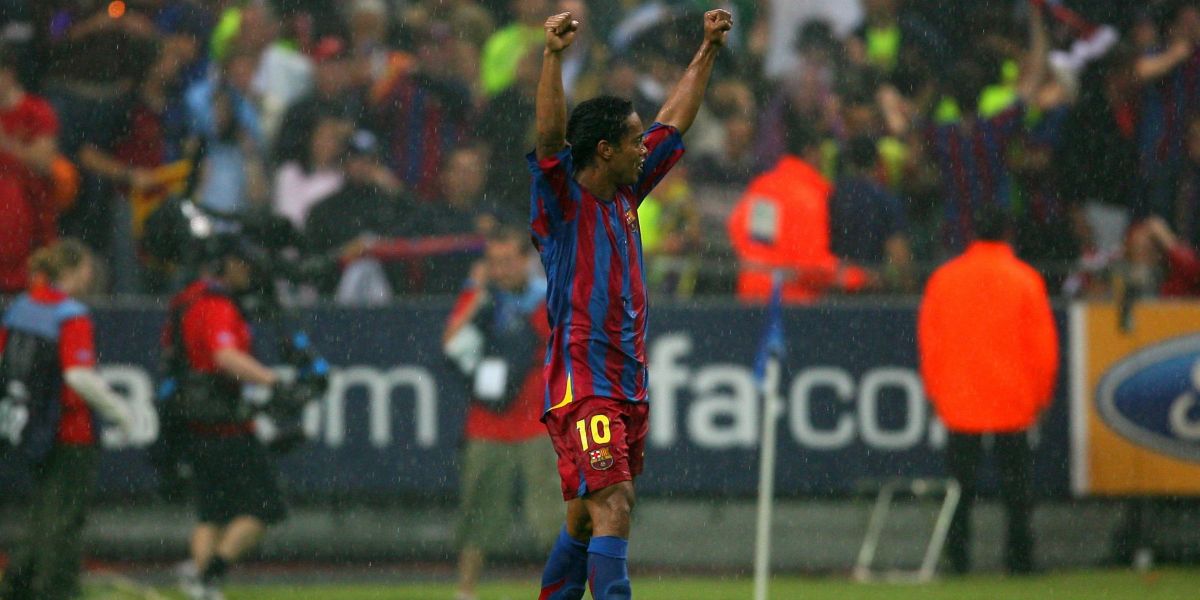
How much would Ronaldinho cost if the player who transformed Barcelona in the mid-2000s suddenly appeared in today’s transfer market? A recent Instagram discussion produced estimates ranging from “at least 200M” and “500 million euros” to an extraordinary “1 billion”. Another supporter offered a different answer entirely, arguing that “he could be priceless”.
There can be no definitive figure because transfer fees are shaped by contract length, the selling club’s financial position, the number of interested buyers and whether the player wants to leave. Ronaldinho’s ability alone would not determine the price. Even so, comparisons with the most valuable players in 2026 suggest that €200 million would probably be the beginning of the conversation rather than the end.
The €30 million signing who changed Barcelona
Ronaldinho joined Barcelona from Paris Saint-Germain in July 2003, shortly after turning 23. According to Barcelona’s official account of the transfer, the Catalan club paid €25 million and agreed to another €5 million in variables, while beating competition from Manchester United and Real Madrid. He signed a five-year contract and became Barcelona’s record acquisition at the time.
That fee may now appear modest, but it was not a bargain-bin transaction in its original context. Ronaldinho had already helped Brazil win the 2002 World Cup and had emerged as one of Europe’s most exciting attacking players. Barcelona were investing in a potential global superstar before he had reached the most dominant period of his career.
Read also: LeBron’s $900 million Saudi bombshell collapses under fact-check
A simple inflation calculation would not explain what he would cost now. The financial strength of leading clubs, broadcasting income, commercial revenues and the use of long contracts have changed football’s economy far more dramatically than ordinary consumer-price inflation. The real question is not what €30 million from 2003 is worth today, but how the current market prices a 25-year-old who is already considered the best footballer in the world.
At his peak, Ronaldinho had almost everything
Ronaldinho’s strongest case begins with what he had achieved by the age of 25. According to UEFA’s report on the 2005 Ballon d’Or, he won the award ahead of Frank Lampard and Steven Gerrard after receiving 225 points in the voting. He was not merely a popular entertainer, but the officially recognised leading player of his generation.
His individual record was even stronger when the entire period is considered. As described by FIFA’s retrospective on Ronaldinho at his peak, he was named FIFA World Player of the Year in both 2004 and 2005 before winning the Champions League with Barcelona in 2006. He had also won the World Cup with Brazil and was the central figure in a Barcelona side that claimed consecutive Spanish league titles.
Those achievements would place him in an exceptionally strong negotiating position today. Clubs frequently pay nine-figure fees for players who may eventually reach that level. Ronaldinho had already reached it, while still being young enough to offer several more seasons at his expected peak.
Read also: Pogacar returns to where it began as Vuelta bid opens door to history
The modern market points beyond Neymar’s record
The most useful comparison is not necessarily another completed transfer, but the estimated value of today’s leading players. According to the CIES Football Observatory’s valuations updated on June 30, 2026, Lamine Yamal is valued at between €316 million and €368 million, Erling Haaland at €208 million to €242 million and Kylian Mbappé at €157 million to €183 million. The model calculates theoretical fair prices rather than confirmed offers, but it demonstrates how highly the market can value an elite player with age and contract length on his side.
A 25-year-old Ronaldinho on a long Barcelona contract would possess several of the qualities that push those valuations upwards. He would combine established elite performance with international fame, positional versatility and the ability to decide the biggest matches. Unlike a teenage prospect, however, there would be little uncertainty over whether he could perform under pressure.
The existing transfer record provides another benchmark. According to Barcelona’s official statement on Neymar’s departure, the Brazilian’s representatives paid his €222 million release clause when he left for Paris Saint-Germain in 2017. No completed transfer has subsequently exceeded that amount.
Ronaldinho at his peak would have a convincing chance of moving beyond that figure. Neymar was also 25 when he joined PSG, but Ronaldinho at the corresponding point had already won the Ballon d’Or, been named FIFA’s best player twice and led Barcelona’s return to the summit of European football. A club attempting to persuade Barcelona to sell him voluntarily would almost certainly have needed to present a world-record proposal.
Read also: Arbeloa raids Real Madrid as Fulham complete ambitious double signing
Why €1 billion would not be his real value
The billion-euro answers in the Instagram debate are better understood as release-clause figures than realistic transfer valuations. According to Barcelona’s announcement of Lamine Yamal’s 2023 contract, the club inserted a €1 billion buyout clause into the agreement. The figure was designed to protect the player and discourage approaches, not to predict the amount another club would genuinely pay.
Barcelona could have placed a similarly enormous clause in Ronaldinho’s contract had he been playing in the current era. That would make him technically available for €1 billion under Spanish contractual rules, but it would not mean his market value was actually €1 billion. Release clauses and expected transfer prices are different measurements.
The same applies to estimates of €500 million. A club determined not to sell could demand that amount, particularly if the player had several years remaining on his contract. However, an asking price created to prevent a transfer is not evidence that a buyer would complete the deal.
His value extended beyond goals and assists
Ronaldinho would also challenge the methods normally used to value attacking players. His goals and assists were important, but his wider influence came from how he controlled matches, eliminated defenders and created opportunities that conventional statistics did not always capture. His presence also turned Barcelona into essential viewing during a period when the club was rebuilding its status.
Read also: Football’s $80 million club: The nine deals closing in on $1 billion
The modern market places considerable value on players who can operate across several attacking positions. Ronaldinho could play from the left, as a central creator, behind a striker or closer to goal. His combination of dribbling, passing, set-piece quality and improvisation would make him suitable for several tactical systems rather than one narrowly defined role.
His global popularity would add another layer to negotiations. Clubs do not recover enormous transfer fees simply by selling shirts, but a player with Ronaldinho’s profile can strengthen sponsorship discussions, international audiences and the wider identity of a project. That commercial appeal would not determine his price alone, but it would make owners more willing to authorise a record investment.
A realistic price for prime Ronaldinho
A reasonable valuation for a 25-year-old Ronaldinho in the 2026 market would be approximately €250 million to €300 million. That range would place him above Neymar’s completed transfer record while remaining below the highest modelled valuation currently assigned to Lamine Yamal. It also reflects the difference between an established world-best player and a younger asset whose potential resale value could remain high for a longer period.
A genuine bidding contest involving several state-backed or extremely wealthy clubs could push the package towards €350 million. The final agreement might include a lower guaranteed fee, substantial bonuses and commercial arrangements rather than one immediate payment. Barcelona’s willingness to negotiate would be just as important as Ronaldinho’s footballing quality.
Read also: Gianni Infantino's FIFA future in doubt as european nations turn against him
The €500 million and €1 billion suggestions are better viewed as symbolic declarations of how irreplaceable supporters considered him. They could function as an asking price or protective clause, but not as the most probable cost of a completed transfer. The supporter who called him “priceless” was therefore emotionally understandable, even if football’s accountants would eventually have demanded a number.
The verdict
Prime Ronaldinho would almost certainly be one of the two or three most valuable players in football today. With a long contract, no desire to leave and Barcelona under no pressure to sell, his price could realistically enter the €250 million to €350 million region. A transfer at that level would make him the most expensive footballer in history.
The figure could never fully measure what made him distinctive. Clubs would be buying a Ballon d’Or winner, a World Cup champion and a Champions League-level match-winner, but also a player capable of turning an ordinary fixture into an event. In today’s market, that combination would not be priceless, but it would come closer than almost any other player in football history.