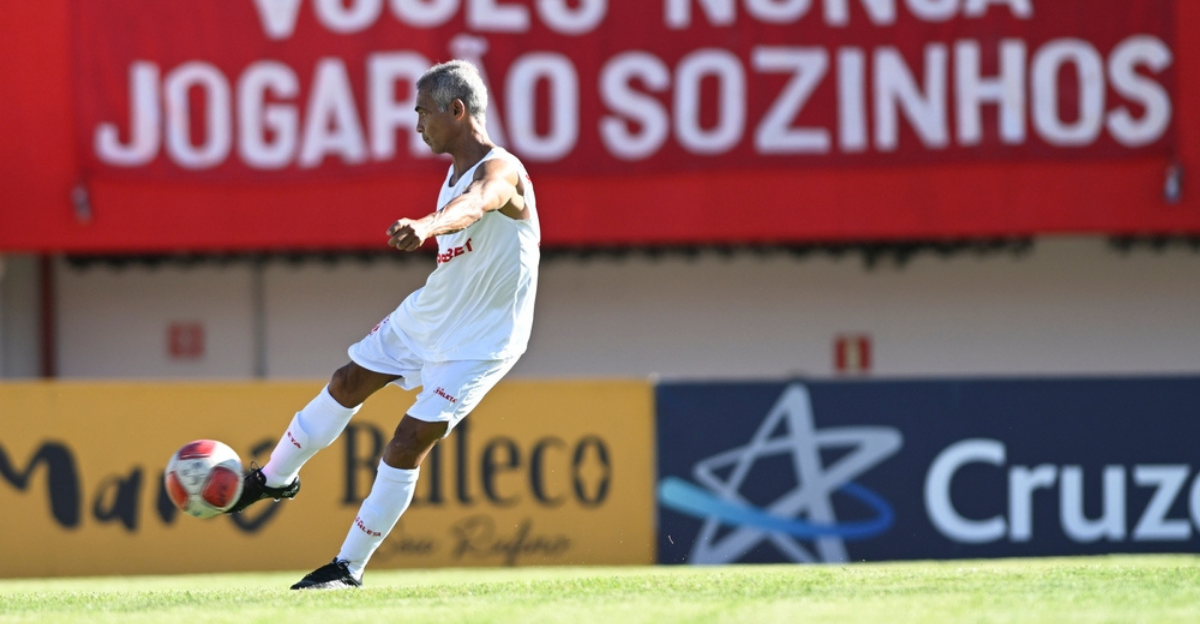
From the impoverished Jacarezinho favela in Rio de Janeiro to the pinnacle of global football, Romario’s career was a testament to raw talent, unwavering self-belief, and a personality as audacious as his goal-scoring record. As detailed by GOAL, the Brazilian striker, who famously declared he would score 1,000 career goals – a figure he claims to have reached – embodied a unique blend of arrogance and genius.
“When I was born, God looked at me and said: ‘He’s the man,’” Romario once stated, a sentiment that defined his approach to the game and life. Standing at a modest 5’5″ (1.65m), he overcame childhood asthma, finding solace and a remedy for his breathing problems on the football pitch. His professional journey began in early 1985 with Vasco da Gama, where he quickly earned the nickname “Baixinho marrento” (Cocky Little Guy) for his precocious confidence. He topped the Campeonato Carioca scoring charts in 1986 and led Vasco to back-to-back state championships in 1988.
Olympic showcase and European call
Romario’s breakout on the international stage came at the 1988 Seoul Olympics. He was the tournament’s top scorer with seven goals, including a double against Nigeria, a hat-trick against Australia, and a crucial equalizer against West Germany in the semi-final, followed by a successful spot-kick in the shootout. Brazil ultimately secured the silver medal, but Romario’s performances had caught the eye of Europe’s elite. Both Barcelona and Real Madrid expressed interest, but it was European Cup winners PSV Eindhoven who secured his signature.
His transition to Dutch football was not without its challenges. According to GOAL, Romario himself described his time in the Netherlands as “f*cking hard,” while his flamboyant lifestyle often clashed with the discipline expected at a European club. Sir Bobby Robson, who later coached him at PSV, captured this duality in his autobiography: “Some mornings he would be phenomenal in training. Other days, you’d take one look at him and know he’d left his energy and his legs at home, or in a nightclub.”
Read also: Roy Keane gives Manchester City stars brutal message over medals after guilty verdict
Yet, his talent was undeniable. In his first season, he scored 25 goals in 33 games, helping PSV clinch a domestic double with the Eredivisie and KNVB Beker. He was also the joint-top scorer in the European Cup in his second season and won the Eredivisie top scorer award for a third time under Robson.
Barcelona and the World Cup crown
In the summer of 1993, Romario moved to Barcelona, where his brilliance truly flourished under Johan Cruyff. He made an instant impact, scoring a hat-trick on his La Liga debut against Real Sociedad. That season, he netted five hat-tricks in the league, including a memorable treble in Barcelona’s 5-0 thrashing of Real Madrid. He finished as La Liga’s top scorer with 30 goals in 33 games, leading the club to the title.
His career reached its zenith in 1994, first with a dramatic recall to the Brazil national team for a do-or-die World Cup qualifier against Uruguay. Romario responded by scoring both goals in a 2-0 victory, securing Brazil’s place in the tournament.
At the 1994 World Cup in the USA, he was the undisputed star, scoring five goals, including crucial strikes against Russia, Cameroon, Sweden, and the Netherlands. Brazil triumphed in the final against Italy on penalties, with Romario converting his spot-kick. His electrifying performances earned him the Golden Ball award, cementing his legacy as a global superstar before his return to Brazil with Flamengo after the tournament.
Read also: Where Erling Haaland could end up if he leaves Man City
Read also: Javier Tebas breaks silence on what should happen to Man City next