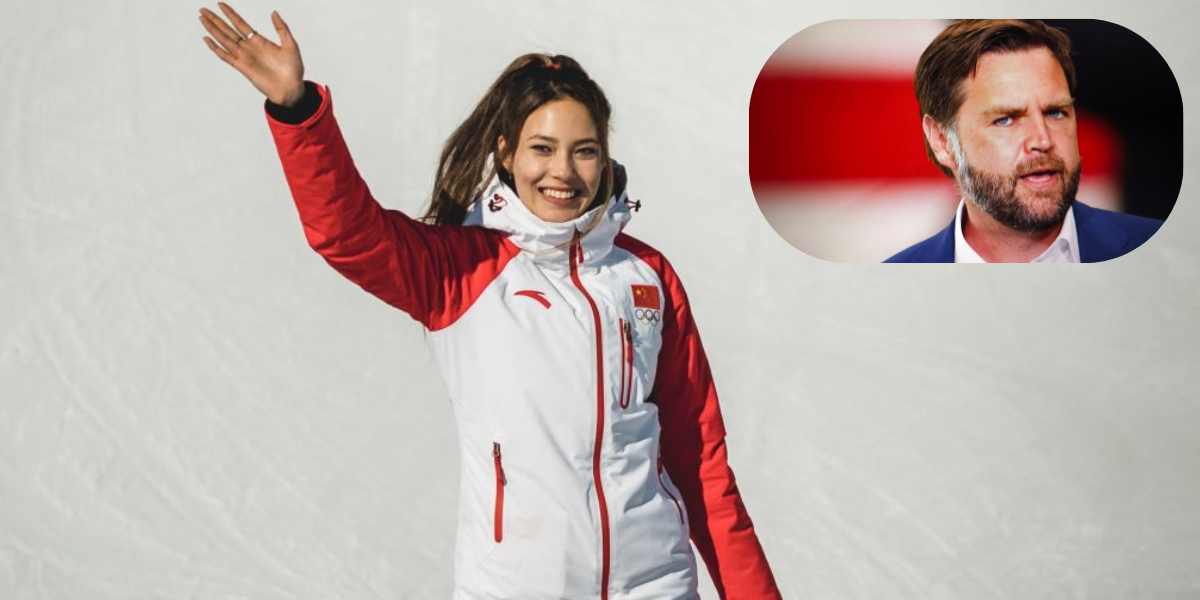
Eileen Gu, the American born freestyle skier who competes for China, has pushed back after criticism from US Vice President JD Vance over her Olympic allegiance.
Gu, 22, grew up in San Francisco but chose to represent China, her mother’s homeland, at the Milano Cortina 2026 Winter Olympics. She left the Games with three more medals, bringing her career total to six and cementing her status as the most decorated female freeskier in Olympic history.
Her decision has sparked debate in the United States since her Olympic debut, particularly amid wider political tensions between Washington and Beijing.
Vance questions loyalty on Fox News
During an appearance on Fox News earlier this month, JD Vance was asked by host Martha MacCallum whether Gu’s competitive status should be reconsidered.
Read also: Messi admitted he targeted one World Cup rival on purpose
“Look, I’ve no idea what her ‘status’ should be,” Vance said. “I think that’s ultimately up to the Olympics committee. I won’t pretend to wade into that.”
He continued: “I certainly think that somebody who grew up in the United States of America, who benefitted from our education system, from the freedoms and liberties that make this country a great place… I would hope that they would want to compete with the United States of America.
“So I’m going to root for American athletes, and I think part of that is people who identify themselves as Americans. That is who I’m rooting for at this Olympics.”
According to Fox News, the comments came during a broader discussion about national representation at the Games.
Read also: Cristiano Ronaldo crisis forces Portugal chief into emergency action
Team USA finished the Winter Olympics with 33 medals, compared with China’s 15. Gu accounted for three of China’s podium finishes.
Gu dismisses criticism
In remarks reported by Fortune, Gu said the backlash reflects broader political attitudes rather than sporting concerns.
“So many athletes compete for a different country. People only have a problem with me doing it because they kind of lump China into this monolithic entity, and they just hate China. So it’s not really about what they think it’s about,” she said, according to Fortune’s coverage of her comments.
International debate around China often centers on human rights allegations, political repression, censorship, and geopolitical tensions with the United States. In public discourse, especially in Western media and politics, these issues are sometimes framed in stark, adversarial terms. That environment can shape how athletes or public figures connected to China are perceived.
Read also: Harry Kane breaks silence on Man City verdict
Gu may be suggesting that some critics are reacting less to the common practice of dual-national athletes choosing one country over another, and more to broader political narratives about China. In that reading, her decision becomes symbolic, tied to larger U.S.–China rivalry, rather than treated as a personal or professional choice.
Her comment implies she sees the backlash as driven by geopolitical sentiment rather than by consistent standards applied to all athletes who compete for countries linked to their heritage.
She added: “Like, if I wasn’t doing well, I think that they probably wouldn’t care as much, and that’s OK for me.”
Gu has faced repeated questions about her nationality choice throughout her career. At a press conference during the Games, a reporter asked whether she viewed her results as “two silvers gained or two golds lost.”
Read also: Phil Taylor comes out of retirement for stunning darts return
“I’m the most decorated female freeskier in history. I think that’s an answer in and of itself,” Gu responded.
“How do I say this? Winning a medal at the Olympics is a life changing experience for every athlete.”
“Doing it five times is exponentially harder, because every medal is equally hard for me, but everybody else’s expectations rise, right? And so, the two medals lost situation, to be quite frank with you, I think is a kind of ridiculous perspective to take.”
Support from fellow US athlete
Gu also received public backing from US figure skater Alyssa Liu, who shares Chinese heritage but competes for the United States.
Read also: ‘If you lie to me, I will leave’: Guardiola’s City warning takes on new weight
“Eileen is doing amazing. I’ve actually known her since I was a kid,” Liu said. “I’m rooting for her always.”
Liu’s comments underscored how differently athletes with similar backgrounds can be perceived depending on which flag they compete under.
Liu’s remarks highlight a contrast: two U.S.-born athletes with Chinese heritage made different competitive choices, yet only one became the focus of political scrutiny. That contrast can suggest that athletes themselves may not frame their decisions primarily in political terms, even if politicians or commentators later do.
Elite athletes typically describe their motivations in terms of training environments, coaching opportunities, family ties, personal identity, or career strategy. International sport is structured around national representation, but for many competitors the focus is performance, achievement and opportunity rather than diplomacy or ideology.
When a politician like Vance comments, however, the framing shifts. The athlete’s choice can become symbolic, tied to national loyalty or geopolitical rivalry. In that context, what may have been a professional or personal decision is interpreted through a political lens.
That does not necessarily mean athletes have no political views or awareness. It means that the arena of competition and the arena of politics operate under different logics. Athletes compete within a national system, but their primary objective is sporting success. Political actors, by contrast, often view high-profile cases as part of a broader narrative about national identity and international competition.
Politics and identity collide at Milano Cortina
Gu’s success in Milano Cortina has once again highlighted how elite sport can become intertwined with questions of national identity and geopolitics.
While the International Olympic Committee allows athletes with dual heritage to choose their country of representation under its eligibility rules, public reaction often extends beyond sport. In Gu’s case, her medal haul has amplified scrutiny that might otherwise have remained muted.
For now, the skier appears focused on competition rather than political debate, even as her achievements continue to fuel conversation on both sides of the Pacific.
Sources: Fortune, Fox News