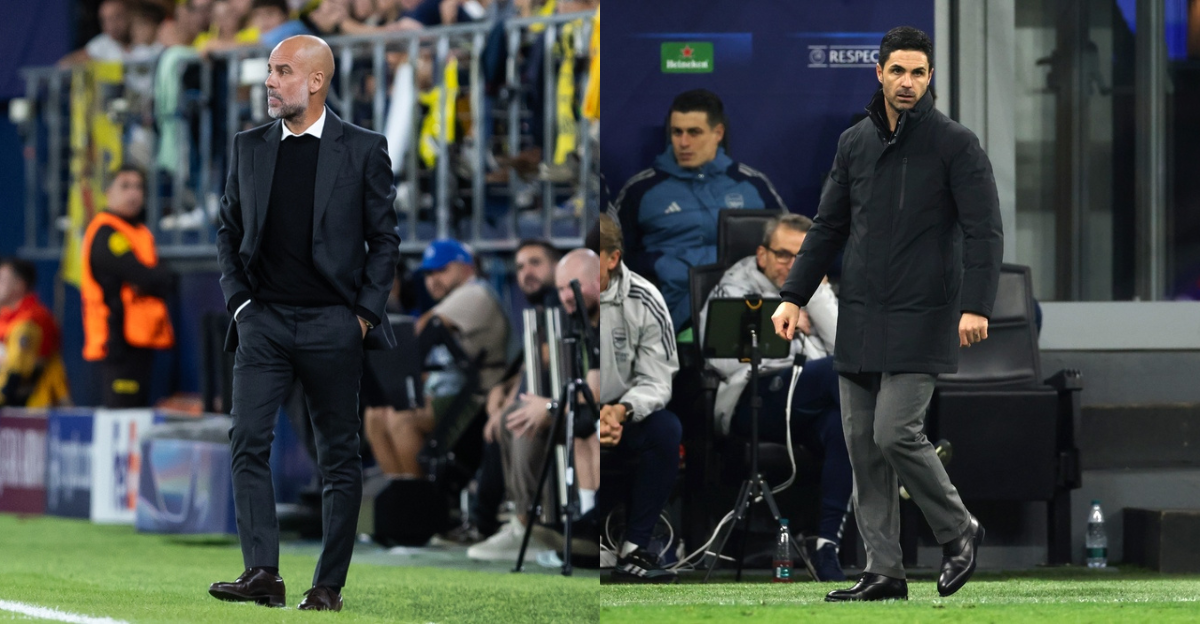
Sunday’s clash between Manchester City and Arsenal could prove decisive in the Premier League title race, but it also highlights a deeper story. On the touchline will be two managers whose careers have been closely linked, now competing to impose their own vision of how football should be played.
For Pep Guardiola and Mikel Arteta, the stakes go beyond three points.
From mentorship to rivalry
Their connection dates back to 1997, when Arteta joined Barcelona’s academy and encountered Guardiola, then the team’s captain. As BBC Sport has reported, the young midfielder was heavily influenced by the Spaniard’s understanding of the game, even during their brief overlap.
That early admiration later evolved into a working partnership. In 2016, Arteta joined Guardiola’s staff at Manchester City, where he became part of a coaching group that helped deliver multiple league titles and reshape English football’s tactical landscape.
Read also: Javier Tebas breaks silence on what should happen to Man City next
When Arteta left in 2019 to take charge of Arsenal, however, the relationship shifted. Contact between the two diminished, and the dynamic moved from collaboration to direct competition.
A shared philosophy, different interpretations
Guardiola’s influence on the modern game remains profound. According to BBC Sport, his Barcelona side established a model built on positional control, quick passing and territorial dominance, forcing opponents to adapt or fall behind.
Coach Andy Mangan admitted: “At first I didn’t understand what he was doing,” a reflection of how unconventional Guardiola’s ideas initially seemed before becoming widely adopted.
Former Barcelona director Pep Segura explained that this approach flipped traditional thinking, encouraging teams to dictate matches through attacking structure rather than reacting defensively.
Read also: Messi admitted he targeted one World Cup rival on purpose
Arteta absorbed those principles but adapted them to a different environment. His years in the Premier League, both as a player and coach, shaped a style that places greater emphasis on physical intensity, pressing duels and set-piece efficiency.
Control versus flexibility
During their time together, Arteta was described as a “formidable dance partner,” according to BBC Sport, underlining his importance within Guardiola’s coaching setup. Even then, he was developing ideas that would later define his own teams.
At Arsenal, those ideas have taken form in a highly structured system designed to control multiple phases of play. The current side, driven by players like Bukayo Saka and Martin Odegaard, reflects that balance between technical quality and physical output.
Yet that structure can become a limitation. When Arsenal’s patterns break down, they can struggle to find solutions outside their system.
Read also: Cristiano Ronaldo crisis forces Portugal chief into emergency action
Manchester City, by contrast, pair structure with adaptability. With players such as Kevin De Bruyne and Erling Haaland, Guardiola’s team often finds ways to improvise in decisive moments, an edge that has repeatedly proved crucial in title races.
The weight of expectation
Both managers now operate under intense scrutiny, where success is measured not just by results but by the manner in which they are achieved.
Guardiola has long shown an ability to evolve without losing his identity. Sean Dyche highlighted that resilience, saying: “In difficult times, Pep didn’t panic.”
Arteta is still chasing that same consistency at the highest level. BBC Sport reports that he has remained committed to his approach despite setbacks, choosing refinement over reinvention.
Read also: Harry Kane breaks silence on Man City verdict
As expectations in elite football continue to rise, the margin for error has narrowed. Dyche captured that shift clearly: “The biggest shift in football now is that winning isn’t enough anymore.”
Sunday’s meeting, then, is not just another step in the title race. It is a direct contest between two philosophies that share the same roots but have grown in different directions.
Sources: BBC Sport
Read also: Phil Taylor comes out of retirement for stunning darts return