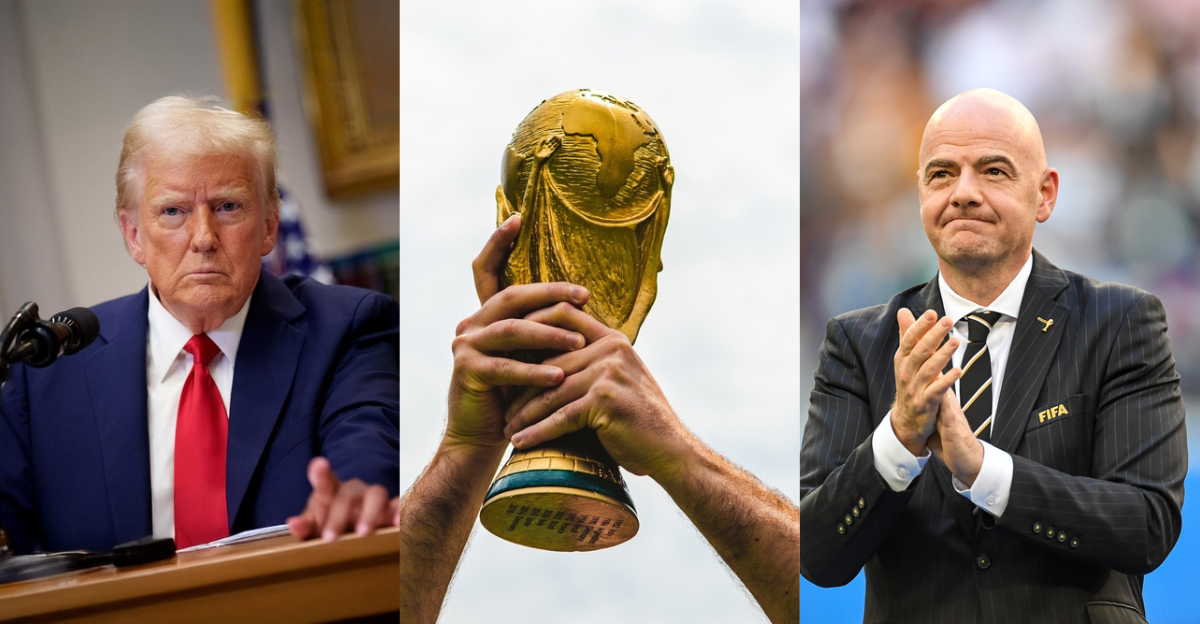
According to Goal.com’s March 31 report by Mohamed Saeed, FIFA President Gianni Infantino used a surprise appearance at Iran’s friendly against Costa Rica in Turkey to shut down speculation about Iran’s status in the tournament. His public line was simple: Iran will be at the World Cup, and its matches will remain where the draw placed them.
But that answer only settles FIFA’s position. It does not settle the deeper political dispute over why Iran objects to entering the United States in the first place, or whether Trump and Infantino are truly reading the situation in the same way.
Why Iran is pushing back
Iran’s dissatisfaction with playing in the United States is about much more than symbolism. According to an AP report on Iran’s position, Iranian officials have argued that it is not realistically possible for the national team to come to the U.S. after American and Israeli strikes on Iran, and the country has also tried to move its group matches to Mexico on safety grounds.
That makes the dispute less about football logistics and more about whether Iran sees the U.S. as a legitimate host for its delegation during an active conflict.
Read also: Javier Tebas breaks silence on what should happen to Man City next
The same AP reporting also shows that the concern is part of a broader policy mood in Tehran, not just a one off football complaint. Iran’s Ministry of Sports has barred teams from traveling to countries it considers hostile, and Iranian officials have said they do not want to boycott the World Cup in principle, but do view travel to the United States as unsafe under the current circumstances.
In other words, Iran is not only asking whether it is allowed to play, it is also asking whether the host country can plausibly present itself as neutral and secure while it is simultaneously part of the conflict Tehran is condemning.
Infantino says football stays separate
Infantino’s answer has been to defend continuity. According to Goal.com journalist Mohamed Saeed, he said, “Iran will be at the World Cup,” and used his appearance in Turkey as a visible show of support for Team Melli.
A later AP report on Infantino’s visit shows the FIFA president keeping to the same message, saying there is only “Plan A” and no alternative arrangement for Iran’s group stage matches outside the United States.
Read also: Messi admitted he targeted one World Cup rival on purpose
That stance fits FIFA’s familiar argument that football should not be rewritten every time geopolitical conditions deteriorate. Yet in this case, the gap between FIFA’s language and Iran’s concerns is unusually stark.
FIFA is treating the issue as an administrative matter, the schedule exists, the draw exists, the tournament goes on. Iran is treating it as a question of state hostility, personal security, and diplomatic legitimacy. That is why the debate keeps resurfacing even after Infantino tries to close it.
What Trump could actually do
The most important distinction is between the core team and the wider delegation. As currently written, Trump’s own December 16, 2025 White House proclamation says the restrictions do not apply to “any athlete or member of an athletic team,” including coaches, necessary support staff, and immediate relatives traveling for the World Cup or another major sporting event.
That means the playing group and essential football personnel are explicitly carved out from the broader suspension that otherwise affects Iranian nationals.
Read also: Cristiano Ronaldo crisis forces Portugal chief into emergency action
So in strict legal terms, Trump cannot simply erase Iran from the tournament by national decree if the current proclamation remains in force. But that does not mean he has no leverage.
The same White House policy text leaves room for case by case decisions by the Secretary of State, the Attorney General, and Homeland Security in matters said to involve U.S. national interests, and the broader visa environment still gives Washington influence over who qualifies as essential and who does not.
In practice, the pressure point may not be the starting eleven or the head coach, but peripheral officials, non essential delegation members, or the wider atmosphere around travel, vetting, and entry.
That is why Trump’s rhetoric matters even when the exemption exists on paper. A president does not need to cancel Iran’s participation outright to make the trip feel politically unstable. He can create uncertainty, raise public pressure, and frame the delegation as a security issue, even if FIFA continues to insist that the team belongs in the tournament.
Read also: Harry Kane breaks silence on Man City verdict
A real gap between Trump and Infantino
There does appear to be a meaningful difference between Trump’s public signaling and Infantino’s. According to CBS News, Trump told FIFA representatives on March 11 that Iran was welcome to play in the World Cup in the United States.
But on March 12, reporting distributed by AP and carried by outlets including NBC Chicago and ESPN, Trump said it was not “appropriate” for Iran to attend and added that the team should stay away for “their own life and safety.”
Infantino, by contrast, has tried to sound consistent from start to finish. He has publicly backed Iran’s participation, dismissed venue change talk, and presented the tournament structure as fixed.
That does not automatically mean there is a direct institutional clash between the White House and FIFA, but it does mean they are projecting different instincts. Trump has sent mixed and politically charged messages, while Infantino has tried to project stability and inevitability.
Read also: Phil Taylor comes out of retirement for stunning darts return
Why this issue will keep growing
According to Goal.com journalist Mohamed Saeed, Infantino wants the conversation narrowed to one answer, Iran is in, the schedule stands, and football moves on.
But the wider reporting from AP, CBS News, and the White House documents shows that the unresolved questions are bigger than that.
Iran is challenging the idea that the United States can be treated as just another host nation under current conditions, and Trump’s own comments have only reinforced the sense that political power in Washington could still affect the terms under which the Iranian delegation travels.
So the real tension is not simply whether Iran plays. It is whether FIFA’s insistence on business as usual can hold when one of the tournament’s hosts is also a central actor in the conflict driving Iran’s objections.
Sources: Goal.com, Mohamed Saeed; AP News; CBS News; The White House.