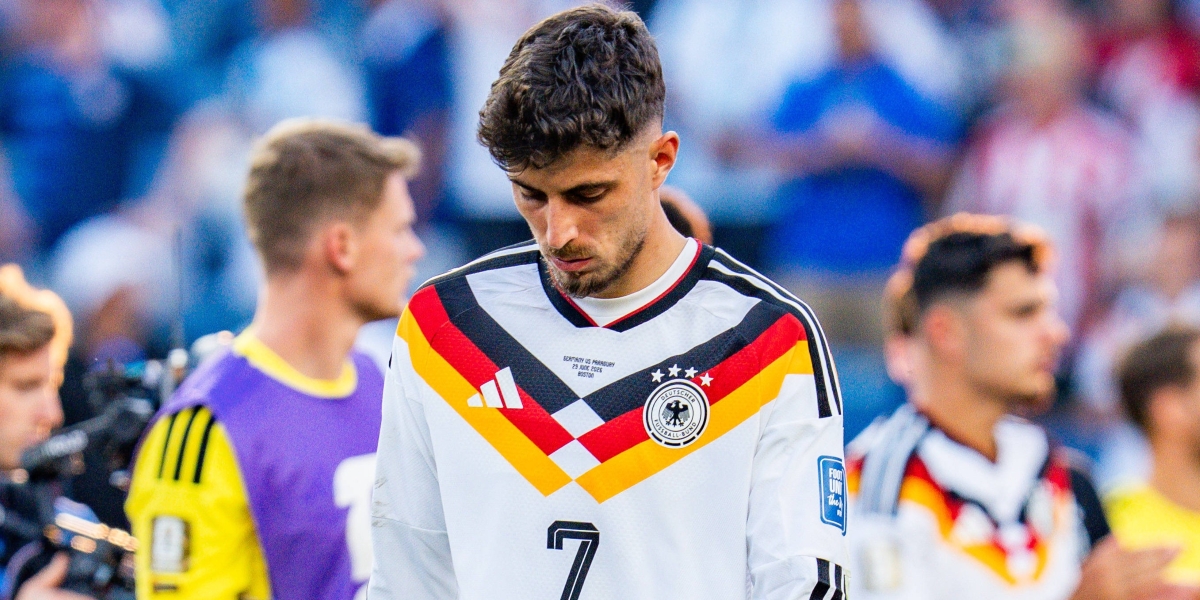
Germany left the World Cup in anger.
The four-time world champions were knocked out by Paraguay after a dramatic Round of 32 match that ended 1-1 after extra time, before Paraguay won the penalty shootout.
For Germany, the defining image was Jonathan Tah’s extra-time header being ruled out after a VAR review. For Julian Nagelsmann, the decision was unacceptable.
But Danish Superliga referee Michael Tykgaard has now offered a more measured explanation.
Read also: Harry Kane breaks silence on Man City verdict
And his view makes the German outrage look less straightforward.
Germany saw a scandal
Germany thought they had taken a 2-1 lead in extra time.
Tah rose inside the box and headed the ball into the net, sparking wild celebrations from the German players. But the goal was checked, and the referee eventually ruled it out for a foul by Waldemar Anton on Paraguay goalkeeper Orlando Gill.
Nagelsmann was furious afterwards. He called the decision “a scandal” and described it as “ridiculous”.
Read also: Phil Taylor comes out of retirement for stunning darts return
That reaction was not surprising. Germany were minutes away from a possible place in the last 16, and the disallowed goal changed the emotional direction of the match.
But anger does not always make a decision wrong.
Tykgaard points to the tactical detail
According to TV 2 Sport, Michael Tykgaard believes the situation should not only be judged by the amount of contact.
“One perhaps forgets the tactical aspect of the situation,” Tykgaard said.
Read also: ‘If you lie to me, I will leave’: Guardiola’s City warning takes on new weight
That is the key point.
From a German perspective, the contact looked small. Anton did not appear to make a violent challenge, and Gill was not obviously taken out in a dramatic way.
But Tykgaard’s explanation goes deeper than that.
“At first glance, it is an interesting situation that could go either way. Immediately, it is a positional battle, and the referee must assess who has the position. He must also assess whether it is accidental contact, and it could look like that,” he said.
Read also: Harry Kane’s Bayern future suddenly comes with a Tottenham escape route
In other words, the referee was not only looking for a push or a clear collision.
He also had to decide whether Anton was using his position to block the goalkeeper rather than making a genuine attempt to play the ball.
Anton gave the referee a problem
This is where the decision becomes uncomfortable for Germany.
Tykgaard pointed to Anton’s body language and his arms, arguing that the German defender did not look completely innocent in the situation.
Read also: ‘I’m not confident’: Red Bull chief delivers troubling verdict on Verstappen’s car
“However, the referee must also look at whether the attacker takes the position for tactical reasons, and that is where there is something to go after. In the pictures, it looks like Waldemar Anton is there more to stand in the way of the goalkeeper than to play the ball, and also clearly has his hands up to ‘control’ the opponent,” Tykgaard said.
That does not mean the call was obvious.
But it does mean Germany gave the referee something to judge.
Anton’s position, his arms and his role in blocking Gill all created enough doubt for VAR to become involved. Once the referee was sent to the monitor, the decision was no longer only about whether the contact looked dramatic.
It was about whether Anton had illegally prevented the goalkeeper from moving towards the ball.
Not big contact, but still contact
Tykgaard did not present the decision as easy.
That makes his analysis more convincing.
He acknowledged that the contact was not major, but argued that it still existed and therefore fell within the referee’s judgement.
“The contact is not big, but it is there. Whether it is big enough to give a free-kick is up to the referee’s judgement,” he said.
That sentence is important.
It explains why the situation has divided opinion. Germany saw a soft call. The referee saw interference. Tykgaard saw a marginal but defendable decision.
That is very different from Nagelsmann’s version of events, where the call was simply a scandal.
Nagelsmann’s anger hides Germany’s own mistake
There is no doubt that Germany had reason to feel frustrated.
A goal was taken away in extra time. A World Cup campaign ended soon after. Emotions were always going to be high.
But Tykgaard’s analysis also undercuts the idea that Germany were only victims of a bad decision.
Anton placed himself in a risky position. He appeared to block the goalkeeper. His arms were involved. Inside the six-yard box, that is always dangerous.
For Nagelsmann, it was easier to attack the referee.
For Germany, the harder lesson is that one unnecessary action helped create the controversy.
Paraguay moved on while Germany argued
Germany eventually lost the shootout, completing another painful early World Cup exit.
Paraguay, meanwhile, advanced after surviving the pressure, the VAR controversy and the penalties.
That is what makes the decision so hard for Germany to accept. It did not happen in an ordinary league match. It happened in extra time of a World Cup knockout game.
But Tykgaard’s explanation shows why the incident cannot simply be reduced to outrage.
The call was debatable.
It may have been harsh.
But it was not impossible to understand.
And for Germany, that may be the most uncomfortable part.