Michael Schumacher, the private champion fans never really knew
For years, Michael Schumacher was defined almost entirely by what he did inside a Formula One cockpit. On Sundays, he was relentless and unforgiving, a driver who extracted every possible advantage. Away from the noise of race weekends, those who knew him say the switch could be almost immediate.
That quieter version of Schumacher is something most fans never encountered and, in the years since his skiing accident, may never fully understand.
A legacy built on results
Schumacher’s résumé still reads like a benchmark for the sport. Racing for Jordan, Benetton, Ferrari and later Mercedes, he won seven world championships, 91 Grands Prix, secured 68 pole positions and set 77 fastest laps.
Those numbers helped shape an image of total focus and mental toughness. Formula One at the time offered little access beyond the circuit, and drivers were largely judged on performance alone. Schumacher fit that world perfectly.
Read also: She changed her flag and felt everything at once, Kasatkina admits she almost cried on court
When the story stopped
In December 2013, shortly after retiring, Schumacher suffered severe head injuries in a skiing accident in the French Alps while with his son Mick. He was placed in a medically induced coma and later returned home following months of hospital care.
More than a decade later, Schumacher has not appeared publicly. German and international media have reported that he has difficulty communicating and is cared for by his wife, Corinna, with strict limits on visitors to maintain privacy.
That silence has meant his public image remains fixed at the moment he left the sport.
“We didn’t see the full picture”
Richard Hopkins, a former Head of Operations at Red Bull who spent years around Schumacher in the paddock, believes that image was incomplete even then.
Read also: FIFA hands trump a peace prize, then goes silent after airstrikes
“I was thinking how Michael would fare in the era of Netflix and Drive to Survive,” Hopkins told SPORTbible. “I think it would have been great. We probably didn’t see the full other side of Michael.”
Hopkins recalled that the transformation could be subtle a conversation over coffee, a quieter presence once the helmet was off. “When he took the helmet off, shoulders dropped, he was a good guy,” he said. “There was a human side to him. That’s why it’s a shame we never saw him in Drive to Survive.”
Today’s drivers are often defined by their personalities as much as their lap times. Schumacher raced before that shift, and his guarded approach now feels like a relic of a different era.
Measuring greatness across generations
Hopkins also sees parallels between Schumacher and Max Verstappen, particularly in how both approach competition.
Read also: Could Marcus Rashford return to Manchester United after Amorim exit?
“Putting Michael and Max in the same machinery and watching them battle would be amazing,” he said, arguing that both drivers are motivated by direct comparison with the very best.
Verstappen has flourished amid constant scrutiny and access. Schumacher, by contrast, built his legacy when results spoke louder than behind-the-scenes footage.
A deliberately small circle
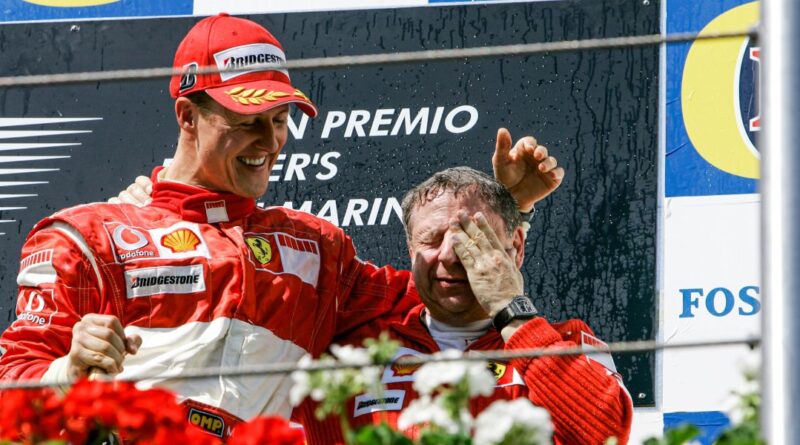
Only a handful of trusted figures including former Ferrari team principal Jean Todt and engineer Ross Brawn are known to visit Schumacher. Hopkins said the boundaries around access are understood without ever being spelled out.
“I’m not going to try and visit Michael,” he said. “I know that’s not going to happen.”
Read also: The American powerhouse set to change Formula 1 in 2026
For fans, that distance leaves an unfinished portrait. Those who worked with Schumacher insist the intensity seen on track was only part of who he was and that away from the stopwatch and the pressure, there was a far more ordinary, human side that most never got to see.
Sources: SPORTbible
Read also: Red Bull lost a mastermind and McLaren just gained a major edge