Bielsa takes aim at hydration breaks
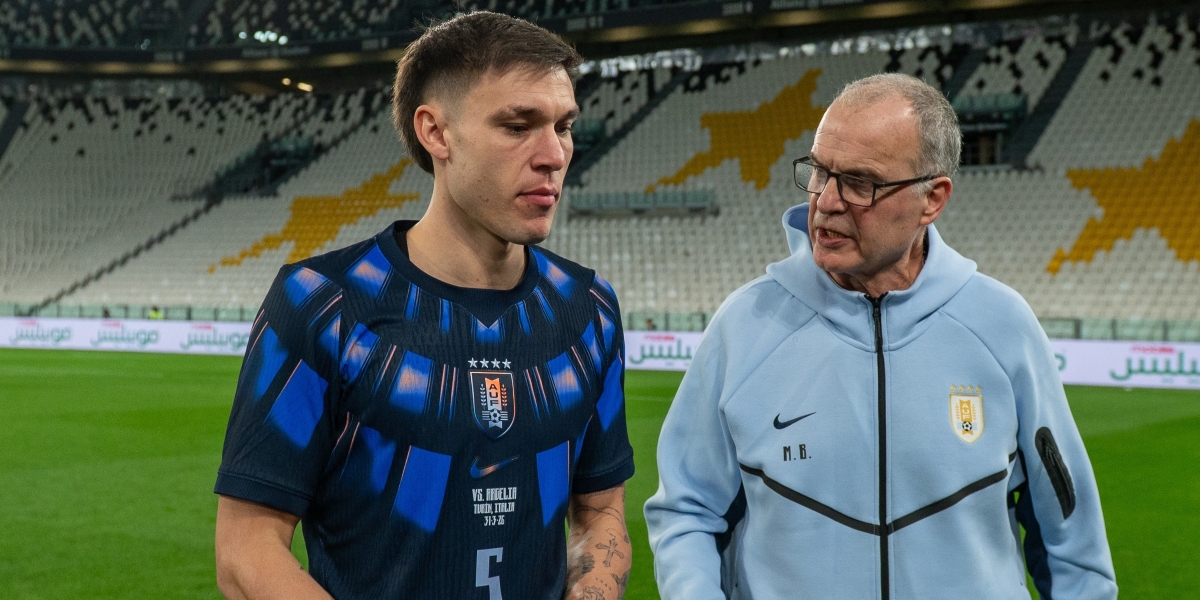
Marcelo Bielsa has never been a coach inclined to accept football’s modern habits without complaint. At this World Cup, the Uruguay manager has turned his attention to one of FIFA’s most visible changes: the mandatory hydration breaks that now split each half into two parts.
According to Ken Early in The Irish Times, Bielsa used a press conference to argue that the pauses have altered one of football’s defining qualities.
“Playing four times instead of two alters the conception of what had been culturally built to interpret football,” Bielsa said. “This change of culture does not add anything and takes away a lot. Obviously when they divided it into four, they did not think about the repercussions for the sport.
“Instead, they thought about other types of repercussions that I will not discuss or analyse. I will just say that before this decision, football had one characteristic, now it has another. People fell in love with the game because of its characteristics.”
Read also: Iran’s national anthem sparks strong reaction before World Cup match vs Belgium
His point was not simply about water breaks. It was about the shape of the game itself. Football has traditionally been defined by long passages of play, shifts in momentum and the need for players to think and adapt while physically tiring. Bielsa believes the new pauses cut into that rhythm.
Coaches gain another window
The drinks breaks are part of a broader shift in elite football, where managers have more chances than ever to influence matches from the touchline.
VAR has already changed the tempo of games. The move to five substitutes, with a sixth available in extra time, has also given coaches greater tactical reach. Teams can now replace almost half their outfield players, allowing managers to refresh pressing structures, protect tired legs and change the tone of a match late on.
For critics, that has made football more controlled and more rehearsed. The game is still fluid, but it increasingly contains moments that look like timeouts, offering coaches a chance to reorganise players before the next phase begins.
Read also: FIFA whistleblower: "The pattern of behaviour hasn’t changed"
Early cited examples from the World Cup, including Thomas Tuchel using a drinks break to issue instructions to England’s players in Dallas and Julian Nagelsmann calming Germany after conceding against Curaçao in Houston.
The influence of other sports is also visible. Arsenal manager Mikel Arteta has spoken admiringly about the precision of American football after watching an NFL game with Josh Kroenke.
“Every single play is a set-piece. Every play is choreographed,” Arteta told Kroenke.
The stars still resist the script
For all the extra structure, the World Cup has not yet become a tournament ruled only by coaches and systems.
Read also: Cape Verde keep World Cup dream alive with Uruguay draw
The early rounds have still belonged, in large part, to the players with the rarest gifts. Lionel Messi opened Argentina’s campaign with a hat-trick. Kylian Mbappé, Erling Haaland and Harry Kane all scored twice. Lamine Yamal struck early in his first World Cup start against Saudi Arabia, while Vinícius Júnior created two goals and scored another in the first half for Brazil against Haiti.
Those performances complicate the idea that football is being fully reduced to a coach’s board. The best players continue to break patterns, improvise under pressure and decide games in ways no drinks break can script.
Ancelotti questions the role of the superstars
Carlo Ancelotti offered a different reading of the tournament in Philadelphia, predicting a World Cup shaped by intensity rather than reputation.
“I think the stars are not going to determine this World Cup,” Ancelotti said.
Read also: L'Equipe suspends presenter France Pierron over "disgraceful" Jeremy Doku World Cup comments
It is a view that fits the modern game’s direction. Smaller teams are fitter, better organised and more tactically prepared than ever. Pressing, set pieces and defensive structure have narrowed the gap between favourites and outsiders.
But the opening stages have also shown the limits of that argument. Messi, Mbappé, Haaland, Kane, Yamal and Vinícius have already left their mark. Even in a tournament increasingly shaped by tactical pauses and sideline intervention, football still finds room for players who can turn a match on their own.
A debate about what football should be
Bielsa’s complaint is unlikely to disappear. The hydration breaks have a welfare argument behind them, particularly in hot conditions across North America. But their use in every match has made them feel like more than a safety measure.
To Bielsa and others, the issue is not whether players should be protected from heat. It is whether football’s authorities understand what makes the sport different from games built around stoppages and set plays.
Read also: Arsenal face major Ødegaard call as summer rebuild gathers pace
The tension is now clear. FIFA wants a safer, more controlled and more commercially manageable product. Coaches welcome more opportunities to intervene. Players, meanwhile, are still trying to preserve the instinctive, flowing game that made them stars in the first place.
That is the argument running beneath the World Cup. The rulemakers may be changing the rhythm, but the game’s greatest players are still finding ways to play through it.