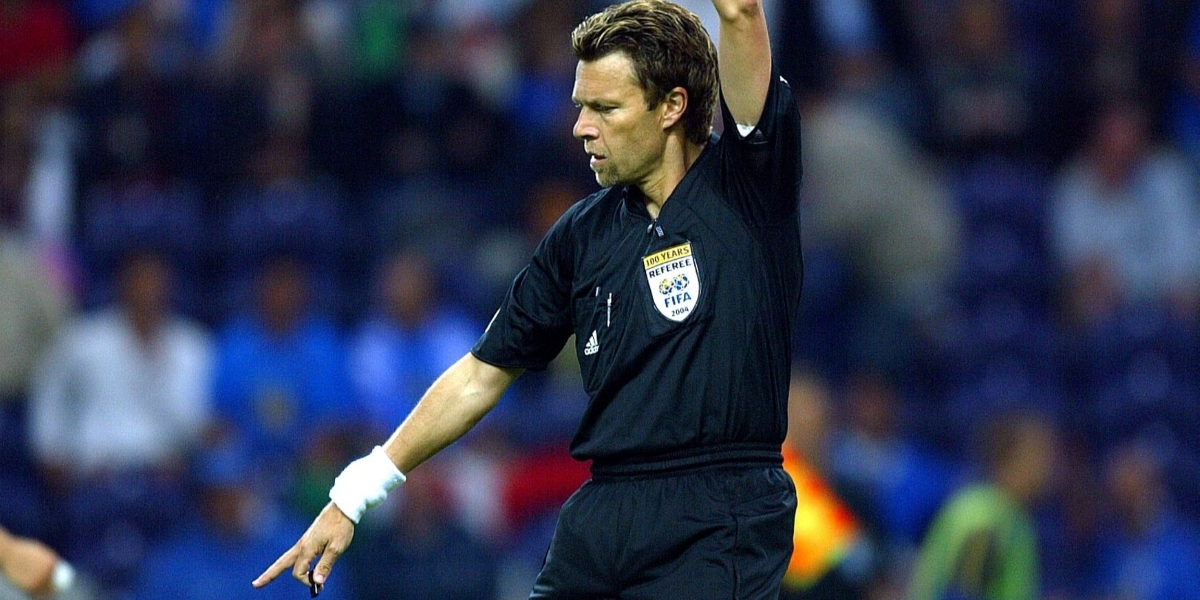
Urs Meier has seen enough to be concerned.
The former Swiss top referee has delivered a sharp assessment of the World Cup group stage, warning that the tournament’s calmer opening phase may not survive the pressure of the knockout rounds.
In an interview with Blick reporter Simon Strimer, Meier said the biggest refereeing controversies had not arrived yet, but made clear that he was unhappy with several parts of the tournament.
No patience with Schärer decision
One of Meier’s strongest criticisms concerns Sandro Schärer.
Read also: Roy Keane gives Manchester City stars brutal message over medals after guilty verdict
The Swiss UEFA referee has still not been given a match at the World Cup, despite having taken charge of a Champions League semi-final.
“One of the negative points of this World Cup is that Sandro Schärer has still not been used,” Meier said.
He added that he could not understand how a referee with Schärer’s profile could remain unused while others had already taken charge of two or three matches.
“If he really does not get a match, I would have absolutely no understanding for that,” Meier said.
Read also: Where Erling Haaland could end up if he leaves Man City
Drinking breaks under fire
Meier was even more direct when speaking about the fixed three-minute drinking breaks in each half.
For him, they are not just about player welfare.
“Everyone knows that it is a disguised advertising break,” he said.
Meier believes the breaks change the game itself. Coaches get a chance to reset their teams, adjust the rhythm and give new instructions in the middle of a half.
Read also: Javier Tebas breaks silence on what should happen to Man City next
After that, the referee also has to find the right line again.
“The drinking breaks are something that has to be abolished again,” Meier said. “What is happening there is not in the spirit of football.”
He did not argue against drinking breaks in extreme conditions. His point was that referees should be allowed to decide when they are actually needed, instead of being locked into fixed pauses.
Praise for a strong referee moment
Not everything in Meier’s assessment was negative.
Read also: Messi admitted he targeted one World Cup rival on purpose
He praised El Salvador referee Ivan Barton for his handling of Paraguay goalkeeper Orlando Gill during the heated match between Paraguay and Turkey.
When Gill sat down and appeared to hold his foot while Paraguay were leading, Barton told him to get up and continue.
“I celebrate things like that,” Meier said. “That is match control for me. If you have an understanding of football and you are on the pitch, you feel it: something is not right here. Do not make a theatre out of it.”
For Meier, that was the kind of authority referees need in a tournament where time-wasting and gamesmanship can quickly grow.
Read also: Cristiano Ronaldo crisis forces Portugal chief into emergency action
A warning before the knockouts
Meier also sees a broader issue in the refereeing line.
He believes officials allowed a generous amount of contact during the group stage, and he accepts that the players largely responded well to it.
But the knockout rounds are different.
“Now, from the round of 32, a different wind will blow,” he said. “The pressure will be completely different.”
The warning is clear. A relaxed refereeing line can work when matches are less desperate. It becomes far riskier when one mistake can end a team’s tournament.
Letexier earns special praise
Meier also pointed to one referee he particularly admires: François Letexier of France.
The 37-year-old took charge of two matches in the group stage and impressed Meier with his active style.
“He fights for his position and decides immediately whether play should continue or not,” Meier said. “That means we have fewer problems with decisions.”
Meier hopes the referee committee does not tell Letexier to move away from that approach.
For viewers who want to study refereeing more closely, Meier’s advice is simple: look out for Letexier’s next match.
Iran treatment called unacceptable
Meier’s strongest words were reserved for events away from the pitch.
At the 1998 World Cup, he refereed the politically charged match between the United States and Iran. Before that game, he helped create the now-famous joint team photo, a moment remembered as a symbol of sport rising above politics.
That history makes his criticism of this World Cup especially pointed.
Iran were based in Mexico but, according to Blick, were only allowed to enter the United States on matchdays and had to leave again immediately afterwards.
“What the Americans have done with the Iranians at this World Cup is not acceptable and has little to do with fair play,” Meier said.
For him, the contrast with 1998 is painful.
Back then, he felt football showed the world that things could be different. This time, he believes the opportunity was missed.
Football faces a sterner test now
Meier’s verdict is not a rejection of the tournament as a whole.
It is a warning.
The World Cup has moved beyond the group stage, and with it the margin for error has shrunk. Referees will face more pressure. Players will test the limits more often. Rules that looked manageable in the early matches may suddenly become decisive.
For Meier, the solution is not complicated.
Use the best referees. Let them lead matches with authority. Remove rules that interrupt the natural flow of football. And keep politics as far away from the pitch as possible.
The knockout rounds will show whether FIFA has listened.