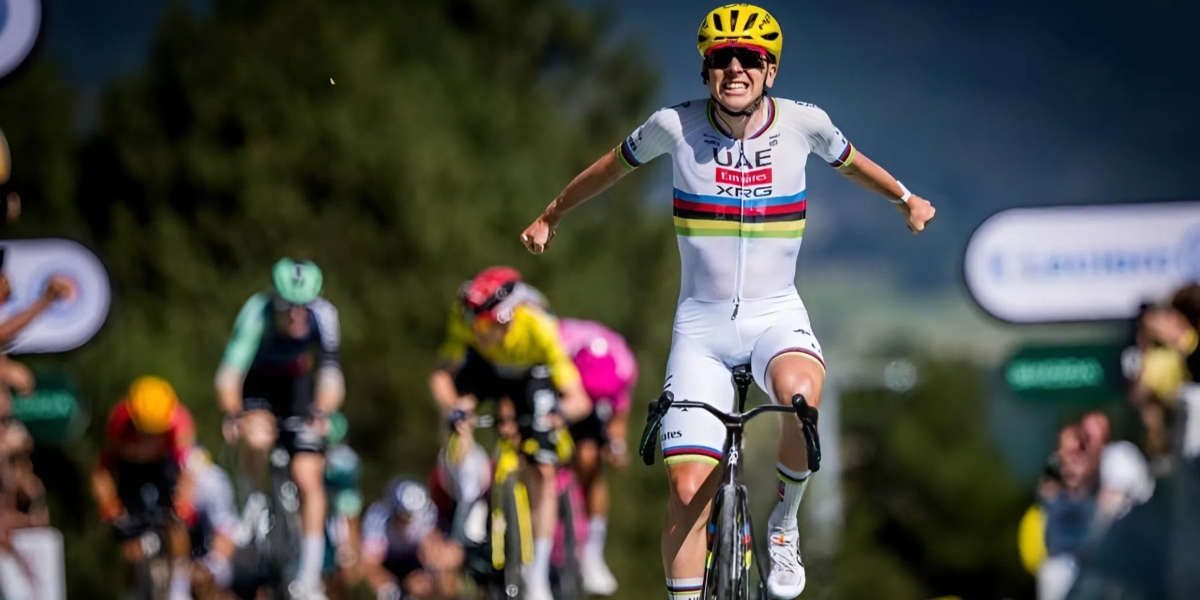
France’s summer ritual meets a hotter reality
The Tour de France remains one of the most powerful sporting images France exports to the world.
A peloton moving through mountains, villages and vineyards still carries the idea of cycling as something simple, human and clean. But inside the race, that image is becoming harder to separate from the logistics that make the spectacle possible.
This year’s Tour has already been shaped by heat. According to AP, the race entered France from Spain during a wider southern European heatwave, with temperatures in Spain reaching around 35 degrees Celsius.
For the riders, the response is immediate and physical: ice packs, cooling vests, cold drinks and recovery strategies. For the race convoy, it means air-conditioned buses, team cars, trucks, generators and a huge moving infrastructure following the riders every day.
Read also: Javier Tebas breaks silence on what should happen to Man City next
That is the contradiction now being discussed inside the peloton.
A French voice raises the issue
Guillaume Martin-Guyonnet, the French rider from Groupama-FDJ United, has pointed to the everyday habits of modern cycling as part of the problem.
According to L’Équipe, Martin-Guyonnet questioned whether every logistical choice around the race can still be justified. One example came from a team time trial, where two buses were used for a short stage, one at the start and one at the finish, mainly so riders could shower.
“Basically, a bus came for a shower,” Martin-Guyonnet said. “Was that necessary when the hotels were twenty minutes away?”
Read also: Messi admitted he targeted one World Cup rival on purpose
The remark matters because it does not come from outside the sport. It comes from a French rider inside France’s most famous race, questioning whether professional cycling can continue to present itself as naturally green while operating like a large travelling industry.
Martin-Guyonnet, listed by Groupama-FDJ United as a 33-year-old French climber from Paris, has long been one of the more reflective voices in the peloton. Here, his criticism is not aimed at stopping the sport, but at making it more reasonable.
The Tour points to progress
The Tour de France has not ignored the issue.
According to the official Tour de France website, organisers say direct emissions have fallen by close to 37 percent since 2013, based on a 2021 audit using the same methodology. The event’s carbon footprint was measured at 216,388 tonnes of CO₂ equivalent across all three scopes.
Read also: Cristiano Ronaldo crisis forces Portugal chief into emergency action
The race also says its residual direct emissions from the organisation, teams, partners and media are offset through Label Bas Carbone programmes backed by France’s Ministry for Ecological Transition.
That is significant progress. But for some riders, the central question is no longer whether the Tour is doing anything. It is whether the current model of elite cycling can ever be made truly compatible with the environmental message the sport naturally carries.
The paradox inside the peloton
Yannis Voisard, the Swiss Tudor rider who has a bachelor’s degree in biology, described that conflict clearly.
“It’s very paradoxical and quite special to experience,” he told L’Équipe. “I have a bachelor’s degree in biology, I’m well aware of everything that’s happening. We’re not going to lie, high-level sport as we practice it is not clean from an ecological point of view. The current system is not designed to be as ecological as possible.”
Read also: Harry Kane breaks silence on Man City verdict
His words cut to the heart of the issue.
Cycling itself may be clean. Professional cycling is something else. The sport depends on global calendars, long-distance travel, team vehicles, sponsor obligations, television production and hospitality areas. The bike is at the centre of it all, but it is surrounded by a machine that runs on far more than leg power.
A French debate beyond the roadside
The environmental debate around the Tour is also broader than transport and team logistics.
Described by Le Monde, the race has also faced scrutiny over fossil fuel sponsorships, with TotalEnergies becoming an official Tour partner in 2026 and several teams linked to oil, gas or state-backed fossil fuel interests.
Read also: Phil Taylor comes out of retirement for stunning darts return
That gives the discussion a distinctly French dimension.
The Tour is not just another race. It is a national institution, organised by a French company, run across French roads and watched as part of the country’s summer identity. If cycling wants to claim a serious environmental role, France’s own race will inevitably be judged more closely than most.
A call for a more reasonable sport
No rider quoted by L’Équipe is calling for the Tour de France to disappear.
The argument is more practical than radical. Fewer unnecessary vehicles, smarter travel planning, more restraint in team logistics and a calendar that takes geography and climate more seriously.
That may not deliver a perfect solution. Professional sport will always carry a footprint.
But the Tour de France has built much of its romance on the purity of the bicycle. As the heat rises and the convoy grows, that image now comes with a harder question.
How green can France’s great race really be?