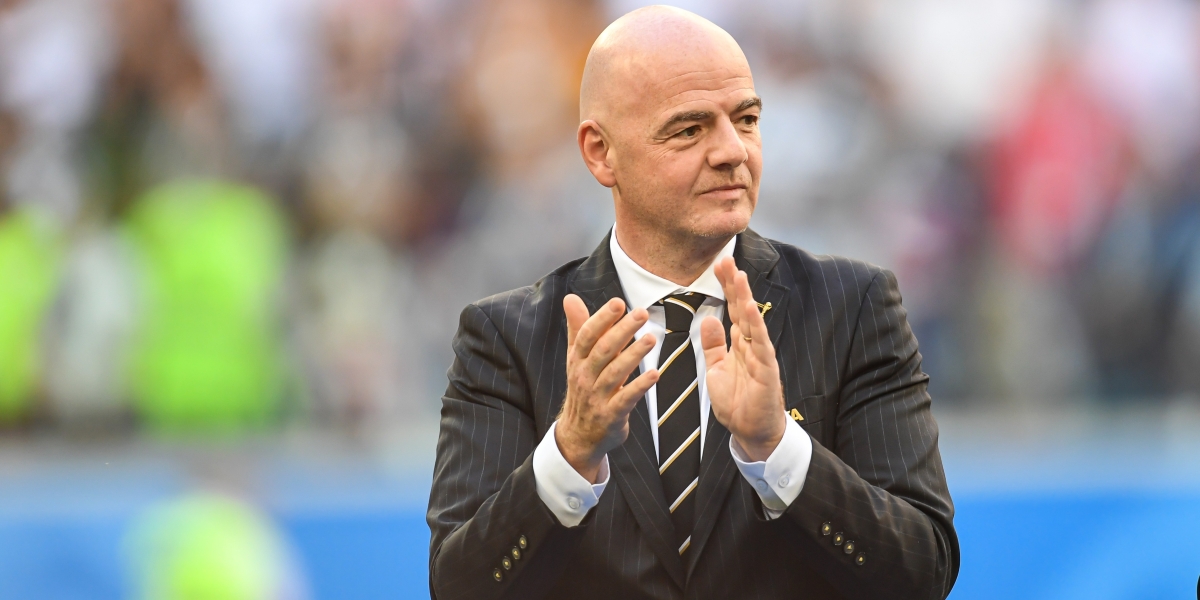
Gianni Infantino has launched a fierce attack on FIFA’s critics, accusing journalists and online commentators of spreading hatred and false information after the 2026 World Cup.
The FIFA president published a lengthy statement one week after Spain defeated Argentina in the final in New Jersey. Rather than focusing only on the tournament’s record crowds and dramatic matches, Infantino used the message to confront those who had questioned FIFA’s decisions.
According to Infantino’s statement on FIFA’s official website, he believed critics had ignored the work carried out by FIFA while concentrating on controversy.
“To those behind their pens and papers, behind their screens spreading hate and false rumours,” Infantino wrote.
Read also: ‘A fraud’ or painfully shortsighted? Journalist turns on Guardiola after City verdict
“While you divide, we unite.”
The message immediately reignited the arguments that had followed FIFA throughout the tournament.
Infantino hits back at the haters
Infantino presented FIFA as a force for peace and unity, insisting that the World Cup had brought countries and supporters together despite political tension, conflict and discrimination.
He pointed to Iran’s participation in the United States as an example of football overcoming international hostility.
Read also: Antonelli and Russel gets huge upgrades
“The Iranian team received visas to enter because football is about peace,” he wrote.
However, the visa situation was more complicated than Infantino’s statement suggested.
Iran’s players and technical staff were allowed to enter the United States, but several officials connected to the country’s administrative delegation were reportedly denied visas.
As reported by Channel News Asia in its coverage of the dispute, Iranian state television claimed that 15 members of the delegation had not received permission to enter the country.
Read also: Saliba is back for Arsenal
The Iranian Football Federation accused the United States of political interference and asked FIFA to intervene.
Infantino acknowledged that some visa applications had been rejected but argued that critics were focusing on the “few people denied visas” instead of the millions who had been approved.
World Cup referee stopped at the border
The visa controversy was not limited to Iran.
Somali referee Omar Abdulkadir Artan was selected to officiate at the tournament but was refused entry after arriving at Miami International Airport.
Read also: Jorge Jesus reveals what Cristiano Ronaldo told him before Portugal exit
Artan was subsequently unable to take part in the World Cup.
According to CBS News reporters Camilo Montoya-Galvez and Joe Walsh, US authorities initially said the referee had been denied entry because of unspecified vetting concerns.
An administration official later alleged that Artan had an association with suspected members of terrorist organisations.
No detailed evidence supporting that claim was released publicly, and Artan was not accused of committing a terrorist offence.
Read also: Mbappé celebrates injury nightclubbing
FIFA said it could not overrule decisions made by American immigration authorities, but the case raised questions about guarantees that tournament officials would be able to enter the host country.
Balogun ruling sparked World Cup fury
The biggest sporting controversy concerned United States striker Folarin Balogun.
Balogun was sent off for serious foul play during the Americans’ round-of-32 victory over Bosnia and Herzegovina. The red card should normally have ruled him out of the following match against Belgium.
However, FIFA’s disciplinary committee imposed a one-match suspension and then delayed its implementation for a probationary period of one year.
The decision allowed Balogun to play against Belgium.
As explained in FIFA’s official statement on the disciplinary ruling, the committee relied on Article 27 of the FIFA Disciplinary Code, which allows certain sanctions to be suspended.
The red card was not cancelled, and the punishment was not removed entirely. The suspension could be activated if Balogun committed a similar offence during the one-year probationary period.
The United States Soccer Federation was also fined $40,000.
Trump phone call raised eyebrows
The case became even more controversial when US President Donald Trump confirmed that he had spoken directly to Infantino before FIFA announced its decision.
“I asked for a review because I didn’t think it was a foul,” Trump said.
As quoted by CBS News in its report on the Balogun controversy, Trump argued that Balogun and the Bosnian defender had simply collided and become entangled.
Infantino confirmed the conversation but insisted that the case would be decided by FIFA’s independent judicial bodies.
There is no public evidence that Trump ordered FIFA to suspend the punishment.
However, the intervention of the US president created the appearance of political pressure, particularly because the decision was announced shortly after the call.
UEFA tears into FIFA decision
UEFA responded with one of its strongest public attacks on FIFA in recent years.
According to UEFA’s official statement on the case, the organisation believed FIFA had crossed a red line by preventing an automatic red-card suspension from taking effect during the tournament.
“We express our disbelief at such an unprecedented, incomprehensible and unjustifiable decision,” UEFA said.
European football’s governing body argued that other players had been forced to serve automatic suspensions and warned that making an exception for Balogun damaged confidence in the competition’s rules.
The Belgian Football Association also attempted to challenge the ruling but was informed that it did not have the necessary legal standing to appeal.
Infantino refuses to name his enemies
Infantino did not directly mention Balogun, Trump, UEFA or La Liga president Javier Tebas in his post-tournament statement.
Instead, he defended FIFA’s disciplinary system in broader terms.
He argued that the suspension or postponement of punishments was common in leading domestic leagues and accused critics of ignoring similar cases in their own competitions.
That defence explained why FIFA was legally permitted to delay Balogun’s ban.
It did not fully explain why the organisation chose to use the rule in this particular case, or why an automatic World Cup suspension was treated differently from similar punishments handed to other players.
FIFA also did not publish a detailed account of the special circumstances that persuaded the disciplinary committee to make an exception.
Infantino still set for another term
The controversy has increased tensions between FIFA and several major figures in European football.
Tebas has openly called for Infantino to resign, while UEFA’s statement revealed a deep disagreement over how the World Cup was governed.
Despite the criticism, Infantino remains in a powerful position.
As reported by The Guardian in its examination of his re-election prospects, more than 200 of FIFA’s 211 national associations had submitted endorsements supporting his candidacy.
Infantino is expected to seek another four-year term at the FIFA Congress in Rabat on March 18, 2027.
No confirmed opponent has emerged, meaning his re-election remains highly likely.
World Cup celebration turns into bitter attack
Infantino’s message was presented as a celebration of a tournament that delivered record attendances and enormous commercial interest.
Instead, its confrontational language ensured that the World Cup’s controversies remained in the spotlight.
The FIFA president portrayed criticism of visa problems and disciplinary decisions as part of a campaign built on hatred and false rumours.
His opponents will argue that questions about consistency, transparency and political influence cannot be dismissed so easily.
The final whistle may have sounded in New Jersey, but Infantino’s angry response has ensured that the battle over FIFA’s handling of the tournament is far from over.