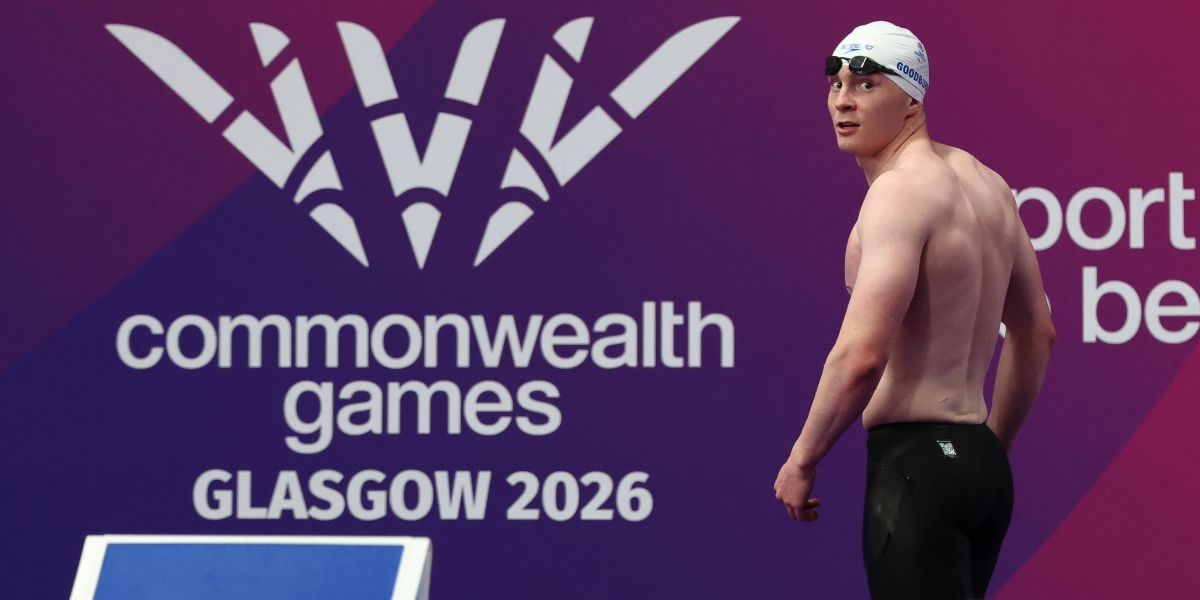
Archie Goodburn did not win a medal when he entered the water at Tollcross International Swimming Centre. He finished joint seventh in the Commonwealth Games 50-metre breaststroke final with a time of 27.42 seconds.
The result ordinarily would have disappeared beneath the gold won by Australia’s Sam Williamson and another medal for Adam Ramsay-Peaty. Instead, Goodburn received one of the loudest welcomes of the entire swimming programme.
The 25-year-old was competing approximately two years after being diagnosed with three inoperable brain tumours. His dream had been to reach a final in front of his home crowd, and Glasgow allowed him to achieve it. (swimswam.com)
Something was happening inside his brain
Goodburn’s symptoms began before the British trials for the Paris Olympics in 2024. During training, he experienced episodes involving weakness, numbness, nausea and an intense feeling of fear.
Read also: Kasper Schmeichel finds completely new path after football retirement
The swimmer initially continued preparing for the trials. He missed Olympic qualification by only a few tenths of a second, believing he had suffered an ordinary sporting disappointment.
Further examinations revealed a much more serious explanation. As described by Isaaq Tomkins in The Guardian’s detailed account of his diagnosis, doctors discovered three oligodendrogliomas, a rare form of brain tumour. The tumours could not safely be removed because they had spread through his brain.
Goodburn suddenly had to consider not simply whether he would reach an Olympic Games, but how many years of life might remain available to him.
Treatment allowed him to keep swimming
The standard options presented to Goodburn included chemotherapy and radiotherapy. Both could potentially affect his physical condition and cognitive ability, while also interrupting his studies and elite training.
Read also: Andy Murray reveals one major regret about Nadal and Djokovic
He was instead given access to vorasidenib, an oral targeted treatment that slows the production of proteins helping certain tumours grow. The medicine delayed the immediate need for chemotherapy and radiotherapy, although it does not cure his cancer.
According to NICE’s guidance published in April 2026, vorasidenib is now recommended within its approved conditions for some patients with grade-two astrocytoma or oligodendroglioma carrying specific IDH mutations. Goodburn had previously joined other patients in campaigning for access to the treatment.
Shortly after beginning the medicine, he returned to a level that exceeded his performances before the diagnosis.
He became faster than before the cancer was discovered
Goodburn completed the 50-metre breaststroke in 27.12 seconds at the 2026 British Universities championships. The performance lowered his own Scottish record.
Read also: Manchester United told to ‘nick’ two Man City stars if relegation hits
The achievement challenged the assumption that his return should be treated as a symbolic participation rather than an elite sporting comeback. He was not merely swimming again; he was swimming faster than at any previous point in his career.
The official Scottish Swimming profile records the time as his personal best. It also lists his previous British title, European medals and international junior success.
Goodburn later qualified seventh from the Commonwealth semi-finals. He entered a final containing Williamson, Ramsay-Peaty, South Africa’s Michael Houlie and several of the fastest breaststroke swimmers in the Commonwealth.
Glasgow gave him the moment he had imagined
Goodburn had watched the 2014 Commonwealth Games in Glasgow as a child. Twelve years later, he returned as a Scottish international in a pool filled with friends, family members and home supporters.
Read also: Thierry Henry issues blunt warning over Liverpool’s £123m signing
The medal positions remained beyond his reach, but less than one second separated the entire field. His reaction time was the fastest of all eight finalists, demonstrating that he was competing rather than simply completing the race. (swimswam.com)
Speaking after the final, Goodburn explained that difficult treatment sessions, hospital appointments and training all served the same purpose. They allowed him to continue doing what he loved and collecting as many important moments as possible.
As quoted by TNT Sports after his final, he said: “When I’m in the hospital, I’m working towards extending my life.”
He graduated days before competing
The sporting comeback took place alongside another demanding challenge. Goodburn continued studying chemical engineering at the University of Edinburgh while training and receiving treatment.
Read also: Roy Keane goes nuclear on Man City after 114 guilty findings
Shortly before the Commonwealth Games, he graduated with a first-class integrated master’s degree. His university later inducted him into its sporting hall of fame.
According to the University of Edinburgh’s announcement, he had balanced elite sport and his degree for seven years before travelling to Glasgow.
The academic achievement gives another dimension to his campaigning. Goodburn understands that medical discoveries alone are not enough if drugs cannot progress through trials, approval systems and public healthcare funding.
His greatest target is outside the pool
Goodburn has become a prominent campaigner for improved brain-cancer research and treatment. He supported a petition calling for greater research funding, genomic testing and improved access to clinical trials and experimental medicines.
The petition attracted more than 109,000 signatures and led to a debate in the British Parliament. MPs were told that brain tumours remain the United Kingdom’s leading cancer killer among children and adults under 40. (hansard.parliament.uk)
Goodburn wants the government to appoint a named national leader responsible for improving brain-cancer outcomes. He has also argued that patients should be given more opportunities to try innovative treatments when conventional options are limited.
His personal treatment has given him additional time and allowed him to reach Glasgow. He continues campaigning because one successful medicine does not provide a permanent answer.
He is swimming for the people who follow him
Goodburn has spoken about competing for the “future Archies”, young patients who may receive the same diagnosis in the years ahead.
That purpose does not mean he has abandoned sporting ambition. He was disappointed by seventh place and openly acknowledged that he wanted to swim faster in the final.
The frustration matters. It prevents his story from reducing him to a patient who should simply be grateful to participate.
Goodburn remains an athlete who wanted a medal. He is also a man using every race to demand that the next person with three brain tumours receives more options than he did.