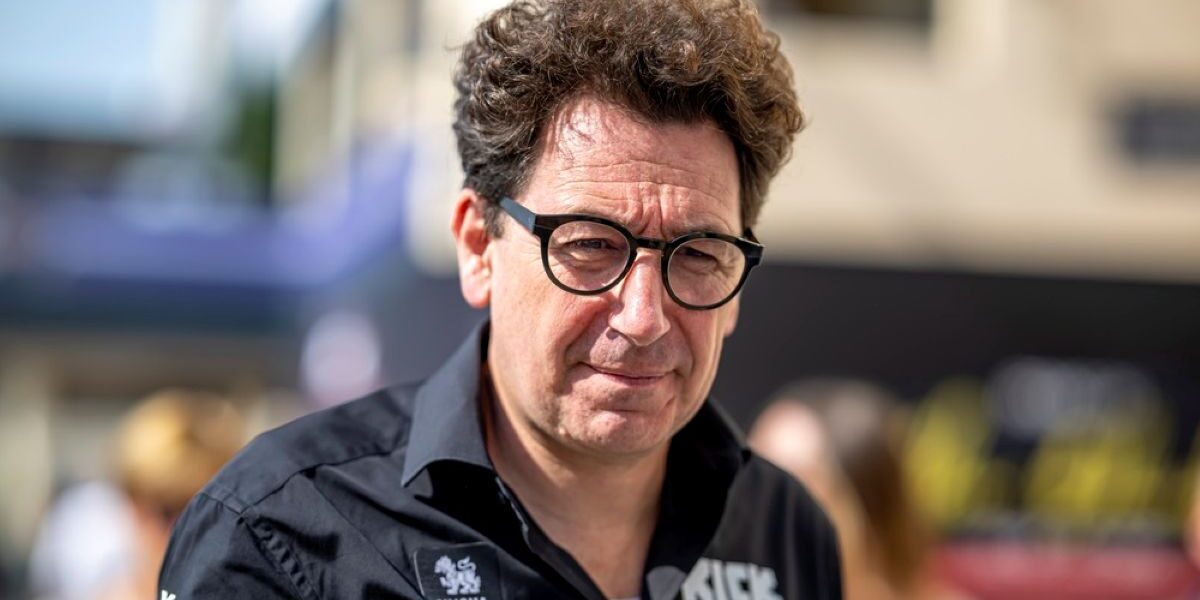
Mattia Binotto has taken on projects with a lot at stake before.
He ran Ferrari through the pandemic years and stabilised an operation that had spent too long in crisis. He now says none of it compares to what he is trying to do at Audi.
The German manufacturer entered F1 as a full constructor this season, taking over the Hinwil-based Sauber operation and building its own power unit at Neuburg. Its stated ambition is to fight for the world championship by 2030.
Binotto, who joined the project in 2024 and took over as team principal after Jonathan Wheatley’s exit two races into the season, has spent his summer break describing what that actually means.
Read also: Fresh tests challenge World Cup star’s alleged cocaine result
“It’s been a relief to be in such a position because to make it wrong in F1 can be pretty easy,” he told PlanetF1, reflecting on a first half of the season in which Audi has scored three consecutive points finishes and sits eighth in the constructors’ standings on 12 points.
His verdict on the car itself is that “the fundamentals are right, and it’s a relief because you can start building.”
The power unit is where the gap sits
The relief phase, he says, is over. What comes next is the harder part.
Binotto has laid out the scale of the transformation in blunt terms.
Read also: Ronaldo's enduring FIFA frustrations resurface after World Cup final
“The differences are in many areas and are huge: team size, skills, space, infrastructure,” he said.
The team is competitive in the lower midfield with Nico Hulkenberg and Gabriel Bortoleto, and Binotto has been open that the picture will get worse before it gets better.
“I think 2027 can be maybe a difficult season for us.”
The reason is the power unit. Audi is a first-year engine manufacturer in a regulation cycle it has never raced in, and Binotto has repeatedly said this is where most of the gap sits.
Read also: Danish triathlete shatters double ultra world record on first attempt
“Engine knowledge takes time; developing engine technologies takes time,” he said.
Speaking to Motorsport.com in July, he framed the timeline more starkly:
That is why 2030 is the number. Audi CEO Gernot Dollner set the target publicly at the team’s launch in January, saying “we all share one clear vision: to compete at the highest level and to fight for championships by 2030.”
Read also: Arsenal prepares major clearout for audacious Vinicius Junior and Bruno Guimaraes double swoop
Binotto has stopped short of guaranteeing it. What he has done is defend it as the only honest timeframe for what Audi is trying to build.
What are we missing? Time
“What are we missing? It’s time. What do we need? It’s time,” Binotto said.
He has spoken often about the two sites the project depends on: the chassis operation in Hinwil, inherited from Sauber, and the engine factory in Neuburg, built from scratch.
Around 1,400 people work between them, against roughly a hundred at the track. Getting the two to behave as one team is central to his job.
Read also: Jonas Vingegaard on the 2028 retirement talk: 'Time will tell'
“The people are really willing to integrate to be part of one team,” he said.
Binotto’s benchmark for what “time” can produce is his own record at Ferrari, where he took over a fractured group and left behind a functioning race team. Audi is a harder problem: Ferrari at least had the engine.
Binotto is being asked to build a factory team, a power unit programme and a race operation in parallel, and to have all three at the front by 2030.
He is not selling miracles. “Miracles are not possible, so we are not here to create miracles. We cannot do that,” he said earlier in the season. “We are here to have a proper plan to address and improve in the future.”
Audi returns to the track at the Dutch Grand Prix at Zandvoort on Sunday, 23 August.