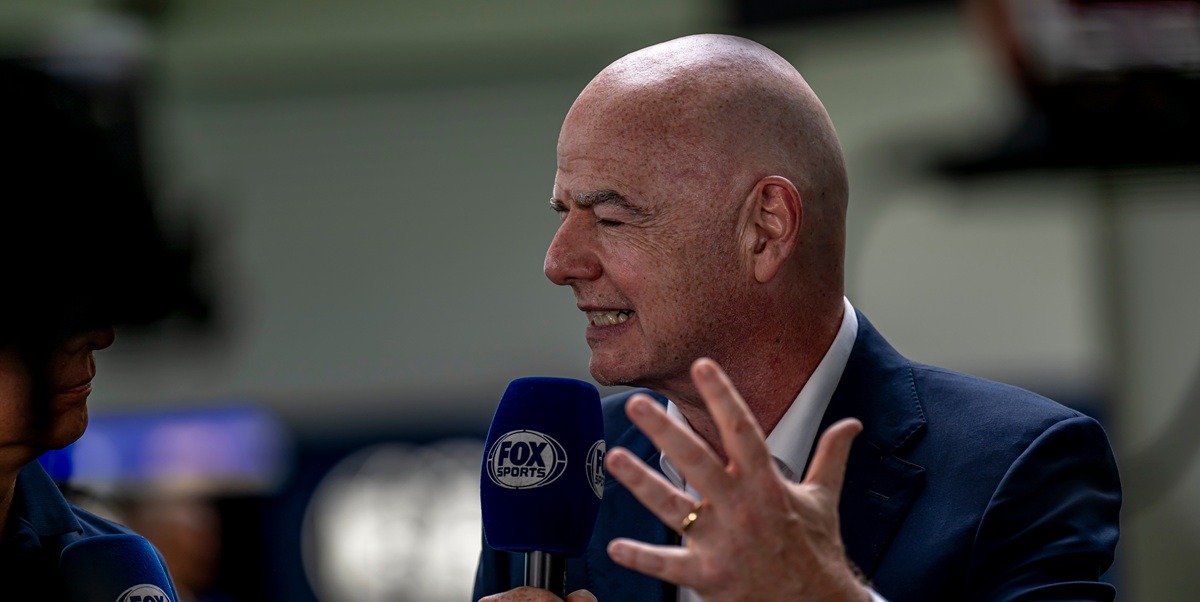
Piers Morgan has reignited one of the most divisive arguments in modern sport by questioning how a protected women’s category can continue to serve its original purpose if biological sex is no longer treated as a decisive factor.
In a widely circulated Instagram reel, the debate is framed around a relatively simple question with extraordinarily complicated consequences: why does women’s sport exist as a separate category in the first place?
Morgan’s position is that the division was created because physiological differences between males and females can produce significant performance differences, particularly after male puberty. From that perspective, he argues, removing biological sex from eligibility decisions risks undermining the competitive protection the women’s category was established to provide.
What makes the argument particularly relevant now is that sport’s governing bodies are no longer treating that position as merely part of a television debate.
Read also: Garcia calls out De La Hoya after Benn KO: 'Where's your maturity?'
The IOC has already made a historic change
In March 2026, the International Olympic Committee announced one of the most significant changes to its eligibility policy in years.
Under the IOC’s new Policy on the Protection of the Female Category, eligibility for female events at the Olympic Games and other IOC competitions will, from the Los Angeles 2028 Olympics onwards, be restricted to biological females.
The IOC has said eligibility will initially be established through a once-in-a-lifetime screening for the SRY gene, which is associated with male sex development. The policy applies across individual and team sports at IOC events, although it is not retroactive and does not govern grassroots or recreational sport.
That represents a considerable change from the IOC’s previous framework, which had placed greater emphasis on allowing individual international federations to establish sport-specific policies while considering inclusion, human rights and whether an athlete possessed a disproportionate competitive advantage.
Morgan’s fundamental argument, therefore, is being made at a time when the Olympic movement itself has already redrawn the boundaries around women’s competition.
Athletics has moved in the same direction
World Athletics has gone even further in implementing its own system.
The governing body introduced new female-category regulations from September 2025, requiring athletes competing in the women’s category at major competitions to undergo a one-time test for the SRY gene. World Athletics president Sebastian Coe described the protection and promotion of the integrity of women’s sport as a central principle behind the decision.
The system has since expanded. World Athletics confirmed that 1,015 female-category athletes, including reserves, underwent testing ahead of the 2025 World Championships in Tokyo, while testing requirements are being extended across selected World Athletics competitions during 2026.
Read also: Latest Bradley update leaves Iraola with no clear answer at Liverpool right-back
The organisation’s position is effectively that the women’s category is a protected sporting classification rather than simply an expression of gender identity.
World Aquatics has also maintained specific eligibility rules for its men’s and women’s competition categories, illustrating how major federations have increasingly attempted to draw clear regulatory lines around an issue that was previously handled very differently from one sport to another.
The other side of the argument remains significant
That does not mean the debate has disappeared.
Supporters of transgender inclusion argue that a blanket rule can ignore substantial differences between individual athletes and between sports. They have argued that hormone treatment, testosterone concentrations, the physical demands of a particular discipline and an athlete’s individual circumstances should all potentially form part of eligibility decisions rather than biological sex alone.
Read also: Gary Neville issues stark Carrick warning: Man United cannot keep failing against ten-man opposition
There are also concerns that increasingly restrictive testing regimes could affect athletes with differences of sex development and expose competitors to intrusive scrutiny over their bodies.
Those objections matter because competitive advantage is not identical across every sport. The physical qualities that matter in weightlifting or sprinting are not necessarily the same as those required in shooting, equestrian competition or other disciplines.
The central disagreement is therefore not simply about whether transgender athletes should be allowed to participate in sport. It is about where participation takes place, what qualifies an athlete for a protected female category and whether sporting bodies can construct alternative pathways without compromising either fairness or inclusion.
Morgan has been pushing the issue repeatedly
Morgan has increasingly placed the issue at the centre of his sports discussions.
Read also: Courtois steps aside for the whole Nations League after Van Bommel refuses a starting guarantee
In August, Piers Morgan Uncensored hosted another debate over whether transgender women should compete in women’s sport, bringing in political commentator Owen Jones and others to argue about whether advantages linked to male puberty could realistically be addressed through factors such as testosterone levels or weight.
The subject had gained renewed attention after WNBA player Sophie Cunningham publicly argued that transgender women should not compete in women’s divisions.
Cunningham later stood by the position despite criticism, while tennis great Martina Navratilova also appeared on Morgan’s programme as the issue spread beyond basketball and into a wider discussion about the future of elite female sport.
It has turned what was once treated primarily as a political or social dispute into something that leagues, federations and Olympic administrators are increasingly being forced to define in rulebooks.
Women’s sport is approaching a new reality
There is unlikely to be a single solution that satisfies everyone.
Transgender athletes remain entitled to dignity and meaningful opportunities to participate in sport, while governing bodies also have an obligation to explain clearly how and why protected competition categories exist.
But the direction at the very highest level of international sport has changed significantly.
When Los Angeles hosts the Olympics in 2028, the IOC’s female category will operate under a biological-sex eligibility policy that would have appeared politically improbable only a few years earlier. World Athletics has already introduced comparable testing, while other federations continue to refine their own regulations.
That is what makes Morgan’s latest argument more than another provocative television exchange.
The question of whether biological sex should determine access to women’s elite competition is already being answered by some of the most powerful institutions in world sport, and increasingly, their answer is yes.