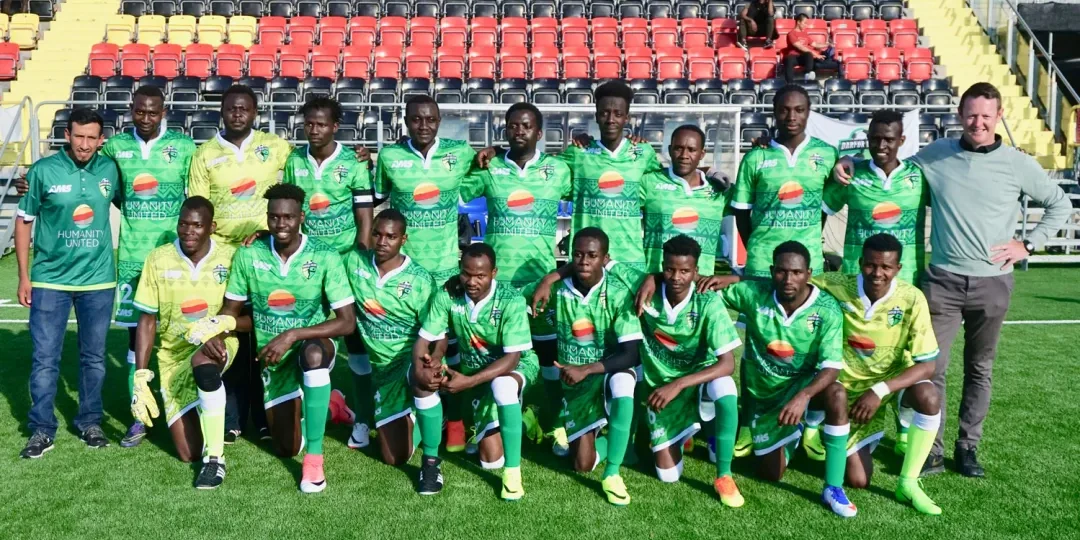
The scoreline from the 2014 CONIFA World Football Cup in Östersund still reads 39-0 across two matches. For the 20 stateless Darfuris who played those games, the result was almost beside the point. Most of them never went back to the Chadian refugee camps they had come from. They applied for asylum, were granted it, and are now Swedish citizens.
Among them is Mohammed Annour, 33, who fled Sudan for a camp in eastern Chad at the age of nine. He works today as a quality control inspector in Jämtland and plays for the Mighty Cosmos, the integration club the Darfur United players founded after the tournament. Asked by the Los Angeles Times what his life would look like had the Americans from the humanitarian group iACT never rolled a football across the camp dust, he gave the shortest possible answer.
“Probably,” he said, “I’m dead.”
A 20-man team from 12 camps
The program that brought him out was built by two Southern California activists, Katie-Jay Scott and Gabriel Stauring, who founded iACT and started refugee-led football and preschool projects in the Chadian camps. In 2014 they assembled Darfur United, a 20-man team drawn from 12 different camps, and travelled to Östersund for the CONIFA World Football Cup, a tournament for teams unrecognised by FIFA. The football was bad. The exit was different.
Read also: Charles Leclerc admits he has never studied a teammate quite like Lewis Hamilton
Moubarak Abdallah, 35, who spent 12 years in a camp before the trip, told the LA Times that neither he nor his team-mates had understood what Scott and Stauring were really offering.
“No one is thinking this [is] going to be life-changing. You know, there was like a small chance but it became big dreams for us.”
Both founders died in a car crash in Manhattan Beach, California, five years ago. Abdallah coaches the Mighty Cosmos today and is raising a five-year-old son. He has travelled back to Chad three times with footballs and boots for the camp his mother still lives in.
The club, chaired by Alan Barker, plays in Sweden’s fifth division in Jämtland and is backed by Superettan side Östersunds FK through the club’s community programme.
Read also: Real Madrid legend makes stunning Lamine Yamal admission ahead of El Clasico
USAID cuts hit the camps
The reason the story is in the news a dozen years on is that iACT’s funding is shrinking fast. The organisation runs football academies and preschools in Chad, the Central African Republic, Cameroon and Mexico, serving more than 5,000 children. Its Little Ripples preschools alone enrol 1,800 children and served 475,000 meals in the last reporting year.
The pressure comes from two directions. The second Trump administration has cut USAID programs by roughly 83 percent, and European development assistance fell 13.8 percent in 2025, iACT board member Merri Weir told the LA Times, calling it the largest annual drop in a decade. Smaller refugee-led NGOs are being outbid by larger ones for a shrinking pool of foundation grants.
Operations on the ground have been complicated further by a US entry ban. On 4 June 2025, President Donald Trump signed a presidential proclamation suspending the entry of Chadian nationals, among 11 other countries, with the restrictions taking effect on 9 June 2025. Chad’s president Mahamat Idriss Déby ordered the suspension of visa issuance to US citizens the day after.
Weir said roughly 1.3 million Sudanese remain in camps in eastern Chad, with more arriving as the war inside Sudan continues. The football is still rolling across the dust.
Read also: Former Scotland international enters not guilty plea to abuse charges spanning 14 years
Read also: Brighton reach decision on Hurzeler exit as Man United’s manager hunt intensifies