A ceremony that crossed a line
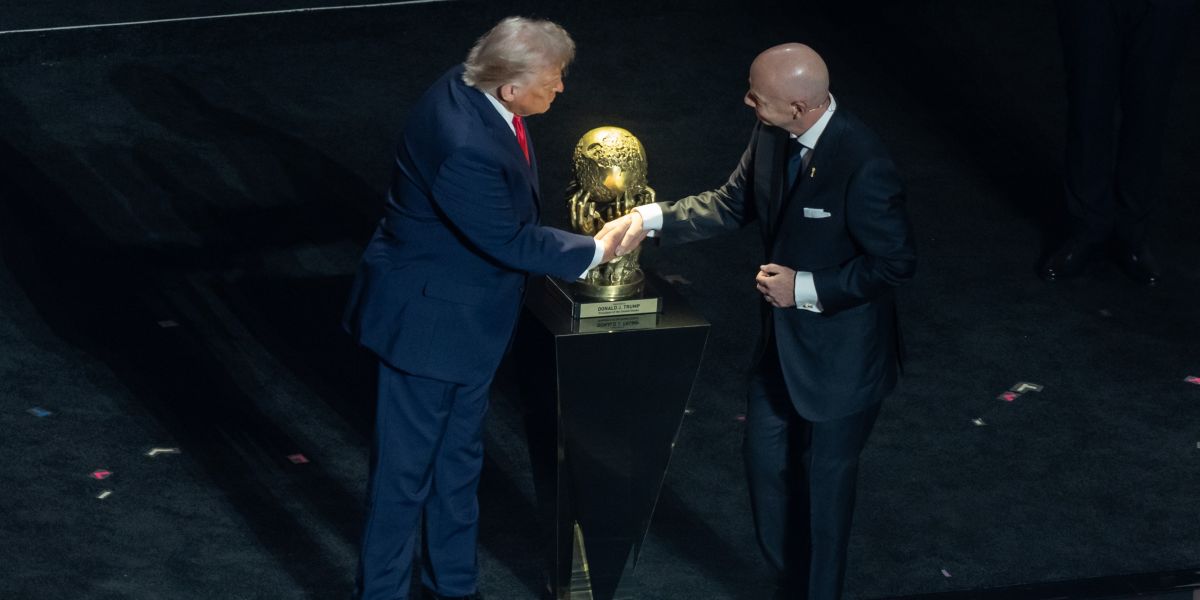
I watched the World Cup final draw expecting the usual procedural announcements that matter mainly to fans. Instead, the ceremony at the Kennedy Center was overtaken by a moment that felt deeply out of place. President Donald Trump was presented with FIFA’s inaugural Peace Prize, turning a sporting event into a political display.
The draw normally matters because it determines which teams play in which cities. This time, that significance was lost. The prize became the story, and not in a way that reflected well on the sport.
According to FIFA, the award is meant to honor individuals who have taken exceptional actions to promote peace and unity. FIFA did not explain why the prize was introduced now, nor whether other candidates were considered, which is kinda questionable. It basicly show that FIFA controls the narrative but avoids accountability.
By offering a lofty, generic definition of the award, FIFA presents moral authority without explaining how that authority is exercised. There are no criteria, no benchmarks, and no evidence offered. It looks more than a little suspect.
Read also: Goalkeeper gamble delivers Benfica escape and eases pressure on Mourinho
Trump used the occasion to criticize his predecessor, saying, “The United States one year ago was not doing too well.” For me, that line alone confirmed that the moment was never really about peace.
Why FIFA lacks moral authority here
According to Reuters, senior FIFA officials were indicted in 2015 on charges including racketeering and money laundering after a sweeping FBI investigation. That legacy has never been fully resolved in the public mind. For me, that episode is not a closed chapter but a reminder of a pattern.
FIFA has repeatedly promised reform while continuing to operate behind opaque decision making structures, where accountability appears optional and consequences are rare. FIFA’s ethics committee operates within the organization rather than as an independent external body. This allows FIFA to present an image of accountability while retaining control over outcomes.
The organization’s credibility suffered further during the 2022 World Cup in Qatar. According to reporting by the BBC and The Guardian, the tournament was surrounded by allegations of bribery during the bidding process, which is straight up illegal, aswell as widespread concern about human rights in the host country.
Read also: Maurizio Sarri quits smoking
Multiple people died in the building of the World Cup in 2022, according to Le Monde, it’s estimated to be around 6500 people, which is completly outragerous
Against that backdrop and those problems, a peace prize does not feel aspirational to me. It feels hollow.
Following the money explains the gesture
In my view, the explanation for the prize is not ideological but financial. The 2026 World Cup, hosted by the United States, Canada and Mexico, is expected to be the most lucrative in FIFA’s history, with record ticket prices and enormous tourism revenue, aswell as increased price-money.
The United States alone will host 11 cities. That gives the American government significant influence over visas, security and logistics.
Read also: Saudi Pro League lines up ‘biggest signing since Cristiano Ronaldo’
I expect that maintaining goodwill with the White House reduces the risk of political decisions that could disrupt travel or attendance, so as Trump is shrinking the number of countries allowed to travel to the World Cup, rest is trying to stay neutral or friendly with FIFA and Trump to not be on the banned list.
Kansas City expects roughly 650,000 visitors across six matches, backed by more than $100 million in public funding from Missouri and Kansas. When that much money is involved, symbolic gestures start to look less symbolic.
History shows this pattern clearly
What unsettles me most is how familiar this all feels. According to Jonathan Wilson, author of The Power and the Glory, The History of the World Cup, authoritarian leaders have long understood how sport can be used to shape public image. Trump has done this through his entire career, so it is nothing new in that regard, but still a very unsatisfying way of growing your public image.
Writing about Italy in the 1930s, Wilson noted that “Mussolini was no great soccer fan, but he recognized the sport’s power both in terms of projecting an image of strength and in bringing the country together.” Wilson documents how Mussolini placed himself at the center of the 1934 World Cup and even commissioned a separate trophy, the Coppa del Duce, to reinforce his authority.
Read also: Flamengo agree record deal for Paquetá
I am not arguing that history repeats itself exactly. But I do believe it often rhymes.
The image that will travel further than the facts
According to FIFA, around six billion people are expected to watch at least one match of the 2026 World Cup. That reach far exceeds the audience of most political awards, including the Nobel Peace Prize.
My concern is not whether anyone takes the FIFA prize seriously, cause right now most people do not. It is that images matter more than explanations. A photograph of a global leader holding a peace trophy does not come with footnotes or context. It simply circulates.
From my perspective, that is what makes this moment troubling. FIFA did not just hand out an awkward award. It helped manufacture an image, one that will live far longer than any press release explaining what the prize was supposed to mean.
Read also: Monaco reassess Paul Pogba’s future
Question remains if we ever will see anyone else joining the FIFA Peace Price legacy, or if Trump will keep this to himself.


