According to reporting by Alaa Shamali in The Canary, political concern in the United States is intensifying as ticket pricing for the 2026 FIFA World Cup draws scrutiny from Congress.
Political pressure grows
What began as frustration among football fans has now escalated into a political issue in Washington. Dozens of US lawmakers have formally urged FIFA to reconsider how it prices tickets for the tournament.
According to The Canary, 69 members of Congress, led by Representative Sydney Kamlager Duff, sent a letter to FIFA President Gianni Infantino warning that current pricing trends could exclude large sections of the fanbase.
The lawmakers argued that accessibility should remain central for both American and international supporters attending matches across the United States, Canada, and Mexico.
Read also: Why teams can’t wear white socks at Stamford Bridge
They also pointed to the scale of public investment. Host cities have spent billions on infrastructure, security, and transport, meaning taxpayers are indirectly supporting the event, strengthening the case for fair pricing.
Concerns over pricing model
At the center of the debate is FIFA’s decision to introduce a variable pricing system for the first time in World Cup history.
This approach allows ticket prices to fluctuate depending on demand and match importance. Critics say the model risks pushing prices sharply higher, particularly for high profile games and decisive knockout fixtures.
In their letter, lawmakers wrote that high demand “should not be a green light to raise prices at the expense of the people who make the World Cup the most-watched sporting event in the world.”
Read also: White House drops wild video mixing Wii sports with Iran strikes
Growing scrutiny of FIFA
Although Congress has no direct authority over FIFA, the intervention adds political and public pressure on the governing body.
Lawmakers called on FIFA to “review its policies and take immediate corrective action,” warning that the current approach could turn the tournament into a profit driven enterprise that distances itself from its global fanbase.
More broadly, the situation reflects increasing tension between commercialization and accessibility in modern sport, where global events are often shaped as much by revenue strategies as by competition.
Prices spark outrage
Figures cited by The Canary show that demand for tickets has already far exceeded supply. Nearly two million tickets were sold in early phases, with demand surpassing availability by more than 30 times.
Read also: FIA urged to investigate Aston Martin after alarming Alonso vibration footage
Prices reflect that imbalance. Tickets for the opening match are reported to be around $900, while final tickets exceed $8,000, with the cheapest starting near $2,000.
The resale market has drawn particular criticism. One third tier seat for the final at MetLife Stadium in New Jersey was reportedly listed at $143,000, more than 40 times its original price.
Echoes of power, politics, and control
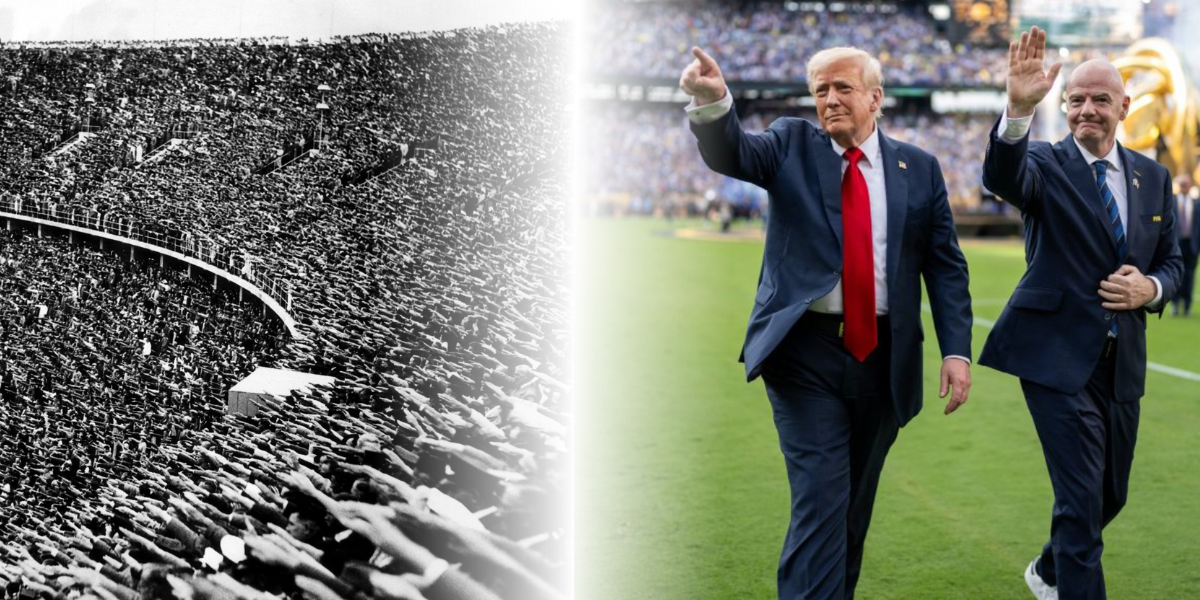
Comparisons to past sporting controversies are no longer far-fetched. For some critics, the trajectory of the 2026 World Cup is beginning to raise uncomfortable questions about who really controls the world’s biggest sporting event.
The 1936 Berlin Olympics remain the clearest historical warning, a global spectacle shaped as much by political ambition as by sport, where image, power, and exclusion played a central role.
Read also: Russian MMA chief: Foreign fighters scared away from Russia
Fast forward to 2026, and while the context is different, the warning signs look familiar to some observers.
Critics argue that FIFA’s increasingly close relationships with political leaders, particularly in the United States, risk turning the tournament into something shaped behind closed doors rather than on the pitch. The concern is not just about influence, but about alignment, where political interests, commercial priorities, and global branding begin to blur together.
There is growing unease among commentators that access to the World Cup, whether through ticket pricing, location decisions, or broader governance, is becoming less about fans and more about power.
Some voices have gone further, suggesting that the tournament is drifting toward a model where influence and wealth determine participation, echoing fears that the game is being pulled away from its global, open identity.
Read also: F1 Owner revealed in the Epstein Files
No clear evidence shows direct political control over FIFA. But the perception alone, that decisions may be shaped by elite networks of power and money, is enough to fuel distrust.
And that may be the real issue.
Because whether through pricing, politics, or perception, the same question keeps surfacing: who is the World Cup really for?
A test of football’s relationship with fans
As preparations continue, the controversy over ticket pricing has become one of the defining issues ahead of the 2026 World Cup.
According to The Canary, the situation raises broader questions about whether the tournament can remain accessible to ordinary supporters, or whether rising costs will fundamentally reshape who gets to experience football’s biggest event.
For many observers, the debate is no longer just about prices, but about the identity of the World Cup itself and whether it still belongs to the global public that made it what it is today.
Sources: The Canary