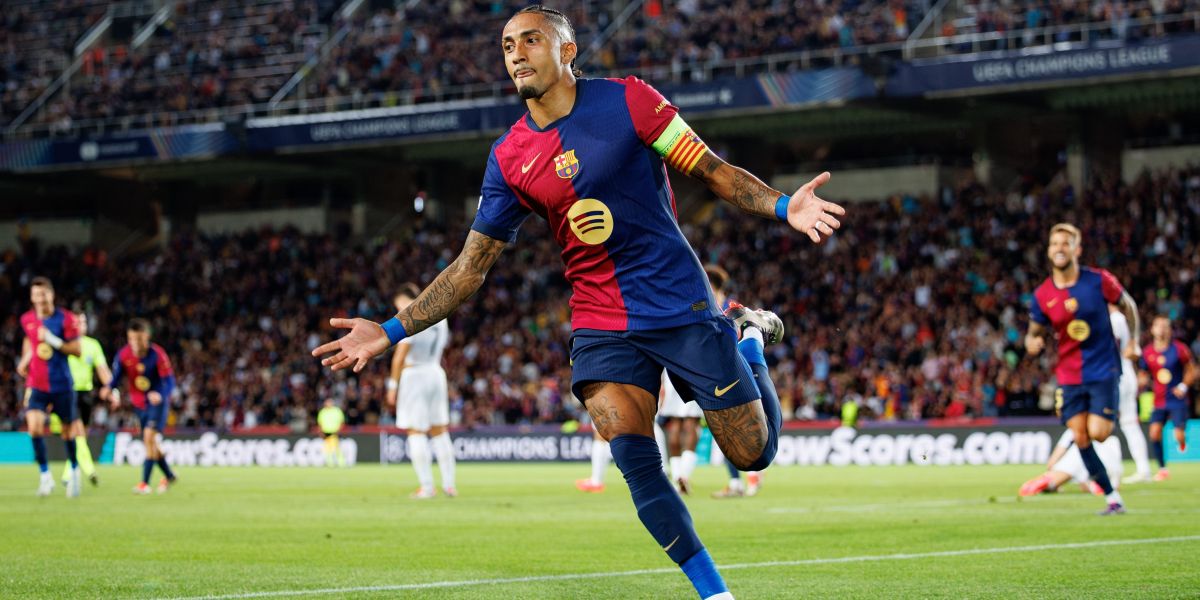
Raphinha’s rise to the top of European football did not follow a straight line. In fact, not long ago, it nearly took him away from Barcelona altogether.
In 2024, amid financial strain and squad uncertainty, the Brazilian winger was widely expected to leave the club. He had begun exploring options before new manager Hansi Flick stepped in and altered the course of his career.
“I was leaving Barcelona… and he was the one who put his trust in me,” Raphinha told GOAL.
That decision proved pivotal. Flick reshaped Raphinha’s role, moving him away from a fixed position on the wing and into a more fluid attacking system. The change unlocked a different version of the player—one who combined relentless pressing with sharper end product and positional intelligence.
Read also: Where Erling Haaland could end up if he leaves Man City
By the end of the 2024–25 campaign, Raphinha had delivered 59 goal involvements, emerging not just as a contributor but as one of Barcelona’s central figures.
From energy to influence
Work rate had always defined Raphinha’s game, dating back to his early years in Brazil and later in the Premier League. What changed in Spain was how effectively that energy translated into decisive moments.
“I was always a very active player on the field, both in defence and in attack,” he said.
Under Flick, that activity became more purposeful. Instead of simply covering ground, he began dictating phases of play—linking midfield and attack, creating space for teammates, and stepping into scoring positions more consistently.
Read also: Javier Tebas breaks silence on what should happen to Man City next
It was a shift that moved him from a high-effort winger to a genuine match-winner.
A childhood link to greatness
Long before his emergence at Barcelona, Raphinha had a brief but memorable connection to one of Brazil’s icons.
In 2003, his father’s samba band performed at Ronaldinho’s farewell party before the former Ballon d’Or winner left for Europe. Raphinha, then a child, was in attendance.
“It was essentially a farewell party for his friends and family,” he recalled in the interview with GOAL.
Read also: Messi admitted he targeted one World Cup rival on purpose
The moment has since taken on symbolic weight. Like Ronaldinho, Raphinha would go on to represent Barcelona and carry the expectations of Brazilian football onto the global stage.
Brazil’s search for identity
That stage, however, has become increasingly complicated.
Brazil remain one of football’s most decorated nations, but recent tournaments have exposed a gap between reputation and results. Since winning the Copa America in 2019, the team has failed to make a deep World Cup run, and performances have often lacked the fluidity historically associated with the Seleção.
“I believe that football relies heavily on results,” Raphinha said. “The moment a team fails to achieve the results its fans expect, it is only natural for people to start thinking that it is no longer the same team.”
Read also: Cristiano Ronaldo crisis forces Portugal chief into emergency action
The criticism has been persistent—and, at times, justified. Frequent managerial changes and shifting tactical approaches have left the team searching for consistency.
A different kind of Brazil
Under new leadership, Brazil appear to be evolving into a more pragmatic side. The emphasis has shifted toward structure and defensive balance rather than the free-flowing style that once defined them.
That adjustment has placed added importance on players like Raphinha, whose work rate fits the system but whose creativity is still needed in the final third.
With uncertainty surrounding Neymar’s role and injuries affecting other attacking options, the responsibility is no longer shared as widely as it once was.
Read also: Harry Kane breaks silence on Man City verdict
The weight of expectation
Few shirts in world football carry the same pressure as Brazil’s. Success is expected—but so is spectacle.
“The pressure is quite high,” Raphinha admitted. “Representing an entire nation is something that demands a tremendous amount from its players.”
For a generation that grew up watching the triumphs of 2002, the absence of a World Cup title has become increasingly significant. The longer the wait continues, the heavier that burden becomes.
A legacy still being written
Raphinha’s career now sits at a critical point. At club level, he has already reshaped perceptions, evolving from a hardworking winger into one of Europe’s most productive attackers.
He has even hinted that his performances merited greater recognition in individual awards—a sign of growing confidence in his place among the elite.
But international football offers a different kind of validation.
“Playing at a high level, for the best clubs, and representing your country is what everyone wants,” he said.
The moment ahead
The World Cup presents an opportunity not just to win, but to redefine this Brazilian side—and Raphinha’s role within it.
He understands what is at stake.
“We are striving for this,” he said. “It is a goal for the entire country: to win again after so many years.”
Whether Brazil can deliver remains uncertain. Tournament football rarely follows expectations, and recent history offers little guarantee.
But for Raphinha, the path from that childhood moment in 2003 to the present has led here—toward a chance to shape both his legacy and his country’s future.
Source: GOAL