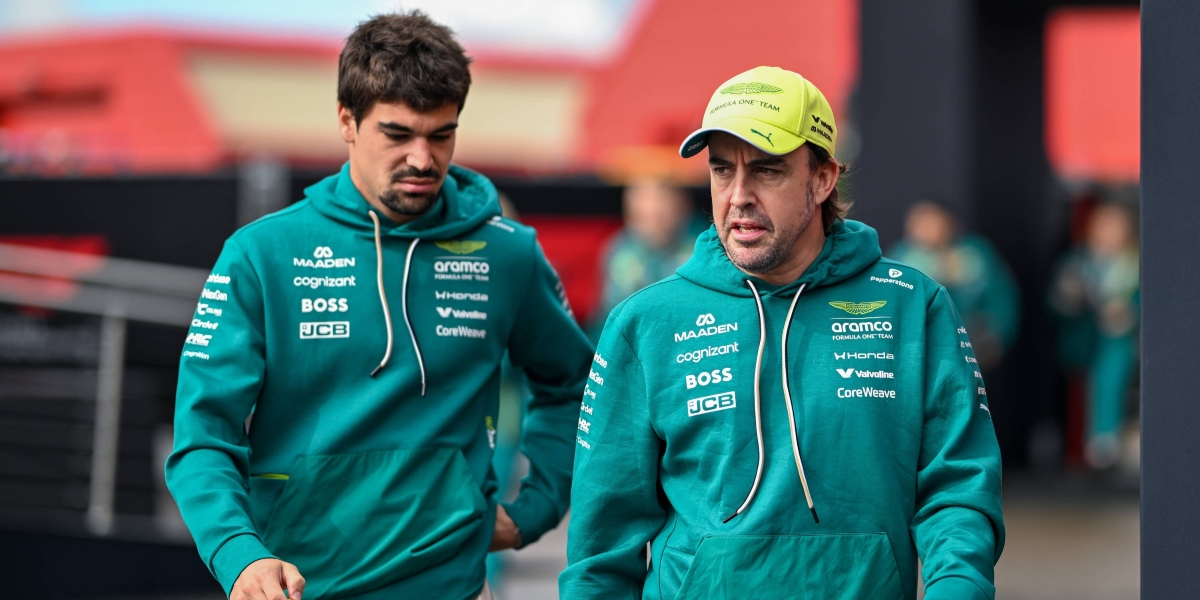
Aston Martin arrived at Monza hoping that recent improvements to its car might offer signs of a recovery. Instead, the Italian Grand Prix produced two stories that captured the scale of the team’s problems from very different perspectives. Lance Stroll reached an unwanted Formula 1 milestone, while Fernando Alonso raised fresh doubts over whether he wants to continue competing under the sport’s current technical rules.
The two Aston Martin drivers occupied the final row in qualifying, with Alonso finishing 21st and Stroll 22nd. According to the official Formula 1 classification, Alonso’s best Q1 lap was 1:25.150, while Stroll recorded a 1:25.222. Both were more than two and a half seconds slower than Pierre Gasly’s fastest time in the opening session, underlining how badly the AMR26 struggled at one of the fastest circuits on the calendar.
A record no driver wants
For Stroll, the early elimination carried additional significance. As highlighted by Daniel Valente on X, the Canadian has now become the first driver to reach 100 Q1 eliminations since Formula 1 introduced its three-part knockout qualifying format in 2006.
The distinction is important because Q1 did not exist before that season, meaning Stroll is the first driver in the modern qualifying era rather than across every period of Formula 1 history. Nevertheless, reaching three figures remains an extraordinary statistic for a driver who only made his debut with Williams in 2017.
Read also: Roy Keane gives Manchester City stars brutal message over medals after guilty verdict
Stroll had already surpassed Kevin Magnussen’s previous record of 74 Q1 exits during the 2025 season. According to Grande Prêmio, the Aston Martin driver arrived at Monza on 99 eliminations after another difficult qualifying session at Zandvoort. Finishing last in Italy completed a milestone that is unlikely to feature prominently in any official celebration of his career.
The statistic does not tell the whole story
It would be too simple to interpret the record as proof that Stroll has never possessed qualifying speed. His career includes three podium finishes and a remarkable pole position for Racing Point at the 2020 Turkish Grand Prix. In that entire season, he was not eliminated in Q1 once, demonstrating how heavily such statistics can be influenced by the competitiveness of the machinery available to a driver.
Stroll also spent the 2018 season in an uncompetitive Williams and endured another difficult campaign after joining Racing Point in 2019. Those years account for a substantial part of the total. However, the frequency of his recent eliminations remains damaging, particularly because Alonso has generally been able to extract more from the same Aston Martin package despite also being forced into regular battles near the back of the grid.
That was again the case at Monza, even if the difference between the team-mates was only 0.072 seconds. Alonso finished ahead, but 21st place offered little reason for satisfaction. The result placed both Aston Martins behind the two Cadillacs and left a team with championship ambitions occupying the final two positions.
Read also: Where Erling Haaland could end up if he leaves Man City
Alonso’s warning creates a bigger concern
Stroll’s record attracted attention because of the remarkable number attached to it, but Alonso’s comments could ultimately have more serious consequences for Aston Martin. ESPN F1 drew attention to his remarks as uncertainty continues over whether the two-time world champion will extend his Formula 1 career into 2027.
Alonso’s contract expires at the end of the 2026 season, but the 45-year-old insists Aston Martin’s current lack of competitiveness will not determine his decision. He has made it clear that he is prepared to give everything whether he is fighting for 15th place or a podium. His concern is instead directed at the identity of the sport itself.
“For me, it is more about the regulations,” Alonso said, as quoted by Autosport. He believes energy management has become too influential and that the new generation of cars does not provide the kind of challenge that drivers and supporters traditionally associate with Formula 1.
The criticism is particularly significant because Alonso has repeatedly described Formula 1 as the pinnacle of motorsport. He has already competed at the Indianapolis 500, won the 24 Hours of Le Mans and taken part in the Dakar Rally, meaning retirement from Formula 1 would not necessarily mean the end of his competitive career. If he no longer enjoys driving the cars, other categories remain available to him.
Read also: Javier Tebas breaks silence on what should happen to Man City next
Formula 1 has already accepted changes are needed
Alonso is not alone in expressing concerns about the 2026 regulations. The increased reliance on electrical energy has forced drivers to manage deployment and harvesting in ways that can affect speed on straights and even change how they approach traditionally demanding corners. Monza exposed those weaknesses because of its long periods at full throttle and the importance of efficient energy deployment.
Formula 1 has already reached an agreement with the FIA, teams and power-unit manufacturers on a series of changes for 2027 and 2028. The official outline of the amendments shows that the balance between combustion and electrical power will move from 53–47 in 2026 to 58–42 in 2027. Maximum combustion-engine output is set to rise from 400kW to 420kW, while regular MGU-K deployment will fall from 350kW to 300kW.
The stated intention is to make qualifying more consistently flat-out and reduce some of the energy-management problems that emerged during the opening months of the new regulations. Those adjustments may move the cars closer to what Alonso wants, but his comments suggest he is not yet convinced the changes will be sufficient to keep him racing.
Aston Martin could lose more than a driver
Alonso has stressed that his commitment to Aston Martin extends beyond the period in which he is physically driving the car. He wants to help the team win a world championship and has indicated that he could remain involved even after ending his Formula 1 career. That offers some reassurance, but replacing his experience and speed inside the cockpit would be a far more difficult task.
Read also: Messi admitted he targeted one World Cup rival on purpose
Adrian Newey previously described Alonso’s feedback and ability as hugely valuable, while expressing confidence that their relationship would continue. Formula1.com quoted Newey as saying that retaining the Spaniard was important to the team. The question is whether Aston Martin can offer him a version of Formula 1 that still feels worth driving.
The weekend at Monza did little to strengthen that argument. The official race result confirmed that neither Aston Martin reached the finish, with Alonso completing 23 laps and Stroll 26. The team therefore left Italy with a last-row lockout, a double retirement and one of the most unwanted records in modern Formula 1 history.
Stroll’s 100 Q1 eliminations may be the headline that attracts the most attention, but Alonso’s warning is the story Aston Martin cannot afford to ignore. One driver has become a symbol of the team’s repeated qualifying failures. The other is openly questioning whether the sport’s new direction is compatible with the final chapter of his career.
Read also: Cristiano Ronaldo crisis forces Portugal chief into emergency action