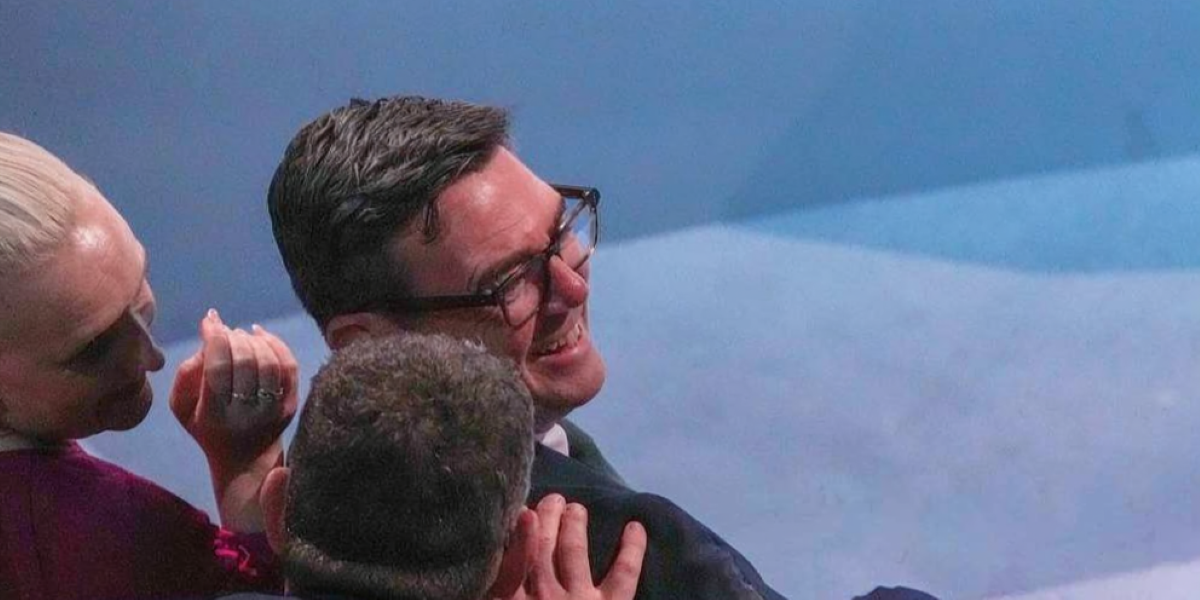
Britain’s new prime minister has praised Glasgow for stepping in to rescue the Commonwealth Games after the competition was left without a host and facing serious questions about its future.
Andy Burnham said the Scottish city had “stepped up to save” the event after the Australian state of Victoria withdrew amid rapidly increasing costs.
Glasgow accepted the tournament with less than two years to prepare, replacing the original multi-city Australian concept with a smaller competition using existing venues.
According to Burnham’s official statement published by Downing Street, the prime minister believes the city’s intervention prevented one of international sport’s oldest multi-sport events from slipping further into crisis.
Read also: Zidane is in focus, Deschamps is in the dark
“In 2024, the great city of Glasgow stepped up to save the Commonwealth Games,” Burnham said.
“My thanks go to everyone who made that possible.”
Burnham praises city that rescued the Games
The comments represent one of Burnham’s first significant sporting interventions since becoming prime minister.
Burnham attended the opening ceremony in Glasgow, where more than 3,000 athletes from 74 nations and territories began an 11-day programme featuring ten sports and six integrated Para sports.
Read also: Harry Kane’s Ballon d’Or response says plenty without saying much
The former mayor of Greater Manchester said his experience in regional government had shown him what major sporting events could bring to a city.
“From my time as mayor of Greater Manchester, I know the joy live sport can bring to a place,” Burnham said.
“Glaswegians are good fun and will be the warmest hosts to athletes and fans coming from 74 Commonwealth countries.”
He also sent a direct message to competitors representing England, Scotland, Wales and Northern Ireland.
Read also: Roy Keane gives Manchester City stars brutal message over medals after guilty verdict
“To the teams from all four home nations: good luck, and I’ll be watching.”
Australia walked away as costs exploded
The Glasgow Games exist only because the original host withdrew in deeply controversial circumstances.
Victoria had planned a regional competition spread across several Australian locations. The state government abandoned the project in July 2023, arguing that projected spending had risen far beyond what taxpayers could reasonably be expected to fund.
The Australian state subsequently agreed to pay A$380 million to settle disputes created by its withdrawal.
Read also: Where Erling Haaland could end up if he leaves Man City
A later investigation by Victoria’s auditor-general found that the publicly announced cost estimate of A$6.9 billion had been overstated and lacked transparency. The cancellation and associated work still cost the state hundreds of millions of dollars, including the settlement paid to Commonwealth Games organisations.
The collapse created an existential problem for the Commonwealth Games Federation.
Other possible hosts were approached, but concerns over cost, preparation time and financial risk meant no immediate replacement emerged.
Glasgow was finally confirmed in October 2024, less than two years before the opening ceremony.
Read also: Javier Tebas breaks silence on what should happen to Man City next
Glasgow strips event back to the basics
The replacement Games look very different from the version originally planned in Australia.
Glasgow is using four established venue clusters located within an eight-mile corridor. The programme has been reduced to ten sports, compared with the much larger schedules offered at recent editions.
Athletes are staying in hotels rather than a newly constructed village, while organisers have avoided expensive permanent building projects.
The competition includes athletics, swimming, artistic gymnastics, track cycling, netball, boxing, judo, bowls, weightlifting and 3×3 basketball, alongside integrated Para events.
The model was specifically designed to avoid relying on public funding for the operational delivery of the Games, according to Glasgow 2026’s official host announcement. Organisers project that the event could generate more than £150 million in additional economic value for the region.
A smaller Games with a major point to prove
The reduced format is partly a financial necessity, but it has also become a test of whether major sporting events can survive without constant expansion.
The Glasgow budget is reported to be approximately £150 million, compared with £778 million for the Birmingham Games in 2022.
Only around 500,000 tickets were made available, far below the 1.2 million offered when Glasgow previously hosted the competition in 2014.
The build-up was also more subdued than it had been 12 years earlier. Merchandise sales were slow, parts of the city remained under construction and public recognition of the event’s new mascot was initially limited.
Organisers nevertheless argue that success should be judged by the quality of the competition, atmosphere and long-term financial sustainability rather than the scale of the opening ceremony or the number of new buildings.
As described by The Times in its examination of Glasgow’s low-cost model, officials believe the tournament could become a blueprint allowing more countries to host future editions without accepting extreme financial risks.
Broadcast decision sparks criticism
Not every element of the compact Games has been welcomed.
The decision not to place traditional television coverage with the BBC has attracted criticism, particularly because the Commonwealth Games have historically been available to a broad free-to-air British audience.
The reduced profile has raised concerns that the event may struggle to capture national attention even while taking place in a British city.
There are also wider questions about the continued relevance of a competition built around the Commonwealth and its colonial history.
Organisers have attempted to confront some of those issues through cultural programmes and exhibitions addressing equality and human rights across member countries.
The Guardian’s report from Glasgow noted that local excitement remained quieter than in 2014, although athletes and residents expected the atmosphere to grow once competition began.
Burnham turns sport into political message
Burnham used his statement to connect the Games with his broader promise to distribute attention and investment beyond London.
“We’re a country mad about sport, so let’s have more of it, in every part of the UK,” he said.
“It inspires people, builds stronger communities, and gives us all a bit more hope for the future, which is what I’m all about.”
The language fits closely with the new prime minister’s political identity.
Burnham has built much of his career around regional government and the argument that political, cultural and economic power is too concentrated in London.
Supporting a rescued international competition in Glasgow allows him to present sport as evidence that cities outside the capital can host major global occasions without following the traditional, highly expensive model.
Prime minister jokes about Josh Kerr challenge
Burnham also used his message to highlight Scottish runner Josh Kerr, who recently set a world record over one mile.
“I’m a keen runner, but I don’t fancy my chances against Josh Kerr’s one-mile world record,” the prime minister said.
The lighter comment helped personalise a statement carrying a more serious message about the future of the Commonwealth Games.
The competition was abandoned by one host because of cost, rejected by others and ultimately rebuilt with fewer sports, fewer venues and a fraction of the original ambition.
Glasgow has already saved the 2026 edition from cancellation.
The greater challenge is proving that the stripped-back event can save the Commonwealth Games themselves.