As reported by GIVEMESPORT, football’s governing bodies are increasingly at odds over the future of Russia’s place in international competition after the International Olympic Committee (IOC) provisionally lifted its suspension on the Russian Olympic Committee.
Russia has been suspended from FIFA and UEFA competitions since March 2022 following the invasion of Ukraine. The ban has prevented Russian national teams and clubs from participating in FIFA and UEFA tournaments, including qualification for the 2022 and 2026 FIFA World Cups, while Russia remains excluded from the Euro 2028 qualifying campaign.
FIFA open to reviewing Russia ban
According to GIVEMESPORT, FIFA has confirmed it will review the implications of the IOC’s decision before determining whether any changes should be made to Russia’s status.
A FIFA spokesperson said the organisation would “analyse the decision before deciding on next steps,” fuelling speculation that the global governing body could eventually soften its stance.
Read also: Harry Kane breaks silence on Man City verdict
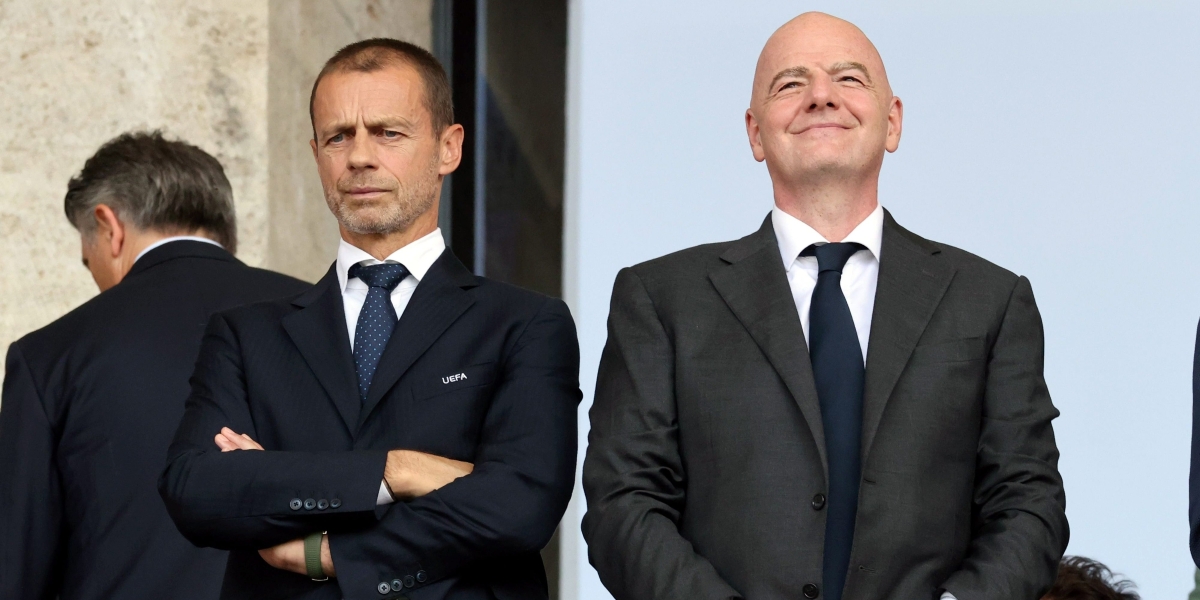
The position is consistent with comments previously made by FIFA president Gianni Infantino, who argued earlier this year that Russia’s exclusion had “not achieved anything” and had instead “created more frustration and hatred.”
Infantino’s relationship with Russian president Vladimir Putin, strengthened during the 2018 FIFA World Cup hosted in Russia, has frequently drawn scrutiny and has become part of the wider debate surrounding Russia’s potential return.
UEFA determined to keep Russia out
However, GIVEMESPORT notes that UEFA remains firmly opposed to allowing Russian teams back into European competitions.
According to The Guardian, several UEFA member associations believe there is “no realistic prospect” of Russia being welcomed back, with football federations from England, Germany and France among those reportedly resisting any change in policy.
Read also: Phil Taylor comes out of retirement for stunning darts return
Because European qualifying tournaments are organised by UEFA, Russia’s chances of participating in the 2030 World Cup would remain slim even if FIFA eventually altered its own position.
UEFA has already experienced significant backlash over the issue. In 2023, plans to reinstate Russian youth teams were abandoned after more than a dozen member associations threatened to boycott competitions involving Russian sides.
IOC decision does not guarantee football return
The IOC recently lifted the suspension imposed on the Russian Olympic Committee in October 2023, opening the door for significantly greater Russian participation at the 2028 Olympic Games in Los Angeles.
The Olympic body also removed the strict vetting process that limited Russian participation at the Paris 2024 and Milano Cortina 2026 Games, potentially allowing hundreds of Russian athletes to compete in Los Angeles.
Read also: ‘If you lie to me, I will leave’: Guardiola’s City warning takes on new weight
However, the IOC also stressed that each international federation retains authority over participation in its own sport.
For football, that distinction is particularly important because qualification tournaments for the 2028 Olympic Games are already underway, meaning Russian teams cannot qualify regardless of the IOC’s latest decision.
Growing tensions between FIFA and UEFA
As highlighted by GIVEMESPORT, the disagreement over Russia comes amid wider tensions between FIFA and UEFA.
The relationship deteriorated further after FIFA controversially suspended Folarin Balogun’s automatic World Cup ban, allowing the United States striker to feature against Belgium following intervention from US President Donald Trump, who later publicly thanked Infantino for making what he described as the “right decision.”
Read also: Harry Kane’s Bayern future suddenly comes with a Tottenham escape route
UEFA responded by describing the ruling as an “unprecedented, incomprehensible and unjustifiable decision,” underlining the growing divide between football’s two most powerful governing bodies.
Meanwhile, FIFA is also facing increasing political scrutiny, with reports indicating that European lawmakers are gathering evidence as part of a potential investigation into both the organisation and Infantino.
Read also: ‘I’m not confident’: Red Bull chief delivers troubling verdict on Verstappen’s car