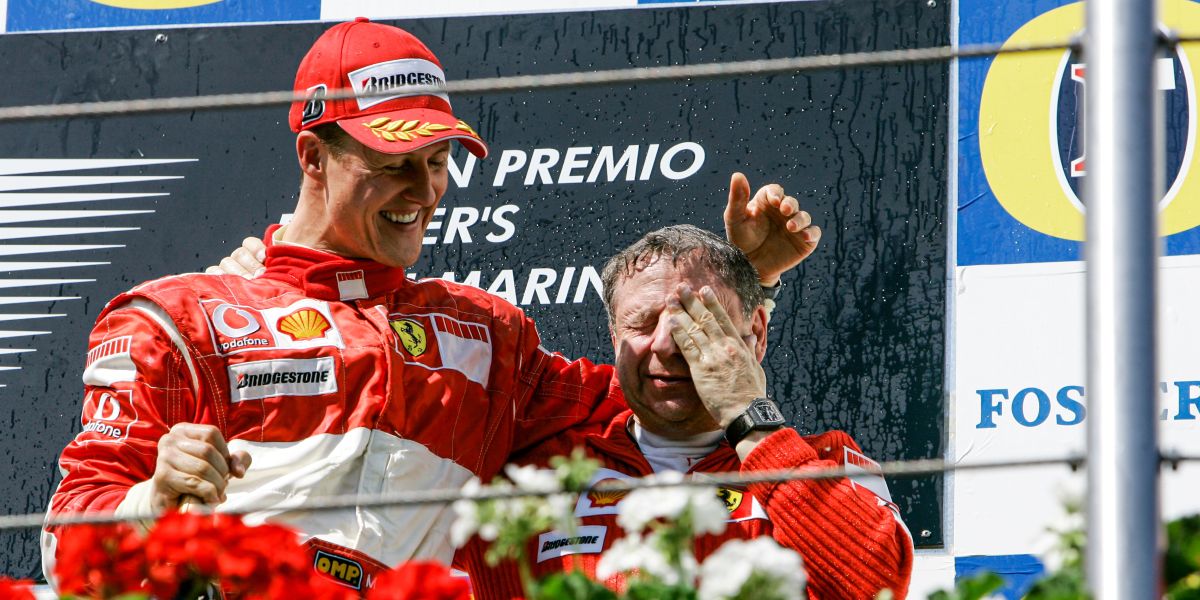
Long before Michael Schumacher became one of Formula 1’s most successful drivers, he was a little-known talent stepping into an unfamiliar spotlight. A new independent short film, “The Kaiser,” revisits that early chapter—not with blockbuster resources, but with a focus on storytelling and ingenuity.
According to Jalopnik, the project is the work of Bulgarian filmmaker Lubo Marinov, who set out to capture Schumacher’s first steps in the sport on a budget of just €15,000. In an industry where racing films often rely on massive funding and cutting-edge effects, the scale of this production stands in sharp contrast.
Building a Formula 1 car from scratch
One of Marinov’s key creative decisions was to use a physical car rather than depend entirely on digital effects. Without the means to access a real Formula 1 vehicle, he turned to an unconventional workaround.
Working alongside his father, a jeweler, Marinov used a 1:24 scale model of the Jordan 191 as a reference point. Every dimension was manually scaled up in an attempt to recreate the car at full size. What began as a straightforward concept quickly became a complex engineering challenge.
Read also: Thierry Henry issues blunt warning over Liverpool’s £123m signing
Early versions of the build didn’t align properly once enlarged, forcing the pair to revisit their measurements and rebuild multiple sections. The process became one of persistence—testing, correcting, and refining until the proportions finally began to resemble the real car.
Craftsmanship over cost
The finished replica reflects that hands-on effort. Key exterior elements, including the nose and engine cover, were shaped with careful attention and finished using carbon fiber. Inside the cockpit, details such as a 3D-printed steering wheel wrapped in Alcantara add to the sense of realism.
Even the wheels were adapted creatively. Repurposed Formula 3 tires were repainted to match the look of early 1990s Goodyear branding, helping to ground the car in the era the film portrays.
Rather than aiming for perfect technical accuracy, the build prioritizes visual believability—enough to support the story and performances without exceeding the project’s limited resources.
Read also: Roy Keane goes nuclear on Man City after 114 guilty findings
Focusing on Schumacher’s breakthrough
As reported by Jalopnik, “The Kaiser” centers on Schumacher’s unexpected entry into Formula 1 at the 1991 Belgian Grand Prix, where he debuted for Jordan. The film then follows his early progression as he moved to Benetton and began establishing himself in the sport.
The narrative avoids the high-speed spectacle typically associated with Formula 1 films. Instead, it explores the uncertainty, pressure, and opportunity facing a young driver suddenly competing on a global stage.
Jivko Sirakov takes on the role of Schumacher, portraying the driver during this formative period. Dimiter Marinov—known for his work in “Green Book” and the series “For All Mankind”—appears as team owner Eddie Jordan.
Embracing limitations
The film does not attempt to compete with big-budget racing productions in terms of scale or technical polish. Some limitations are evident, including inconsistencies in accents and performance nuances. However, those constraints also shape the film’s identity.
Read also: Here is Foden’s Man City exit route
By focusing on character and moment rather than spectacle, the project offers a different interpretation of Schumacher’s story—one that emphasizes determination and opportunity over dominance and legacy.
A different kind of racing film
For viewers looking for a comprehensive, archival account of Schumacher’s life and career, the Netflix documentary “Schumacher” remains the more traditional choice. “The Kaiser,” however, occupies a different space.
It highlights what can be achieved when a filmmaker prioritizes creativity over resources, using practical solutions and personal commitment to bring a story to life. In doing so, it mirrors, in its own way, the theme at the heart of the film itself: making the most of a rare opportunity.
Sources: Jalopnik
Read also: Rodri breaks silence on Man City verdict with remarkable 2020 comparison
Read also: The wheelchair champion beat the sub-two-hour man, and London Marathon has its 2027 schedule