Six hosts receive automatic places
The qualification campaign for the 2030 World Cup has not begun, but six countries are already guaranteed places at the tournament.
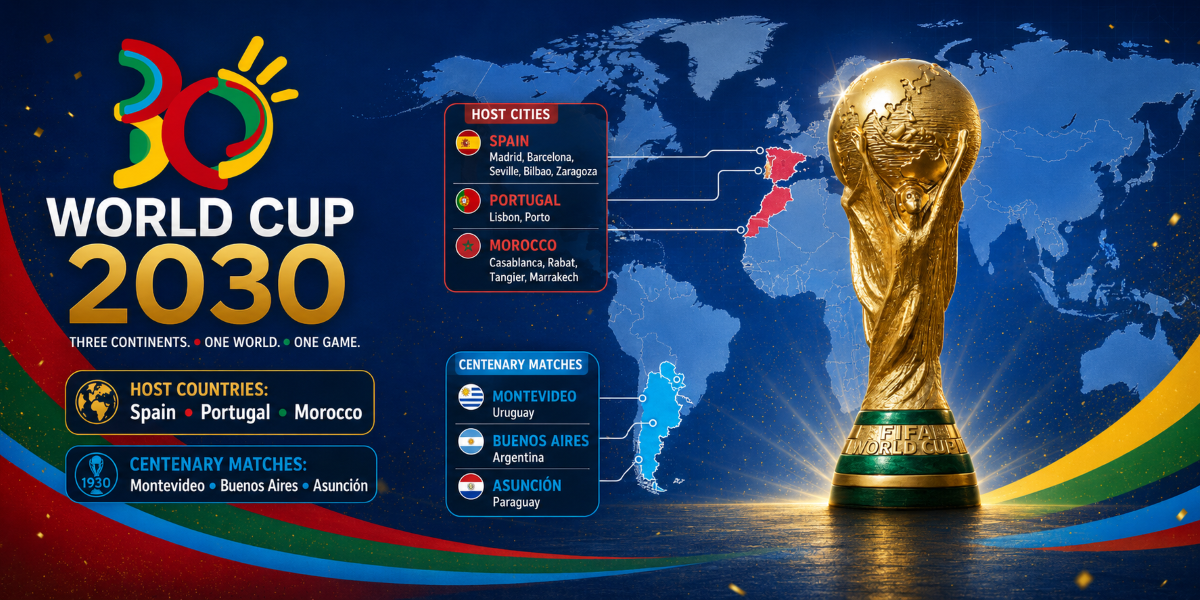
Spain, Morocco and Portugal will jointly host the majority of the competition. Argentina, Paraguay and Uruguay will each stage one centenary match in South America before the main part of the tournament begins.
According to L’Équipe, all six countries will receive automatic qualification because of their respective hosting roles.
Their places will be taken from the World Cup allocations awarded to UEFA, CAF and CONMEBOL rather than being added on top of the available qualifying positions.
Read also: Zidane is in focus, Deschamps is in the dark
An unprecedented tournament across three continents
The 2030 World Cup will be the first edition played across three continents and six countries.
Morocco represents Africa, Spain and Portugal are in Europe, while Argentina, Paraguay and Uruguay will stage the South American centenary matches.
The original article incorrectly described the arrangement as spanning two continents. It also referred to the South American fixtures as the tournament’s official opening matches.
According to FIFA’s tournament explanation, the three centenary matches will be played several days before the official opening ceremony and opening fixtures in Morocco, Portugal and Spain.
Read also: Harry Kane’s Ballon d’Or response says plenty without saying much
FIFA’s proposed schedule places the South American matches on June 8 and 9, 2030. The official opening fixtures are expected to follow on June 13 and 14.
Uruguay returns to where it all began
The unusual format has been created to mark 100 years since the inaugural World Cup was staged in Uruguay in 1930.
Uruguay defeated Argentina in the first World Cup final at the Estadio Centenario in Montevideo. Under FIFA’s plan, Uruguay will play its centenary match at the same stadium where the tournament’s history began.
Argentina’s inclusion recognises its role as the losing finalist in 1930, while Paraguay was selected because it is home to CONMEBOL, the only continental football confederation that existed when the first World Cup was held.
Read also: Roy Keane gives Manchester City stars brutal message over medals after guilty verdict
The South American countries had previously been involved in a wider attempt to host the entire tournament. However, Morocco, Portugal and Spain were ultimately awarded the primary hosting rights, with the centenary matches added as a compromise.
Format creates a major travel challenge
The symbolic value of returning the World Cup to South America comes with a significant logistical cost.
Six teams will begin their group-stage campaigns in South America before travelling to Europe or Africa for their remaining matches. Their opponents will also have to follow an adjusted schedule.
FIFA expects to give the six teams playing in South America approximately 11 or 12 days between their first and second matches. Their remaining group opponents are expected to receive five or six days to travel and prepare.
Read also: Where Erling Haaland could end up if he leaves Man City
It will be the most geographically dispersed World Cup ever staged, placing unusual demands on players, supporters and tournament organisers.
Spain will defend the trophy at home
Spain enter the next World Cup as defending champions after beating Argentina 1–0 in the 2026 final.
According to FIFA’s match report, Ferran Torres scored the winning goal in the 106th minute as Spain claimed their second world title.
Their automatic qualification means Spain will have the opportunity to defend the trophy on home soil. Morocco and Portugal will also avoid qualification, while Argentina are already guaranteed the chance to respond to their defeat in New Jersey.
Read also: Javier Tebas breaks silence on what should happen to Man City next
Major questions remain unanswered
Although the six automatic qualifiers and hosting arrangement are confirmed, several important details remain unresolved.
The location of the final has not yet been announced. FIFA has also considered a proposal to expand the tournament from 48 to 64 teams, but no such change has been formally approved.
As described by L’Équipe, both the final venue and the number of participating teams remain open questions.
What is already certain is that the 2030 World Cup will be unlike any previous edition. Six countries are through before qualification begins, while the tournament will stretch from the birthplace of the competition in Montevideo to its new hosts in Africa and Europe.