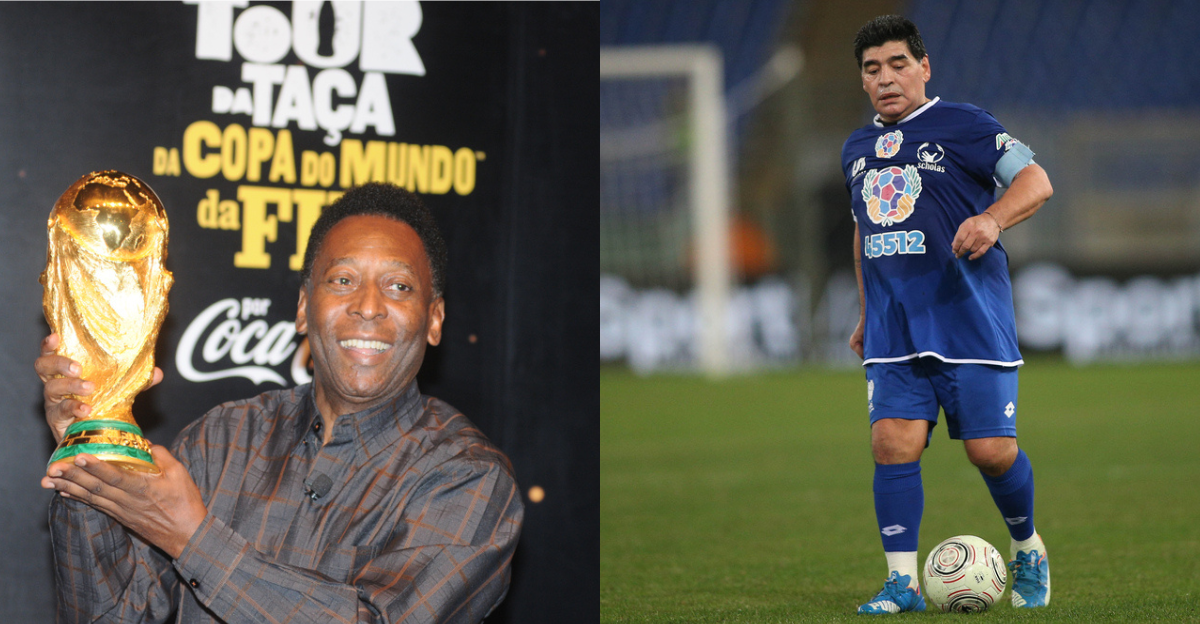
For decades, a curious anomaly persisted in football’s most prestigious individual award: neither Pelé nor Diego Maradona, widely considered two of the greatest players of all time, ever lifted the Ballon d’Or. As highlighted by GiveMeSport, the reason was not a lack of talent or achievement, but rather a historical quirk in the award’s eligibility criteria.
A European-centric era
From its inception in 1956 until 1994, the Ballon d’Or, created by France Football, was exclusively awarded to players holding European nationality. As GiveMeSport explains, this rule fundamentally excluded South American legends like Pelé and Maradona from contention, regardless of their extraordinary performances.
Pelé, the Brazilian icon who led his nation to three World Cup triumphs, spent his entire club career at Santos in Brazil before a stint with the New York Cosmos. As he himself once explained, “I didn’t play in Europe.” His retirement in 1977 came long before any changes to the award’s rules.
Diego Maradona, the Argentine maestro, did play for prominent European clubs such as Barcelona (1982-1984), Napoli (1984-1991), and Sevilla (1992-93). However, his Argentine nationality meant he remained ineligible under the rules in place at the time.
Read also: Kane breaks his silence on the Ballon d'Or: "The 73 goals speak for themselves
As noted by GiveMeSport, this was particularly striking in 1986, the year of Maradona’s legendary individual performance at the World Cup in Mexico. That year, the Ballon d’Or was awarded to Igor Belanov of Dynamo Kyiv, while Maradona, despite his brilliance, could not even be considered for the prize.
The eligibility rules began to evolve in 1995, when the award was opened to players of any nationality, provided they played for a European club. George Weah became the first non-European winner that year. The final barrier was removed in 2007, when the Ballon d’Or became open to any professional player anywhere in the world.
Retrospective justice and enduring legacies
While the official award eluded them during their playing careers, both Pelé and Maradona eventually received honorary recognition. Maradona was presented with the Ballon d’Or d’Honneur in 1995, shortly after the initial rule change. Pelé received the Ballon d’Or Prix d’Honneur in 2013 at the FIFA Ballon d’Or gala. Reflecting on the moment, Pelé stated: “Now I thank God that I can complete my trophies at home.”
GiveMeSport also highlights France Football’s retrospective assessment of the years in which non-European players had been excluded from contention. The exercise examined how the historical Ballon d’Or results might have looked had players from around the world always been eligible.
Read also: Rune returns against Radulov as Denmark host Bulgaria in Davis Cup
The results were striking:
- Twelve of the 39 pre-1995 awards changed hands in the retrospective.
- All 12 retrospective awards went to South American players.
Pelé was retrospectively awarded seven Ballons d’Or for 1958, 1959, 1960, 1961, 1963, 1964 and 1970. These hypothetical wins would place him second on the all-time list with seven, behind Lionel Messi’s eight and ahead of Cristiano Ronaldo’s five.
Diego Maradona was retrospectively awarded two Ballons d’Or for 1986 and 1990. That total would put him alongside several players who officially won the award twice.
Other notable retrospective winners included Garrincha in 1962, Mario Kempes in 1978 and Romário in 1994.
Read also: Kane cracks the door open to a new challenge: 'I never rule anything out'
It is important to note that the retrospective exercise did not alter the official Ballon d’Or roll of honour. Pelé and Maradona therefore remain without an official competitive Ballon d’Or despite their honorary awards.
Nevertheless, as GiveMeSport points out, looking back at the award through modern eligibility rules illustrates just how much its early restrictions shaped its history. Pelé and Maradona were never overlooked because their performances fell short of Ballon d’Or standards; for most or all of their careers, the rules simply prevented them from competing for the prize.
Read also: Ronaldo stays in Jorge Jesus's plans, but reports point to a Portugal farewell in six days