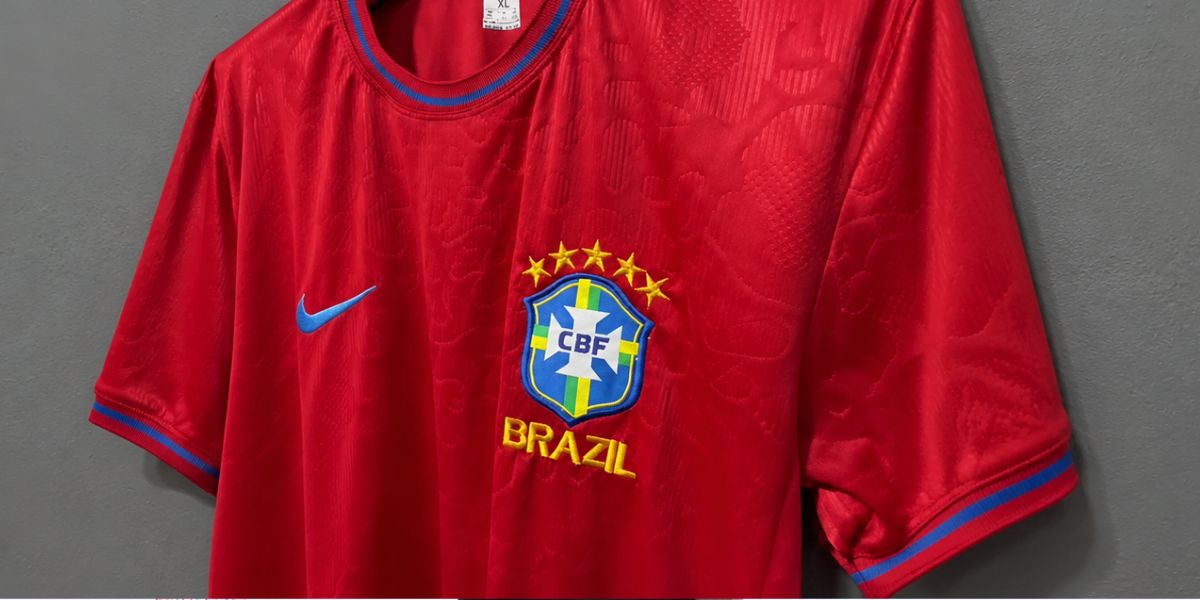
The red Brazil shirt was never worn at the 2026 World Cup. A Nike prototype leaked in April, with the Air Jordan logo in place of the swoosh and bold blocks of red where generations of fans expected the familiar blue, yellow and green trim. Within weeks, the Brazilian Football Confederation (CBF) summoned Nike to an emergency meeting and asked for production to be halted.
The reason was not fashion. Red is the color of the Workers’ Party (PT), the party of President Luiz Inácio Lula da Silva. Green and yellow, the colors of the Seleção, have been adopted as the uniform of the right, worn at rallies for former president Jair Bolsonaro and now for his son, Senator Flávio Bolsonaro.
CBF president Samir Xaud, 41, framed the decision in national-flag terms when he confirmed the veto to reporters.
“Blue, yellow, green and white are our flag’s colors and these are the ones that must be used.”
Read also: “Anything is possible”: Bayern refuse to let Rio Ngumoha go
“Not for political ideology. I want to make that clear.”
Nike duly started producing a blue alternative. The Seleção played the summer tournament without a stitch of red on them.
The 20 clubs that refused to vote
Xaud’s mandate was contested from the start. A group of 20 clubs including Flamengo, Corinthians, São Paulo, Fluminense, Internacional, Cruzeiro and Santos announced a boycott of the CBF presidential election that installed him, saying they could not endorse a vote that offered no choice.
Xaud, previously head of the Roraima state federation, ran unopposed for a four-year term after the courts removed his predecessor Ednaldo Rodrigues. The clubs demanded “democracia, transparência e representatividade” (democracy, transparency and representativeness) before recognizing new leadership.
Read also: Rybakina stands alone: the only WTA Finals qualifier still on court before Indian Wells
The protest did not stop the ballot. It did stamp the man who would later pull the red shirt as politically exposed on day one.
Richarlison takes a presidential candidate to the federal police
Three days before Lula and Flávio Bolsonaro’s final campaign push, Brazil forward Richarlison went to the authorities. On October 20, the Tottenham striker filed a complaint with Brazil’s federal police accusing Flávio Bolsonaro of using the courts to seize his private island off the coast of Rio de Janeiro.
Richarlison said he bought the island for approximately R$10 million (around £1.5m), received an approach from Bolsonaro’s camp and refused to sell.
“I didn’t want to sell the island to him and they took advantage of the situation in court,” he said.
Read also: Lewandowski names his Ballon d’Or winner – and it’s not Harry Kane
“Those guys took the island without spending a penny, as far as I know. I have not received a penny.”
He said he is not trying to recover the land, only the money.
“I’m asking the federal police to help and investigate this properly because we want answers.”
Flávio Bolsonaro’s camp has rejected the allegations.
Read also: Alex Eala falls to Diana Shnaider as her struggles against left-handers continue
The 2027 Women’s World Cup is on the ballot
Whoever wins on Sunday takes office with Brazil as host of the FIFA Women’s World Cup 2027, the first edition staged in South America. The tournament runs from June 24 to July 25, 2027, across eight host cities: Rio de Janeiro, São Paulo, Belo Horizonte, Brasília, Salvador, Fortaleza, Recife and Porto Alegre.
The event has been one of Lula’s set-piece projects, framed around social policy as much as sport.
“We talked about how this World Cup can be a landmark for women’s football, boost the practice of sport in the country and inspire girls and boys in the whole of Brazil,” Lula told FIFA president Gianni Infantino.
He also tied the tournament to a campaign against violence against women, calling it a chance to make the event “a historic moment for the sport and for our country.”
Read also: Lionel Messi issues powerful warning to parents: “You’re not helping them”
Sunday is on a knife edge
Polls into the final 48 hours put the race within the margin of error. Average polling puts Flávio Bolsonaro on roughly 51% of valid votes to Lula’s 49%, with Datafolha’s final survey showing a 50-50 tie. Of 36 surveys, 31 have given Flávio a lead, two show ties and three put Lula ahead. Prediction markets Polymarket and Kalshi have priced Flávio’s chances at 76-77%.
The first round on October 4 ended with Flávio Bolsonaro on 47.03% and Lula on 45.16%, a gap of around 2.2 million votes among more than 158 million registered Brazilians. Abstention hit 21.08%, the highest since 1998.
Voting opens at 8am Brasília time on Sunday 25 October, with ballot boxes closing at 5pm and official counting beginning immediately through Brazil’s electoral court, the TSE, and its Resultados portal and app.