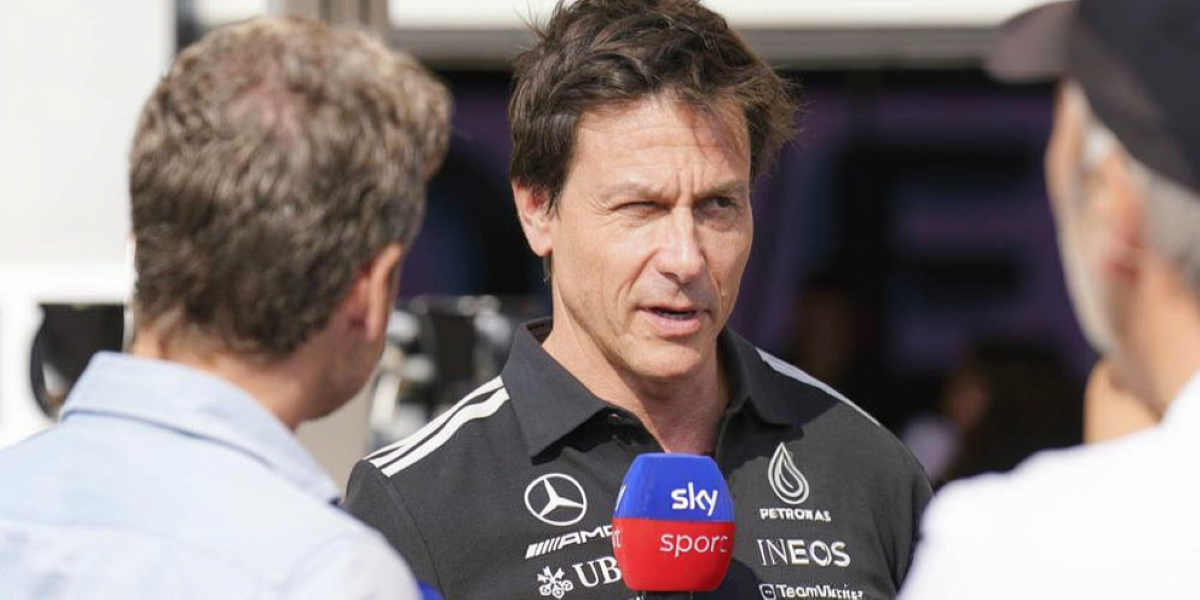
Toto Wolff has aimed a furious attack at rival Formula 1 teams after a technical failure left drivers dependent on their engineers during a chaotic Hungarian Grand Prix.
The Mercedes team principal accused unnamed members of opposing pit walls of behaving like “Teletubbies” after they allegedly failed to warn slower drivers that championship contenders were approaching from behind.
The problem emerged when part of the blue-flag system stopped working at the Hungaroring. Drivers would normally receive a warning on the display inside their cars when a faster competitor is preparing to lap them.
With that electronic notification unavailable, they had to rely on physical flags, trackside light panels and information provided over the team radio.
Read also: Tadej Pogacar youngest and fastest to five Tour de France titles
According to Sky Sports’ detailed report on Wolff’s outburst, the system failure caused problems in several important battles and contributed to a collision involving Oscar Piastri and Carlos Sainz.
Wolff launches extraordinary attack
Wolff’s frustration reached its peak when slower cars interfered with the fight involving Mercedes driver Kimi Antonelli, Ferrari’s Lewis Hamilton and Red Bull’s Max Verstappen.
“The marshalling system [was] not functioning and cars at the back defending in the Lewis and Kimi fight,” Wolff told Sky Sports F1.
“It’s disgraceful from some of the Teletubbies engineers that sit on the pit walls of these teams not telling their drivers what’s happening behind.”
Read also: Neymar returns to Santos squad as internal crisis threatens final chapter
Wolff appeared to direct his criticism primarily at the engineers rather than the drivers.
Those on the pit wall have access to timing screens, live gaps and information showing when a leading car is closing rapidly. With the automatic warning system compromised, Wolff believed the teams had a greater responsibility to intervene over the radio.
His choice of words immediately became one of the most memorable quotes of the weekend, but the underlying complaint concerned a serious issue.
Drivers travelling at racing speed cannot always identify whether a car approaching behind is fighting for position or attempting to put them a lap down. A failure to communicate can therefore create both sporting and safety consequences.
Read also: Supercomputer predicts Premier League winners in 2026-27
Piastri collision exposes the danger
The most dramatic incident involved Piastri and Sainz.
Piastri had been following the Williams driver for much of a sector while attempting to maintain his position in the fight for victory. Sainz, who was involved in his own battle with Fernando Alonso, moved across as Piastri attempted to pass.
The cars made contact, forcing Piastri to take evasive action and costing the McLaren driver valuable time.
“I was right behind him for a sector. I couldn’t believe what happened,” Piastri said.
Read also: Mbappé launches reported €50,000 image reset before Mourinho reunion
“Getting crashed into by a lapped car is never one of the things you expect that can go wrong in your race.”
Sainz received a five-second penalty but argued that he had not known Piastri was approaching. He pointed towards the failure of the warning system and acknowledged that clearer communication from the Williams pit wall might have helped prevent the collision.
Piastri later retired from second place with a gearbox problem. The contact was not publicly identified as the cause of that failure.
Mercedes suffered in the confusion
Antonelli also encountered slower cars while defending third place from Hamilton and attempting to close on Verstappen.
Read also: Chelsea target Henderson as Alonso's past praise resurfaces
The Italian eventually secured the final podium position, extending his lead at the top of the drivers’ championship despite a difficult weekend for Mercedes.
Formula 1’s official review of the Hungarian Grand Prix confirmed that Antonelli recovered from seventh on the grid to finish third, while teammate George Russell climbed back to seventh after dropping towards the rear at the start.
Wolff believed Antonelli might have finished second without the traffic problems and other interruptions.
The result still strengthened Mercedes’ championship position. Antonelli entered the summer break 50 points ahead of Hamilton and 59 clear of Russell, while Mercedes maintained a 72-point advantage over Ferrari in the constructors’ standings.
Wolff also turns anger on Mercedes
The Austrian did not reserve all his criticism for rival teams.
Mercedes made several errors of its own during the weekend, and Wolff admitted that the championship leaders had failed to operate at the required standard.
Russell suffered a serious launch problem that caused his engine revs to fluctuate and dropped him to 19th on the opening lap. The team had also lost valuable preparation time after handing Antonelli’s car to reserve driver Frederik Vesti during the first practice session.
Antonelli was then given a three-place grid penalty for failing to slow sufficiently under yellow flags in qualifying, while Russell experienced a water leak that required components to be changed.
As described by Formula 1’s report on Wolff’s assessment of Mercedes’ weekend, the team principal said Mercedes had spent much of the event playing catch-up.
“The prevailing feeling is that we should have done better,” Wolff said.
“If we would have had a fault-free week, I think we would have fought for the victory or at least two cars on the podium.”
Drivers escape Wolff’s criticism
Wolff made clear that he did not blame Antonelli or Russell.
He praised Antonelli for resisting Hamilton despite using the hard tyre against the Ferrari driver’s softer compound. Russell was similarly commended for moving through traffic after the start-line failure effectively destroyed his original race plan.
“You can’t fault the drivers today,” Wolff said.
“Kimi’s defence on the hard against Lewis on the soft was brilliant driving. And the same with George.”
The contrast was striking.
Wolff defended his own drivers, criticised Mercedes’ operational mistakes and then delivered his most colourful attack against engineers working for other teams.
System failure leaves uncomfortable questions
Blue flags are among Formula 1’s most familiar procedures, but the Hungarian race demonstrated how heavily their enforcement now depends on technology.
Track marshals continued to wave physical flags, yet modern drivers are accustomed to receiving immediate electronic information inside the cockpit.
When that system failed, responsibility shifted towards the teams. Some responded quickly, while others appeared unable to warn their drivers before the leading cars arrived.
The FIA’s post-race documentation included a formal infringement for ignoring blue flags, confirming that the confusion produced at least one disciplinary case.
The episode also followed other recent technical and operational problems involving timing and race-control systems, increasing pressure on Formula 1 and the FIA to ensure that essential information remains available even when one element fails.
A joke with a serious message
Wolff’s “Teletubbies” comment will inevitably attract more attention than the technical details behind it.
It is an unusual insult from one of Formula 1’s most powerful figures and perfectly suited to social media.
However, his wider argument is harder to dismiss.
When an automated safety and sporting system stops working, the pit wall becomes the final source of reliable information for the driver. Failing to communicate can interfere with a race, create unfair advantages and place cars in dangerous situations.
Mercedes left Hungary with another podium, an increased championship lead and a list of problems that Wolff believes should never have occurred.
Some belonged to his own team.
The most embarrassing ones, in his view, belonged to the “Teletubbies” sitting elsewhere on the pit lane.


