VAR can save a player from dismissal
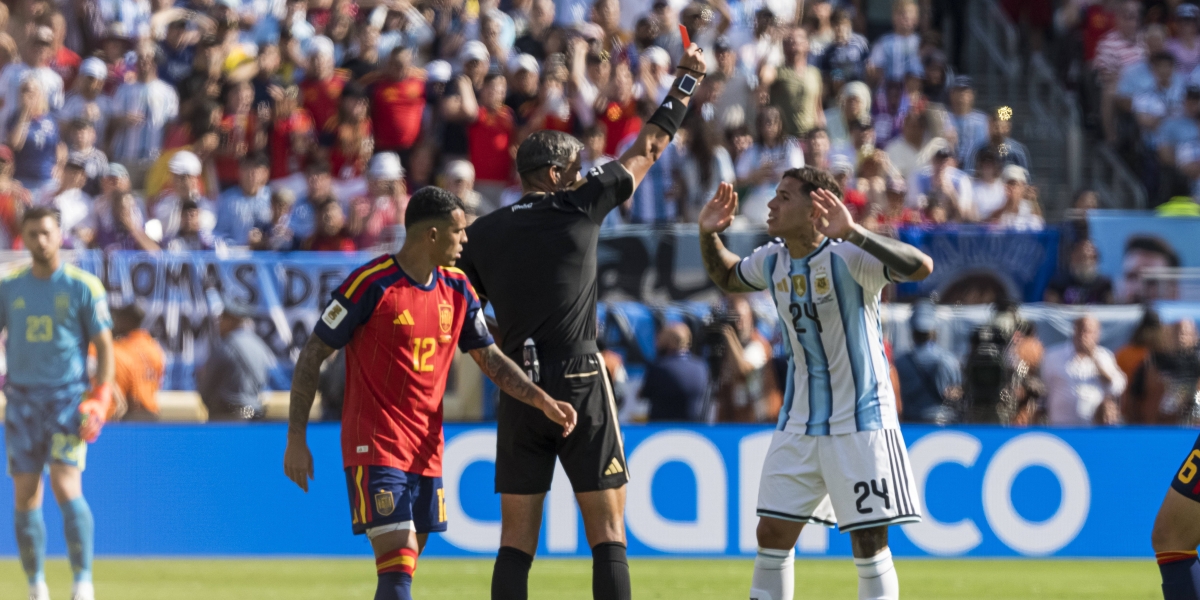
One of football’s most frustrating VAR restrictions has finally been relaxed. During UEFA competitions this season, a clearly incorrect second yellow card can be reviewed, giving the referee the opportunity to cancel the booking and allow the player to remain on the pitch.
Until now, VAR’s powers around yellow cards have generally been severely limited. A direct red card could be reviewed, but an incorrect second booking leading to the same practical punishment often could not. That created situations in which officials knew a player had been wrongly dismissed but were prevented by the protocol from correcting the decision.
Under UEFA’s updated approach, the video assistant may recommend an on-field review when the second yellow card is clearly wrong. The referee can then overturn the booking and withdraw the resulting red card. VAR is not being given unrestricted authority to examine every caution, meaning the intervention applies specifically when an incorrect second yellow would remove a player from the match.
According to UEFA’s official explanation of its refereeing approach, the organisation wants “minimal interference for maximum benefit”. UEFA refereeing director Roberto Rosetti says the ambition is to make VAR applications more consistent across European football while returning the on-field referee to the centre of the decision-making process.
Read also: Kylian Mbappe had just hit top form – now Real Madrid have a problem
The corner rule only works in one direction
Another change could prove considerably more controversial. VAR is now allowed to reverse a wrongly awarded corner kick in UEFA matches, but only when the mistake is completely clear and the check can be completed immediately without delaying the restart.
If the ball was last touched by an attacker but the referee awards a corner, VAR may provide information that changes the restart to a goal kick. The same principle does not operate in reverse. When officials incorrectly award a goal kick after the ball was last touched by a defender, VAR cannot intervene to award the attacking team the corner it should have received.
The result is a deliberately asymmetric system. UEFA can prevent a team from scoring after receiving a corner it did not deserve, but the technology cannot restore an attacking opportunity that was wrongly taken away. The likely practical justification is that corners can lead directly to decisive incidents, while using VAR to recover every missed corner could create additional checks and longer delays.
Even so, the distinction will be difficult to explain if a decisive error occurs in a major Champions League match. Two identical mistakes concerning which team touched the ball last will receive different treatment solely because one produces a corner and the other produces a goal kick.
Read also: Premier League boss breaks silence with damning Manchester City statement
New checks before the ball is in play
VAR’s authority is also being extended to certain attacking offences committed before a free kick or corner has been taken. If an attacker commits a clear offence before the ball enters play and that action directly contributes to a goal, a penalty or another disciplinary sanction, VAR can now ask the referee to intervene.
In that situation, the resulting goal, penalty or sanction can be cancelled and the original free kick or corner retaken. The development gives video officials a new way of addressing holding, blocking or violent conduct occurring inside a crowded penalty area before a set piece is delivered.
The change does not mean that VAR will review every piece of physical contact before every corner. An offence must be clear and must have a direct impact on what subsequently happens. However, the rule could still increase attention on the pushing and blocking that have traditionally been treated with considerable tolerance at set pieces.
VAR can also correct mistaken identity when the referee punishes the wrong player. The review is limited to identifying the person responsible, meaning the video assistant cannot use the process to reconsider whether the underlying offence itself deserved a yellow card.
Read also: Kasper Schmeichel finds completely new path after football retirement
The changes form part of the official amendments to the Laws of the Game for 2026/27. Several of them are competition options rather than compulsory universal rules, allowing UEFA and domestic organisers to choose whether and how they are implemented.
UEFA rejects two controversial red-card options
UEFA has decided not to introduce an automatic red card simply because a player covers their mouth while speaking to an opponent. The measure was created as an optional tool against racist, discriminatory or abusive language concealed from cameras and officials, but UEFA concluded that covering the mouth alone should not be treated as a sending-off offence.
Referees may still regard the action as unsporting behaviour and show a yellow card, particularly when they believe the player is deliberately attempting to hide a conversation. UEFA can also open a disciplinary investigation after the match if footage, testimony or other evidence suggests that discriminatory or abusive language was used.
The organisation has likewise rejected the option of automatically showing red cards to players who leave the pitch in protest. UEFA nevertheless warns that a team responsible for a match being abandoned can forfeit the fixture under its competition regulations, giving the governing body another mechanism for dealing with collective protests.
Read also: Andy Murray reveals one major regret about Nadal and Djokovic
These choices create the possibility of different disciplinary standards across competitions. An action that does not automatically result in dismissal during a Champions League match could theoretically be treated differently by a domestic league that adopts another version of the optional rules.
Time-wasting faces a stricter response
UEFA is also increasing its efforts to prevent unnecessary delays. A substituted player must now leave the field within ten seconds. If the player fails to comply, the replacement may be forced to wait until the first stoppage after one minute has passed following the restart, effectively leaving the team temporarily short-handed.
A player who receives treatment must generally remain outside the pitch for one minute after play restarts. There are exceptions involving goalkeepers, serious injuries, collisions between team-mates, fouls resulting in cards and situations where the injured player is due to take a penalty.
Referees will also use a five-second countdown against teams delaying throw-ins and goal kicks. If the limit is exceeded, a throw-in can be awarded to the opposition, while an opponent delaying a goal kick risks conceding a corner. The measures are designed to increase the amount of playing time without relying on increasingly long periods of stoppage time.
Read also: Manchester United told to ‘nick’ two Man City stars if relegation hits
UEFA will meanwhile continue the captain-only communication system introduced at Euro 2024. Referees are expected to explain major decisions to the captain, while other players who surround or confront the official risk being cautioned for disrespectful behaviour.
The same mistake may receive different answers
UEFA says it has worked with refereeing leaders from all 55 national associations in an attempt to align interpretations across Europe. Every club entering a UEFA competition will also receive a briefing before the league phase begins, while the organisation has published a video platform containing more than 100 examples of correct and incorrect interventions.
Complete uniformity remains unlikely because several of the new rules are optional. National leagues can make different choices, leaving players, coaches and supporters to navigate one refereeing standard domestically and another in European competition.
The expanded review of second yellow cards removes one of VAR’s most difficult contradictions, but the corner rule immediately creates a new one. Technology can now correct an error that wrongly gives a team an attacking opportunity, yet it must remain silent when the same error wrongly removes one.
UEFA wants fewer interventions, shorter delays and greater consistency. The first decisive incident will reveal whether a rule that deliberately works in only one direction can deliver all three.